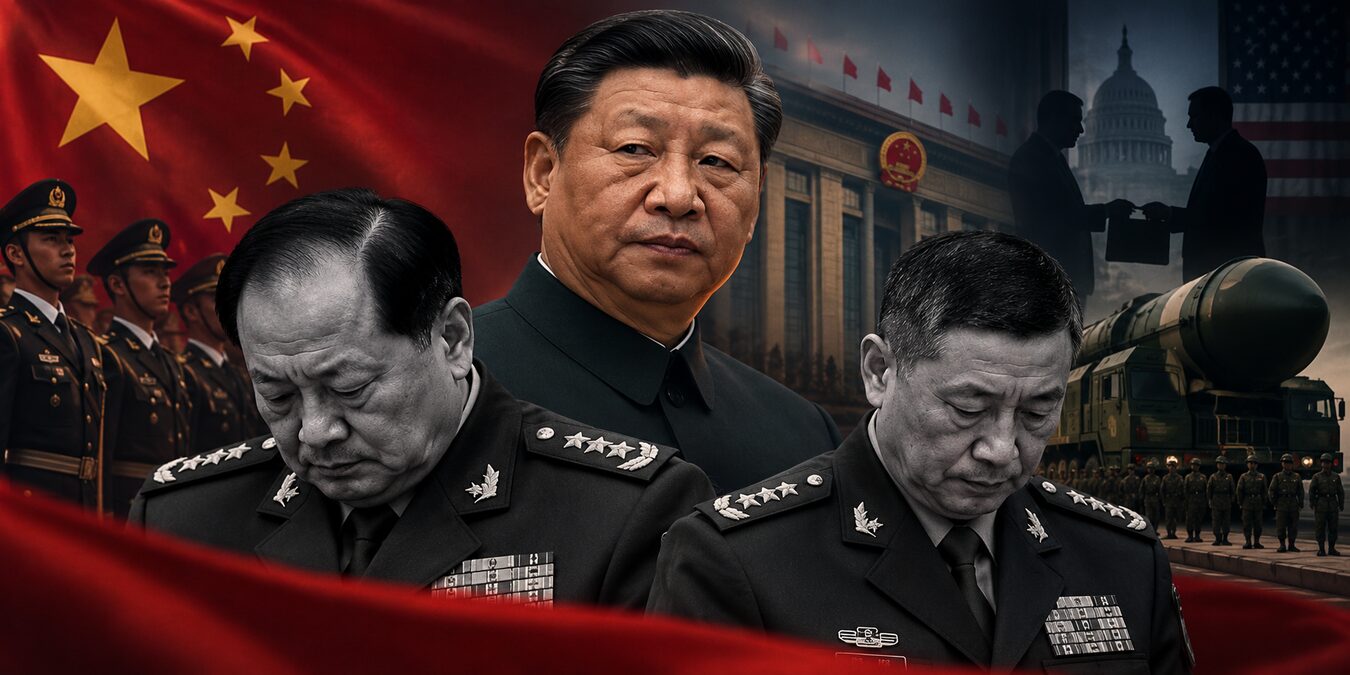
China’s Communist Party has expelled its two most senior generals over disloyalty and corruption. A Politburo meeting chaired by President Xi Jinping approved the decision on Monday, September 21. Zhang Youxia, vice-chairman of the Central Military Commission (CMC), and Liu Zhenli, chief of staff of its Joint Staff Department, also lost their military ranks. Military prosecutors will now examine both cases.
The expulsions close a probe that opened in January. They also revive a claim Beijing has never answered publicly.
What the Party Said about the Two Generals
Xinhua said the two men “formed cliques and factions” and were “disloyal and dishonest to the party.” The agency said they “crossed red lines and basic limits,” adding that “the sums involved were exceptionally large.” Officials gave no further details of the alleged crimes.
Zhang ranked second only to Xi in the chain of command and also sat on the party’s 24-member Politburo. Liu ran the department that plans People’s Liberation Army operations.
The Nuclear Allegation
In January, The Wall Street Journal reported a far graver accusation. People familiar with a briefing attended by top Chinese officers said Zhang had shared key technical information on China’s nuclear weapons with Washington. The same sources said he took cash bribes in exchange for high-level promotions within the military procurement system.
Beijing has never confirmed that account. Monday’s statement makes no mention of a foreign power, espionage, or state secrets, relying instead on the standard vocabulary of a corruption case. Still, this would not be the first time a general has been ousted under the guise of corruption. Bribery for promotion has long been a fixture of the People’s Liberation Army — a practice the party has generally tolerated, since a corrupt official is easier to control. But it has also often served as the pretext for purging generals who have fallen out of favour.
PLA and Espionage
The PLA has lost senior officers to foreign intelligence services before, a history that lends some credence to reports of Zhang leaking nuclear secrets to the US.
In 1999, China executed Major General Liu Liankun by lethal injection after sources said he had passed secrets to Taiwan for roughly five years, including details on war games, missile tests, and troop deployments. He remains the most senior PLA officer known to have spied for Taipei.
The United States has also drawn a PLA insider directly into its fold. In December 2000, Senior Colonel Xu Junping defected to Washington after handling all Chinese military contacts with the United States; according to reports, he had approached the CIA himself.
Neither man commanded the PLA outright, but both sat close enough to its centre to make Zhang’s case plausible.
A Hollowed-Out Generals-Less High Command
Xi has stripped his own military of much of its leadership. Official data show more than 50 senior military and defence-industry figures removed or placed under investigation over the past two and a half years. He Weidong, the other CMC vice-chairman, fell in October 2025.
The commission once held seven members. Only two remain active — including Xi himself, as chairman.
Joseph Torigian, a China politics specialist at American University, pointed to the reversal in Zhang’s fortunes. He said Zhang now faces “accusations of corruption and materialism that have brought down so many others,” noting that propaganda had once held him up as proof of a loyal new generation of commanders.
Timing and What Follows
The announcement carries diplomatic weight, landing just days before Xi travels to the United States for talks with President Donald Trump. A party conclave on internal governance and discipline follows in October.
Prosecutors must now build their cases. Chinese military trials take place behind closed doors, and verdicts rarely surprise anyone.
Zhang, 76, comes from revolutionary stock — his father, Zhang Zongxun, served alongside Xi’s father. He is one of very few serving commanders with combat experience, having fought in the 1979 border war with Vietnam.
Liu, 62, enlisted in 1983 and also saw action on the Vietnamese frontier. He commanded the PLA Ground Force before his promotion in 2022.
Analysts are now watching one question: Xi has removed the officers who would command a war, but nobody outside the party knows who will replace them.