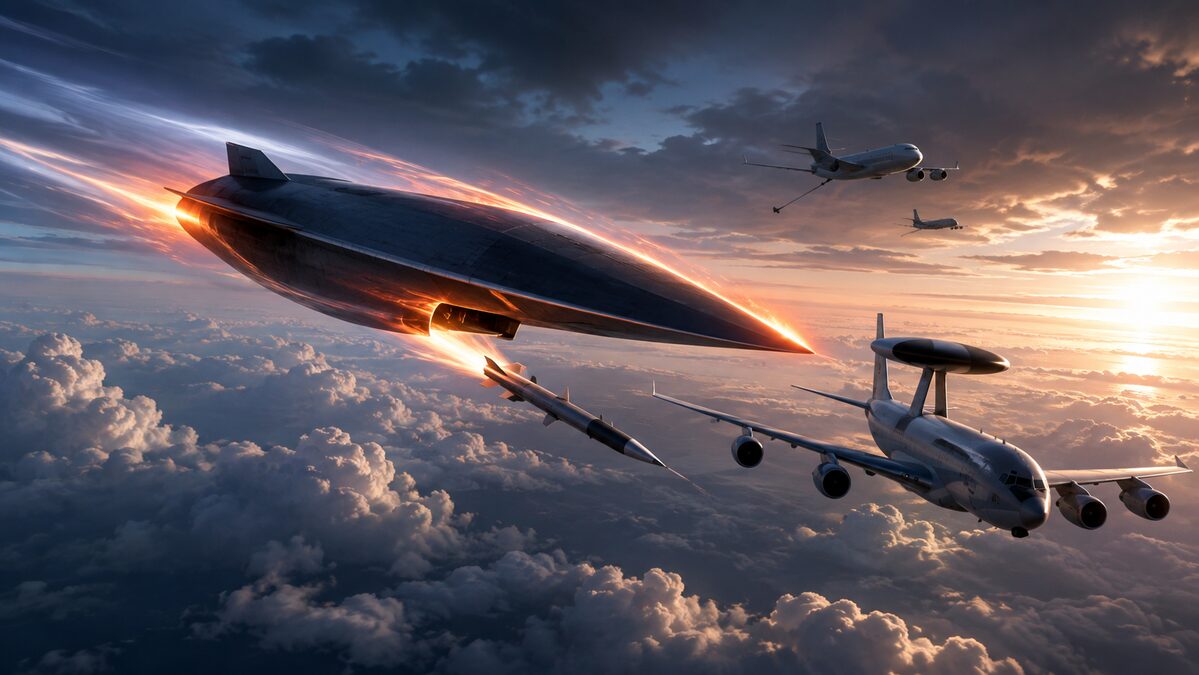
China has developed hypersonic glide vehicles that can launch air-to-air weapons in mid-flight, Bloomberg reported on 24 August, citing a person with direct knowledge of the matter. The weapons are designed to threaten high-value aircraft — airborne radar planes, refuelling tankers and flying command posts — thousands of miles from Chinese soil.
If the account holds, it breaks a rule that has governed air warfare for 50 years. Support aircraft stayed alive by staying far back. That distance may no longer buy anything.
What the Report Actually Says
According to the report, the glide vehicles form part of a wider effort to make China’s missile stockpile do almost every military job. That stockpile is the world’s largest, at more than 3,150 ballistic weapons. China has also added air-to-air capability to some hypersonic cruise missiles and built anti-ship roles into several missile types, the person said. They asked not to be identified because of the information’s sensitivity.
Beijing has not commented. Nor has the Pentagon.
Why This Is Technically Hard
A hypersonic glide vehicle rides a rocket booster into the upper atmosphere, separates, then glides above Mach 5 while changing course. The Congressional Research Service notes that the important difference from an ordinary warhead is not speed but manoeuvre. That makes the weapon difficult to track and harder still to intercept.
Firing a second weapon from a hypersonic platform is a far bigger step. The vehicle is wrapped in superheated plasma. Sensors struggle to see through it. Then the released missile must find, chase and hit an aircraft that is itself moving and turning.
The Aircraft China Wants to Kill
Fighters cannot fight for long without help. Tankers give them range. Radar planes give them sight. Command aircraft give them orders. Remove those three, and a modern air force shrinks fast.
China has been working towards that for years. The PL-17 air-to-air missile is reported to carry roughly 250 miles — other estimates put its range as high as 300–500km, or about 185–310 miles, so figures vary by source — and runs at Mach 4 or more, using a dual-pulse motor with an active radar seeker. Reportedly, it may also carry a passive anti-radiation seeker, which would let it home in on a radar plane’s own emissions. Analysts have nicknamed it the “AWACS killer.”
The Iran war then showed the theory working in practice. On 27 March 2026, an Iranian missile and drone strike on Prince Sultan Air Base in Saudi Arabia destroyed a US E-3 Sentry, leaving the fleet down to only a handful of serviceable aircraft. “They’re going after the tankers. They went after the E-3,” a former military official said. “The bad guys understand that if we blind the eyes and handicap the ability to project power, then we don’t have to deal with the fighters.”
Washington Has No Settled Answer
The US Air Force still cannot decide what replaces its radar planes. It tried to cancel the E-7A Wedgetail in the fiscal 2026 budget, citing survivability, delays and cost. Congress refused. Lawmakers appropriated a little more than $1 billion and barred the service from shutting the line. The Air Force then awarded Boeing roughly $2.4 billion in March. Deliveries have since slipped to fiscal 2028.
Meanwhile the service is betting on orbit. The Space Force awarded SpaceX $4.16 billion on 29 May to start building satellites that track moving aircraft from space, under the Space-Based Airborne Moving Target Indicator (SB-AMTI) program. Roughly $7 billion more sits in the 2027 request.
Ammunition is the third problem. Stocks were already thin for a peer fight before the Iran war and are now thinner still. Replenishment will take years.
Reasons to Stay Sceptical
Similar claims have wobbled before. In 2021, it was reported that a Chinese glide vehicle released a separate object mid-flight during a fractional-orbital-bombardment test. At the time, reporting switched between describing a missile and describing countermeasures, and even Pentagon and Space Force officials spent weeks publicly correcting each other’s characterisations of what had actually happened. Nothing conclusive about an air-to-air capability followed from that episode.
The current report rests on one anonymous source. No test footage has surfaced. No range figure has been published. Capability demonstrated once in a trial is also not capability fielded across a force.
So, Is This the Next Big Challenge?
Probably not on its own. But the direction is the story. China is no longer only trying to win the fight for the sky. It is trying to remove the machines that make the fight possible, and to do it from further out each year.
American planners have understood that for a decade. They have not yet funded a settled answer.