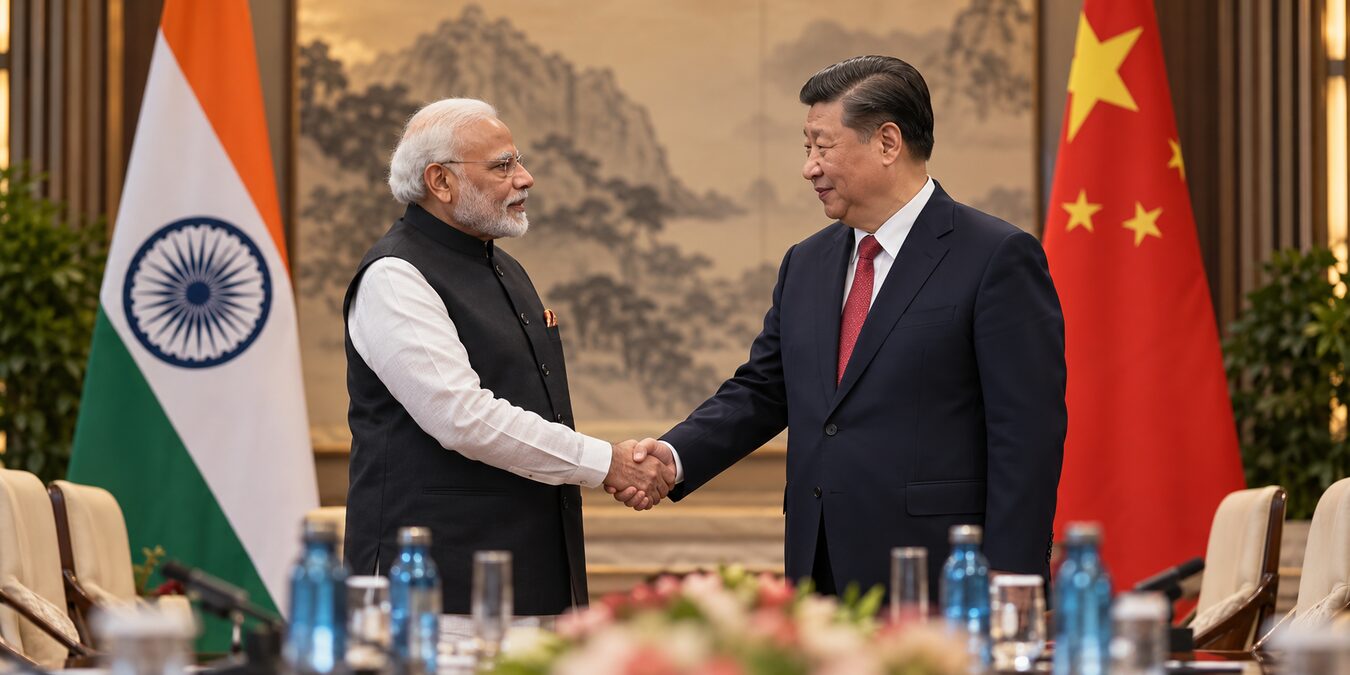
Prime Minister Narendra Modi and Chinese President Xi Jinping met for less than an hour at Bharat Mandapam on the afternoon of September 12, on the sidelines of the 18th BRICS Summit. Within hours, New Delhi and Beijing had each published their own account of what was said. The two readouts agree on the warm parts, diverge sharply on the hard ones — and one contains a line on Taiwan, Tibet and the United States that the other omits entirely.
Common Ground
Read side by side, the Ministry of External Affairs release and the Chinese foreign ministry statement share real substance. Both record the same formula for a border settlement — “fair, reasonable and mutually acceptable.” Both describe the relationship as strategic and long-term. Both pledge further work on trade friction, cultural exchange and travel. Modi thanked Beijing for its support of India’s BRICS chairship, which China will hand over in 2027.
The meeting carried weight simply by happening: it was Xi’s first visit to India in seven years.
The Sequencing Fight
Where the two accounts split is over what comes first. India’s readout puts the border ahead of everything else. Modi said peace and tranquility along the border remains “an essential basis for the continued development of bilateral relations,” and pressed both sides to honor existing agreements.
Beijing rejects that ordering. Its statement calls instead for “parallel, mutually reinforcing progress” on the relationship and the boundary question — each track advancing on its own, neither waiting on the other.
That disagreement is the argument in miniature. Conditionality is India’s main lever: market access, investment and normalized traffic held out in exchange for a quieter, thinned frontier. Parallelism removes that lever entirely. Both governments restated their positions on the same afternoon, in the same building, and neither moved an inch.
The Line That Appears Only Once in the Readouts
Beijing’s readout quotes Modi saying India’s China policy is “not affected by any third party,” and that India’s positions on Taiwan and Tibet remain unchanged. New Delhi’s version contains none of it.
This is not new. The same third-party language appeared in Beijing’s account of the Tianjin meeting in August 2025 — and was absent from Delhi’s account then, too. China uses near-identical phrasing when describing its relationships with other countries, including Mexico; it never names the “third party” because it does not need to.
Delhi has fought this fight before. In August 2025, a Chinese readout quoted External Affairs Minister S. Jaishankar affirming Taiwan’s status; Indian officials called it a misquote, and Beijing described the clarification as a surprise. This time, India’s silence isn’t consent — it’s a calculation that disputing another government’s minutes costs more than ignoring them.
One Word, Swapped
Modi reportedly offered three principles: “mutual respect, mutual sensitivity and mutual interest.” China’s text keeps respect, drops sensitivity, and inserts trust in its place. The substitution is not incidental — it reflects Beijing’s preference to treat Tibet as a matter of principle rather than sensitivity. Small edits, in diplomatic text, carry outsized meaning.
The two documents also differ in shape. Beijing frames Xi’s remarks as a numbered four-point framework and closes with a lengthy paragraph detailing what it says Modi pledged. Delhi’s version is flatter and largely unattributed, giving Xi almost no direct voice.
Whose Grievances Get Named
India’s readout is specific about its complaints: structural trade imbalance, supply-chain disruption, and a demand for “meaningful, predictable” market access. China’s version asks both sides to address each other’s economic concerns “in a balanced way” — with Beijing signaling that India’s investment screening and visa restrictions belong on the table alongside its own export controls.
What Wasn’t Announced
No new mechanism came out of the meeting. Both readouts point back to existing channels: the 25th round of Special Representative talks on August 25, and military flag meetings held September 6–7. Neither statement mentions troop de-escalation or withdrawal — issues Jaishankar has raised alongside restrictive trade measures. Neither mentions Pakistan, the Brahmaputra, or Arunachal Pradesh.