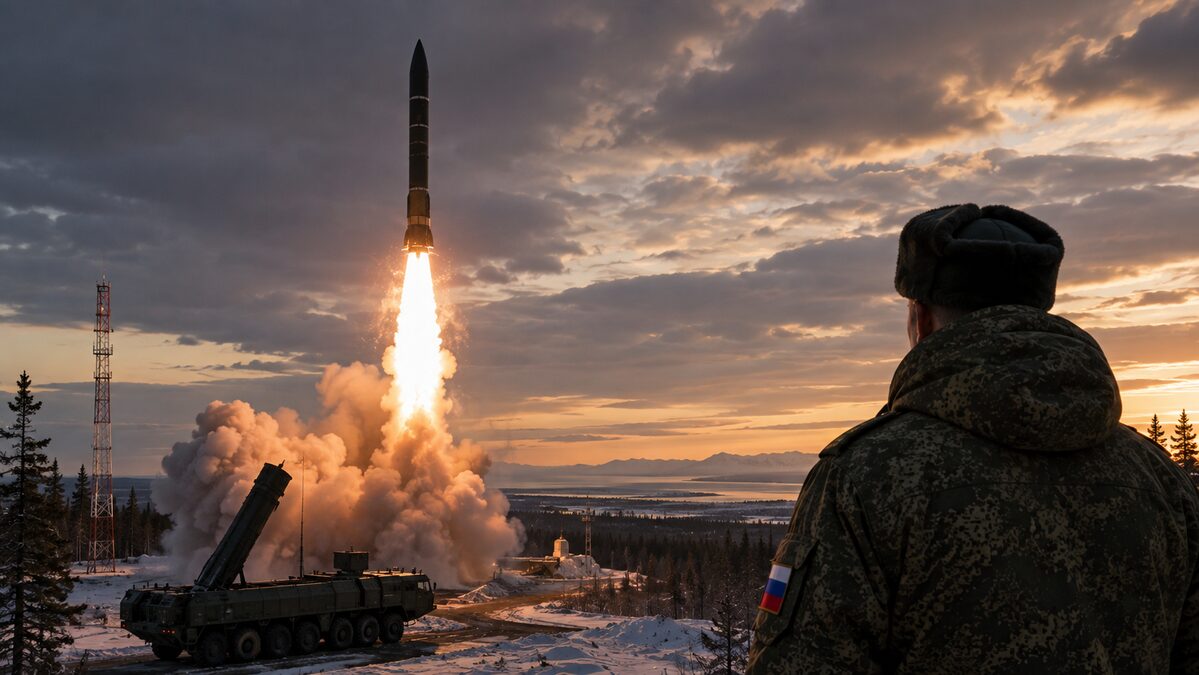
Russia’s Defence Ministry announced a strategic missile launch on Friday, August 28. The test used a mobile, solid-fuel intercontinental ballistic missile fired from the Plesetsk Cosmodrome in the Arkhangelsk region, with training warheads flying more than 6,700 kilometers east to the Kura range on Kamchatka. The launch came just days after CIA Director John Ratcliffe left Moscow — a coincidence in timing that few in Washington or Moscow are treating as coincidental.
What the Missile Test Involved
The ministry released details via Telegram: a road-mobile launcher battery moved to a remote site, where crews prepared and fired the missile.
The ministry did not name the missile, but Russian media identified it as an RS-24 Yars — the same type reportedly fired along an identical route during exercises in mid-May. The Yars is a three-stage, multiple-warhead missile that can launch from silos or mobile transporters, making it difficult to track.
Footage of the launch appeared on Friday, although Russia likely conducted the launch a day earlier, on Thursday, August 27. Authorities lifted air-navigation warnings near Plesetsk and Kamchatka late that day.
The Spy Chief Who Arrived Unannounced
Ratcliffe landed in Moscow on Tuesday, August 25, aboard a US military transport that had flown from Joint Base Andrews via Riga. It was the first visit by a CIA director to Russia since William Burns in November 2021.
Reports soon indicated the purpose: Ratcliffe had come to warn Russia against attacking a NATO member, citing fresh US intelligence assessments suggesting Putin might test the alliance’s resolve through a limited strike on an allied state. Baltic officials, for their part, have downplayed any sense of imminent danger.
Moscow’s response was dismissive. Kremlin spokesman Dmitry Peskov dismissed the reports as fear-mongering, and foreign intelligence chief Sergei Naryshkin called the meeting unremarkable. President Trump described the trip as “sort of semi-routine.”
Why the Missile Test Reads as a Signal
No one has proven a direct link between the visit and the launch. But the sequence is tight: a private warning on Tuesday, a public denial on Thursday, and an ICBM crossing nine time zones on camera soon after — a pattern that reads to many observers as deliberate signaling.
Context reinforces that interpretation.
No Treaty Caps the Arsenals Now
The timing carries added weight because the New START treaty expired on February 5, 2026, leaving American and Russian strategic arsenals unconstrained by binding limits for the first time in over fifty years.
Putin had proposed in September 2025 that both sides informally continue observing the treaty’s central limits for a year, but Washington never formally responded before the deadline passed. Inspections, meanwhile, had already stopped in 2023, leaving both sides to monitor each other via satellite and inference rather than verification.
Diplomacy, for now, remains stalled. Peskov told reporters Friday — hours before the launch video appeared — that peace talks were in a “deep pause.”
The test lands in a widening gap: no treaty, no active negotiation, and no shared framework for interpreting intent. Each side is left to guess at the other’s meaning — precisely the uncertainty that arms control was designed to eliminate.