
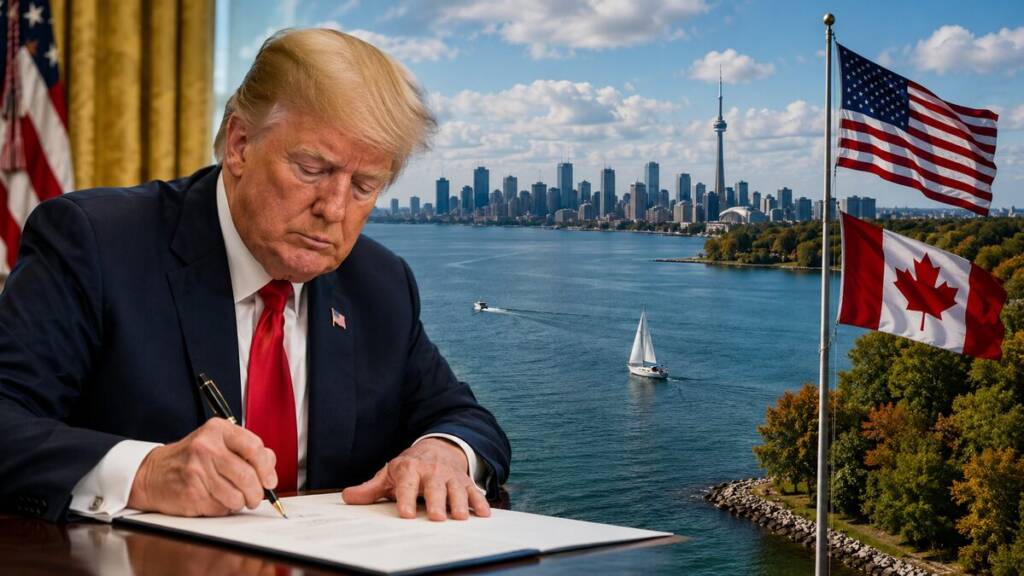
US President Donald Trump signed an executive order on 27 August renaming Lake Ontario as “Lake America,” tying the decision openly to his collapsing trade talks with Canada. Google Maps switched the label for American users three days later.
Canada has refused to follow. The row now runs alongside a tariff fight worth billions.
Why Trump Did It
Trump signed the order in the Oval Office, flanked by boards showing the new name, and told reporters the change was official and effective immediately.
Asked what message he was sending Ottawa, Trump denied sending one, then complained that Canada had spent years “ripping us off” on trade. He said Canadians wanted treatment as a state without being one.
The timing explains the rest. Trade negotiations between Washington and Ottawa broke down late on 21 August, after which Trump imposed 50 per cent tariffs on roughly $20 billion of Canadian goods.
Canada hit back with matching duties on steel, dairy, appliances and electronics, set to take effect on 8 September.
Prime Minister Mark Carney blamed American negotiators for the collapse. They “asked too much, and they offered too little,” he told reporters in Ottawa. Trump was blunter about his counterparts, saying Canadian officials had “treated us very badly” on 27 August.
He had teased the idea for days beforehand: on 25 August he posted an altered map online, crossing out the old label and adding a gold “Lake America” tag.
The order also landed amid a personal feud. Ford had told the Associated Press that Ronald Reagan would be disgusted by Trump’s tariffs; Trump dismissed the remark as bluster and called the premier a flunky.
What Trump’s Executive Order Actually Does
The order gives Interior Secretary Doug Burgum and the Board on Geographic Names 30 days to act. Officials must update the Geographic Names Information System, the federal naming database, and remove references to Lake Ontario from government maps, contracts and communications.
The text claims most of the lake’s volume for the United States, arguing that the deepest waters sit inside American territory.
The US Geological Survey moved within hours, its director confirming the new name across official electronic documents. Trump hinted at more renaming to come: “Now, all we need is an ocean,” he told reporters.
Google Maps Switched First
Google announced its change on Saturday, 29 August. American users now see “Lake America” on Maps. However, Canadians still see “Lake Ontario”; everyone else sees both names, with the new one in brackets.
The company said it follows official government sources for place names — in the United States, that means the federal naming database, Google explained in a blog post. It applied the same rule to the Gulf of America in February 2025.
The switch even caught Ontario. Several provincial government and business websites that embed Google Maps data briefly displayed the American label. Stephen Crawford, Ontario’s minister of public and business service delivery, said officials were reviewing those sites.
Rivals have split; MapQuest refused the change and built a mocking name generator instead, while Apple Maps had not switched by Sunday.
Canada Answers with a Billboard
Ontario Premier Doug Ford unveiled a large sign near Grimsby on 29 August reading “Lake Ontario, Now and Always,” in English and French. The sign stands about two storeys high beside a road that many American visitors use.
Ford wore a Team Canada jersey for the unveiling, telling reporters Canadians would “never ever back down from a bully.”
Carney offered a history lesson on X: the name comes from the Wendat word Ontari’io, meaning “the lake is beautiful, the lake is big.” He noted that the name predates both Canadian Confederation and American independence.
American politicians objected too. New York Governor Kathy Hochul said her state would not use the name, accusing the president of “deflecting from the real needs of Americans.” Vermont’s Republican governor, Phil Scott, called the move “petty and disappointing.”
Can Trump Actually Do It?
Trump controls how his own government labels places, but he cannot bind Canada or anyone else. Both countries manage the lake jointly under the Boundary Waters Treaty, and the province of Ontario took its name from the lake in 1867.
The Gulf of America episode showed how far the pressure can go. The Associated Press refused the new name in 2025 and lost White House access for months; a federal judge later reversed that restriction.
What Happens Next
Watch 8 September, when Canadian retaliatory tariffs land as Ottawa has already trimmed some measures on seafood to limit domestic damage.
Watch the 30-day clock too: federal agencies must finish scrubbing the old name by late September.
The order changes the map. It does not change what people living around the lake say.