
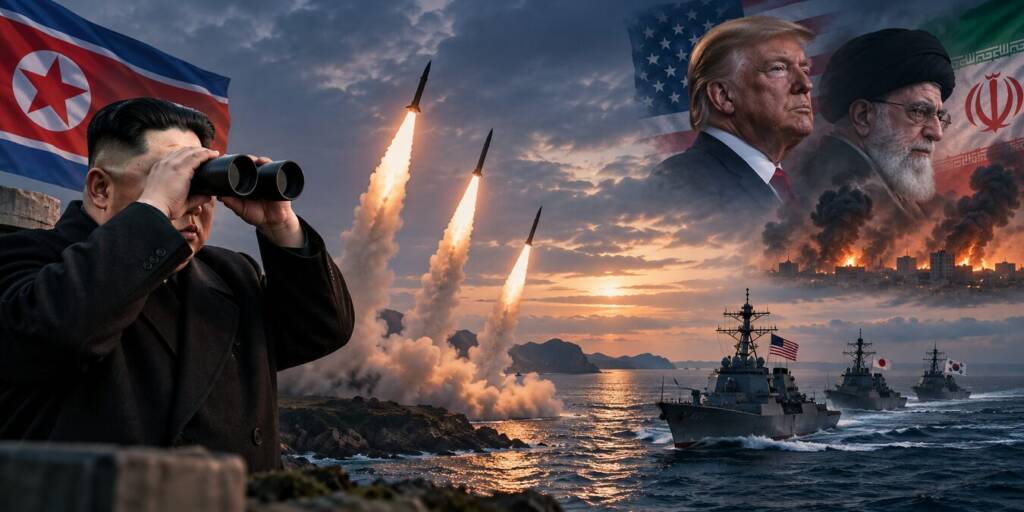
North Korea fired several ballistic missiles into the sea off its east coast at around 5:20 a.m. on Saturday, South Korea’s Joint Chiefs of Staff said, a day after the United States, Japan and South Korea wrapped up five days of war games aimed squarely at Pyongyang.
South Korea’s military detected the launches near the coastal city of Wonsan and tracked the missiles for roughly 250km before they fell into the waters Koreans call the East Sea. Seoul’s presidential National Security Office convened an emergency meeting with the defence ministry and other agencies. US Pacific Command said the launches posed no immediate threat to American territory or allied forces. Pyongyang has so far said nothing.
The Drills Came First, the Missiles Followed
The sequence follows a familiar script. The three allies ran their Freedom Edge exercise from September 7 to 11 in international waters east and south of Jeju Island, rehearsing missile defence, anti-submarine warfare, cyber operations and maritime interdiction. North Korea objected before the ships even sailed, with a foreign ministry spokesperson calling the exercise “a threat to the DPRK and regional countries.”
Defence Minister Kim Song Gi went further on the opening day, warning that his country would take “strong and reflective countermeasures from the standpoint of power.”
Saturday’s salvo was the second in three weeks. On August 20, the North fired more than ten short-range missiles while Seoul and Washington ran a scaled-back version of their annual Ulchi Freedom Shield exercise — one President Trump had ordered the Pentagon to trim, calling the drills inappropriate and hostile toward North Korea, and citing among his reasons Seoul’s refusal to back him over the war in Iran. Kim Yo Jong, the North Korean leader’s sister, dismissed the gesture within hours.
Why Fire Missiles While Iran Burns?
That war began on February 28, when American and Israeli aircraft struck Iran and killed Supreme Leader Ali Khamenei. More than six months on, US forces hit Iranian targets again on September 1, and Tehran answered with missiles and drones fired across the region.
For Kim Jong Un, analysts argue, Iran settled an old argument rather than opened a new one. Experts point to several lessons Pyongyang likely drew from the conflict — starting with the simplest: nuclear weapons deter. Iran hedged, never finished a bomb, and lost its leader to a decapitation strike. North Korea finished its bomb, and nobody has tried.
The same episode carried a harder lesson. American and Israeli interceptors performed well, and Iran’s buried missile sites failed to protect its launchers — so Pyongyang will likely scatter its road-mobile rockets across smaller bunkers and field more decoys.
Yang Uk, a defence specialist at Seoul’s Asan Institute, said Kim “has done the right thing” by refusing a denuclearisation deal. Joel Wit, a former US State Department official, said Kim now looks emboldened.
The launch, in other words, answers the exercise more than it answers Iran — and it costs Pyongyang almost nothing. Trump keeps asking for a meeting, and short-range missiles rarely close that door.
Can North Korea Really Hit America?
Not with these missiles. A 250km flight threatens South Korea and Japan, not Los Angeles.
Pyongyang’s claim to intercontinental reach rests instead on the Hwasong-20, the solid-fuel missile it paraded on October 11, 2025, which KCNA called a “super-powerful strategic attack weapon.” The Arms Control Association notes the missile’s differently shaped nose suggests a multiple-warhead payload. Analysts put its theoretical range above 15,000km — enough to reach any American city — though many question whether the North has solved re-entry and guidance. Trump has put North Korea’s total arsenal at 57 warheads.
North Korea has never test-flown the Hwasong-20. That restraint carries its own message: an ICBM launch would wreck the summit Trump wants, so Kim holds that card in reserve and fires smaller weapons instead.
Does a Security Umbrella Cover Pyongyang?
Not a clearly defined one. The treaty Kim and Russian President Vladimir Putin signed in June 2024 obliges each side to give immediate military help if the other faces armed aggression. Neither government has ever spelled out whether Russian nuclear weapons shield North Korea, and Moscow has avoided the question.
What Pyongyang has gained is narrower but real: a friendly Security Council veto, fuel, food, and probable technical help. Chinese President Xi Jinping visited Pyongyang in June.
What Comes Next
Trump wants a fourth meeting with Kim. Reports list Shenzhen, on the margins of the APEC summit on November 18–19, among the venues under discussion. Kim has stayed silent.
The North, meanwhile, keeps building. It commissioned the Kang Kon, its second 5,000-tonne destroyer, on September 6, and says the warship can carry nuclear-armed missiles.