
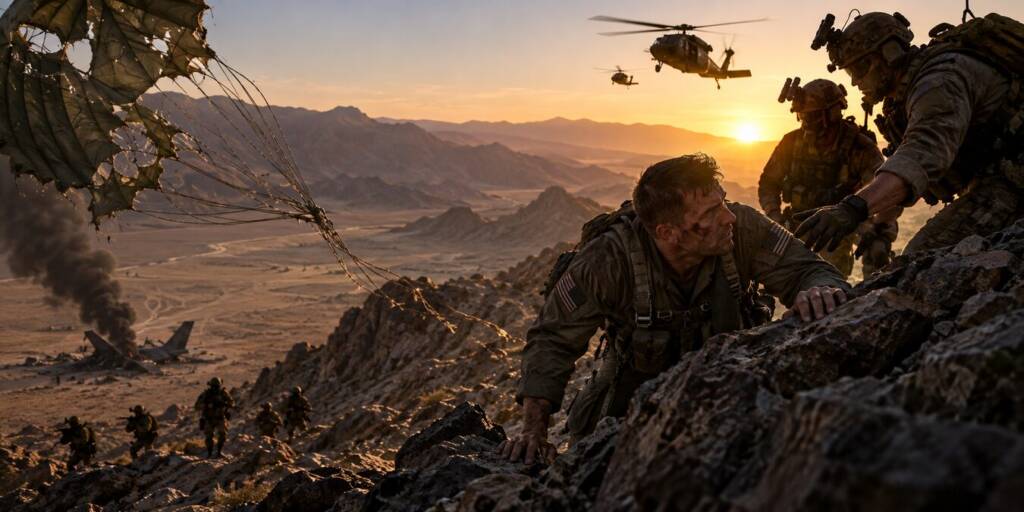
A United States Air Force colonel has described falling into the Iranian desert beneath a shredded parachute, breaking his back on landing, then climbing a 7,000ft ridgeline on broken bones to escape Iranian troops hunting him. He survived 50 hours behind enemy lines before two American pararescuemen reached him.
CBS broadcast his account on Sunday, September 13, in the season premiere of *60 Minutes*. The correspondent, Norah O’Donnell, conducted the interview. The programme identified the officer only by his mission call sign, “Bravo”, citing continuing threats from Iran. He served as the weapons systems officer aboard the F-15E Strike Eagle that Iranian forces shot down on April 2, and neither he nor his pilot had spoken publicly until now.
Where the jet came down
Admiral Brad Cooper, the American commander directing the war, said the crew were flying over a mountainous stretch south of Isfahan, close to where Iran had stored much of its highly enriched nuclear material. Their target that night, Cooper said, was industrial sites tied to Iran’s drone and missile programmes rather than the Isfahan nuclear facility itself.
The jet carried the call sign Dude 44. A shoulder-fired missile costing roughly $100,000 destroyed an aircraft worth about $30 million. Iranian media published images of the wreckage, and Tehran later displayed debris it said came from a US helicopter lost during the rescue — a claim Washington has not confirmed.
Hit like a freight train
Bravo likened the impact to a collision with a freight train. The crew fought briefly to save the aircraft, failed, and ejected within seconds. He credited his pilot, known as Alpha, with saving both their lives. The F-15E staggers its two ejections deliberately, leaving the men roughly five miles apart.
Alpha landed safely. Bravo did not. The missile had torn his parachute, and he looked up mid-descent to find it barely there — a sight he called the most terrifying thing he had ever seen. Military debriefers later estimated he struck the desert floor at between 70mph and 100mph. The fall broke his back, an arm and a shoulder, sprained an ankle and left cuts across his head and face. He described his survival as a modern-day miracle.
A bounty, and 1,500 hunters
Iranian state television announced a bounty within hours, and videos of armed groups searching the valleys spread online. Cooper said about 1,500 Iranian fighters were operating within a 10-mile radius, and US military sources said some came within a few hundred metres of Bravo.
Bravo decided the safest direction was upwards. Despite his injuries, he hiked and climbed a 7,000ft ridgeline, explaining his motivation bluntly: he had no intention of appearing on Iranian television. He also delayed using his radio until he had put distance between himself and his landing site. His first messages — that he was hurt and moving, and that God is good — told commanders he was alive.
The CIA, a deception and a desert airstrip
Six hours after the shoot-down, US forces went in for Alpha in daylight, committing 21 aircraft. The US secretary of defense, Pete Hegseth, said the raiders fought their way in and out. They recovered the pilot, searched unsuccessfully for Bravo, and withdrew.
Hegseth then made the decision he says he will not forget: waiting another 24 hours. Bravo spent that day in the cold high desert with almost no food or water.
The CIA proved pivotal in the second attempt, running a deception campaign to confuse Iranian units and deploying classified technology that fixed Bravo’s exact position. American bombers and drones struck Revolutionary Guard forces nearby to clear the approach. Two large search-and-rescue aircraft then landed on a makeshift desert strip and unloaded small “Little Bird” helicopters, which carried operators to the ridgeline.
Declassified surveillance footage, which General Dan Caine talked O’Donnell through, shows two Air Force pararescue operators, or PJs, walking Bravo out. His only words to them, he said, were: “Let’s go.”
The escape nearly failed. Cooper said 92 special operators stood on Iranian soil — the first American boots there in 46 years — with several hundred more in the air and up to 5,000 supporting the mission. When the rescue plane’s landing gear sank into the sand, a clandestine Air Force unit extracted everyone. US aircraft then bombed the stranded plane so that no American technology survived. Bravo reached safety as the sun rose on Easter Sunday.
A row over the interview itself
Reports have said Hegseth and political appointees pushed both airmen to appear, that both initially resisted doing so, and that military officials feared the segment would expose classified details. Hegseth later met the men privately and asked rather than ordered. Alpha declined, citing security concerns, and issued only a written statement praising his rescuers. The chief Pentagon spokesman, Sean Parnell, rejected the reporting as “a complete lie”, saying each man chose for himself.
Fighting began on February 28. By the time Dude 44 fell, 18 US service members had died and American aircraft had flown some 13,000 missions. A ceasefire in April and the Islamabad Memorandum in June both collapsed, and the war continues.