
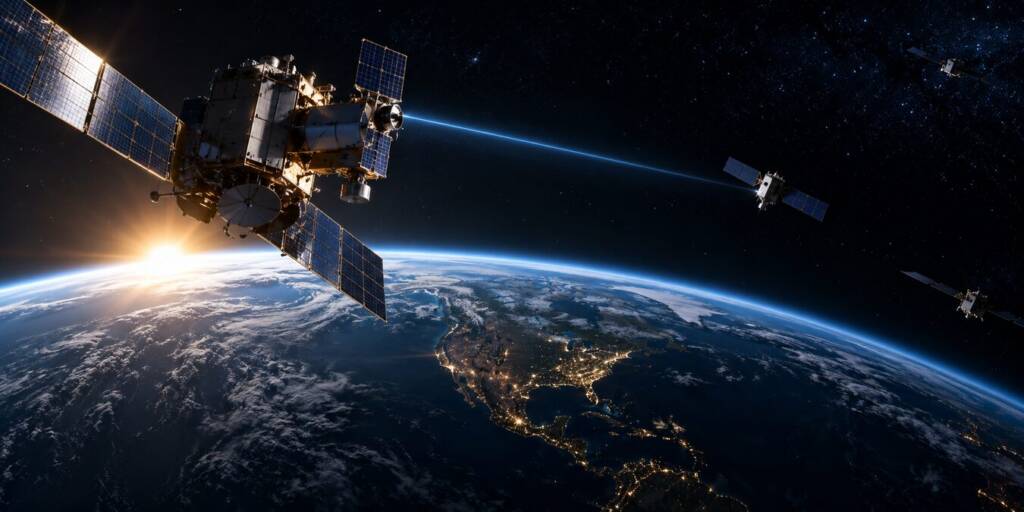
US space weapons are already in orbit — Washington confirmed it for the first time on Monday. Secretary of the Air Force Troy Meink made the disclosure at a conference in National Harbor, Maryland. No American official had ever said so on the record.
Speaking at the Air, Space and Cyber Conference, Meink said the United States now fields “on-orbit space control weapons capable of defending the joint force.” He named no system and gave no numbers.
A US Space Force spokesperson later confirmed the capability, saying space control employs “kinetic and non-kinetic means to affect adversary capabilities.” The weapons, the statement added, serve both offensive and defensive purposes.
What Space Weapon Is Up There?
Nobody outside the Pentagon knows. Victoria Samson, chief director of space security and stability at the Secure World Foundation, called the moment unprecedented. “I don’t think any US government official has ever said that before,” she said.
Samson doubts the weapons are built to physically destroy targets — senior American officers have warned repeatedly against creating debris in orbit. She expects something quieter instead: space-based jammers or electronic warfare payloads.
She also flagged the diplomatic cost. Washington must now accept that Beijing and Moscow may make identical announcements of their own, she said — an outcome she argued does not serve US national security.
Does This Open the Floodgates?
Space is already militarised. Armies have used satellites for spying, targeting and communication since the 1960s. Weaponisation is the next step — placing arms in orbit itself — and Monday’s statement moved that line into public view for the first time.
Deterrence works only when rivals know what you hold, and Meink appeared to choose openness for that reason. But analysts caution that the same logic invites matching declarations from Beijing and Moscow. Neither capital responded on Monday.
The Orbital Chessboard
The rivalry did not begin this week. General Michael Guetlein, then vice chief of space operations, said in March 2025 that Chinese satellites were practising “dogfighting in space.” The Space Force later said five spacecraft had manoeuvred around each other in low Earth orbit.
Russia has drawn sharper warnings still. The White House said in February 2024 that Moscow was developing a nuclear anti-satellite weapon — a device that would not target a single satellite but sweep an entire orbital band in one detonation. President Vladimir Putin denied any such plan.
Russia has also demonstrated the threat directly: a 2021 missile test destroyed one of its own satellites, scattering debris across low Earth orbit.
The Treaties That Never Arrived
Nothing Meink described breaks international law. The 1967 Outer Space Treaty bans nuclear arms and other weapons of mass destruction from orbit — but it says nothing about jammers, lasers or conventional interceptors.
Attempts to close that gap have failed. Russia vetoed a US-Japanese Security Council resolution on 24 April 2024 that merely restated existing treaty obligations; the vote was 13 in favour to one against, with China abstaining.
Russia’s UN ambassador Vasily Nebenzya dismissed the draft as a “dirty spectacle,” arguing that it ignored conventional weapons. Moscow and Beijing have long pushed a broader ban at the Conference on Disarmament, which Washington rejects as unverifiable and silent on ground-launched anti-satellite missiles. The deadlock is now decades old.
Reagan’s Space Weapon
Americans have heard a version of this story before. President Ronald Reagan announced the Strategic Defense Initiative on 23 March 1983, promising to render nuclear weapons “impotent and obsolete.”
Critics christened it Star Wars. The programme imagined laser battle stations and orbital interceptors, and Washington spent tens of billions of dollars over a decade — without ever deploying a single working space weapon, at least not publicly.
The idea has returned under a new name. Meink said space-based interceptors for President Donald Trump’s Golden Dome shield are now ready to fly, though Guetlein warned last month that funding gaps could stall the project.
Why Delhi Should Care
India joined the counterspace club on 27 March 2019, when the DRDO destroyed the Microsat-R satellite at roughly 283 kilometres altitude. Mission Shakti made India the fourth nation to demonstrate the capability.
New Delhi has since built the Defence Space Agency rather than repeat the test. Indian forces depend on satellites for navigation, imaging and secure communication — a shooting war in orbit would not spare them.
The Real Danger Is Not the Weapon
It is the wreckage. Every destroyed satellite spawns thousands of fragments travelling at several kilometres per second, and those fragments go on to strike other satellites. Scientists call the cascade the Kessler syndrome.
More than 9,500 military and civilian satellites now circle the Earth. Banking, farming, weather forecasts and air traffic all ride on them. A brief exchange in orbit could darken services on every continent.
Meink’s sentence changed no hardware. It changed the conversation. Space is no longer a place where great powers pretend to be unarmed.