
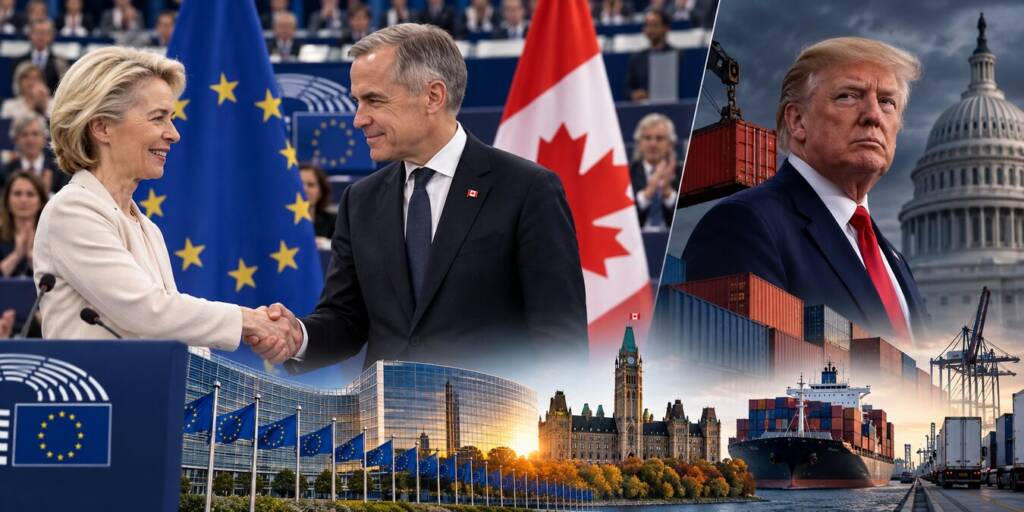
Canadian Prime Minister Mark Carney has embraced a European offer to make Canada the EU’s first associate member. Addressing the European Parliament in Strasbourg on 17 September, he said closer ties would shield Canada’s markets and sovereignty.
The night before, US President Donald Trump had called the idea “laughable” and threatened Europe with tariffs.
An Offer That Does Not Yet Exist
European Commission President Ursula von der Leyen made the offer on 16 September. Her prepared State of the Union text did not include the key line. With Carney watching from the front row, she said Europe wants ties at “the highest level possible.” Carney was the first head of government to attend the annual speech.
The status does not exist in EU treaties, so the bloc would have to create it. She also proposed an Alliance for the Future to build on CETA, the existing free trade deal.
As Carney began his reply the next day, someone in the chamber shouted “USA, USA.” “Europe and Canada are stronger together,” Carney told lawmakers, who gave him a standing ovation.
He wants deeper integration in areas from defence and critical minerals to artificial intelligence, space and finance. But he told reporters Canada is not seeking full EU membership. This year, Canada became the first non-European member of the EU’s €150 billion joint defence-buying fund.
Why Canada Is Turning To EU
Canada’s pivot follows months of escalating pressure from Washington. Canada sent 72 per cent of its goods exports to the US last year. After trade talks collapsed in August, Trump imposed 50 per cent tariffs on roughly US$20 billion of Canadian goods.
Canada hit back on 8 September with matching duties of 15–50 per cent. Trump has since banned some Canadian imports, including alcohol and motorcycles. The same day von der Leyen spoke, he told officials to start removing Canadian goods from federal purchasing.
Carney has accused Washington of using “economic integration as a weapon.” Last year, he vowed to double non-US exports within a decade, saying Canada “can’t rely on one foreign partner.”
An Abacus Data survey this month found about 80 per cent of Canadians favour deeper EU cooperation.
What Canada’s EU Bid Means For Ties With Washington
Trump told reporters he would impose “very serious tariffs” on Europe if he judged the plan “a hostile act.” Europe’s own trade deal with Washington could suffer — that deal caps US tariffs on most EU exports at 15 per cent. The new US levies have even hit goods the North American trade pact once shielded, raising questions about the pact’s future.
Carney insisted the plan was not a reaction to Trump’s threats. In Strasbourg, he told lawmakers: “We do not seek power to dominate others.” Days earlier, he said Canada “will continue to be the US’s most important partner in many key areas.”
James Lindsay, a senior fellow at the Council on Foreign Relations (CFR), expects Ottawa’s shift to last. Even with a trade truce, he said, Canada “will continue to reduce its vulnerability.”
Are America’s Closest Allies Hedging?
Trump’s pressure appears to be pushing other allies to hedge too. Since Trump began imposing tariffs on partners and allies, US allies have been forging new trade ties while sidelining Washington. Canada reached a preliminary deal with China, and Britain reset its relations with Beijing. The EU sealed a trade deal with India and signed a pact with four South American nations.
CFR senior fellow Manjari Chatterjee Miller wrote that once-firm US allies now “regarded the United States as an unreliable partner.” She points to the Arctic defence deal Canada struck with Denmark after Trump’s threats over Greenland. But Miller also warns against blaming Trump alone, noting that the Biden administration favoured selective coalitions too.
Few allies want a clean break. Vina Nadjibulla, vice-president of the Asia Pacific Foundation of Canada, said allies want a “US-plus strategy.” Many will not cut loose from Washington, she said, because the US remains vital to their security.
Hurdles In Brussels And Ottawa
Any new status would need backing from all 27 EU governments. Reports say some governments were angry that von der Leyen had not consulted them first. Ten member states, including France, Ireland and Italy, still have not ratified CETA.
In May, Germany proposed a similar status for Ukraine, with summit seats but no voting rights. That plan stalled after some capitals objected.
At home, Conservative leader Pierre Poilievre backs trade and defence ties with Europe. But he said Canadians should face “no EU taxes, no EU laws and no EU open-border immigration policies.” Carney has promised debates and a final vote in the Canadian Parliament on any deal.
Carney will host EU leaders in Montreal on 29–30 October to discuss the plan in detail. One footnote: Canada already shares a short land border with Denmark, on Hans Island near Greenland.