
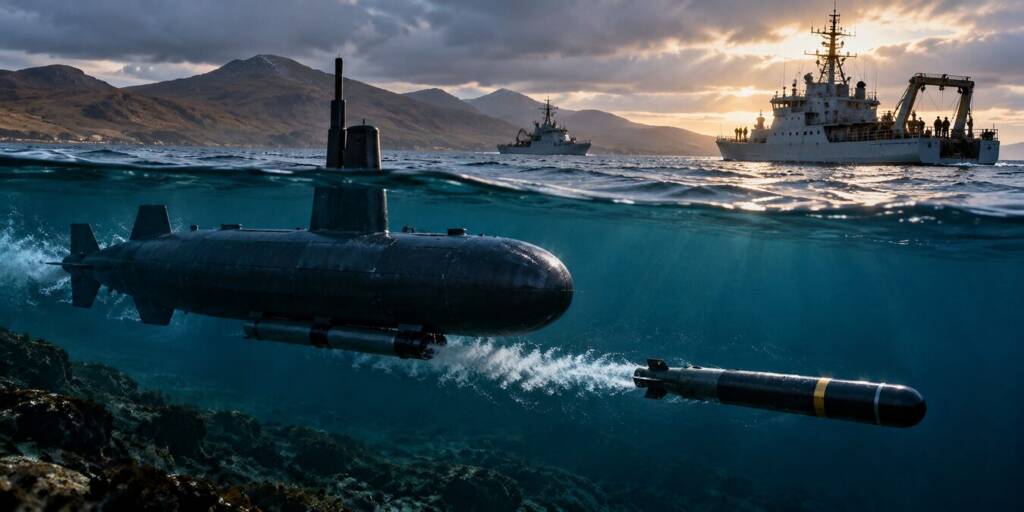
The Royal Navy’s XV Excalibur launched an exercise Mk 48 torpedo on 13 September at the British Underwater Test & Evaluation Centre (BUTEC) in Scotland, the US Navy said. Teams from both navies, the Defense Innovation Unit and industry partners ran the trial under Project Broadsword and Trial Iron, part of AUKUS Pillar 2 — the alliance’s advanced technology track with Australia.
The UK government called it the first time either nation had fired a torpedo from an uncrewed underwater vessel; until now, only crewed submarines had carried out such launches.
“A Historic First,” Says US Navy Chief
Admiral Daryl Caudle, the US Chief of Naval Operations, called the test “a historic first for allied undersea warfare.” The US Navy said the trial proved the American weapon and the British vehicle worked together mechanically, electrically and digitally — meaning allied forces can now swap weapons between each other’s drones with relative ease.
How Excalibur Carried the Torpedo
Excalibur did not fire the Mk 48 from an internal tube; instead, the drone carried it externally, mounted beneath its hull. Neither navy has said how operators controlled the drone during the test, or whether the torpedo was fired at a target.
Plymouth-based firm MSubs built Excalibur under the Royal Navy’s Project CETUS. The vessel measures 12 metres long and 2.2 metres wide, with an electric motor powered by battery packs fitted outside the hull. Baird Maritime puts its range at 1,000 nautical miles, though other outlets cite 1,000 standard miles, leaving the exact figure unclear. The drone can stay at sea for up to five days and dives deeper than any crewed Royal Navy submarine.
What the Mk 48 Brings
The Mk 48 was jointly developed by the US and Australia, the UK government said, and is designed to hunt both surface ships and deep-diving submarines.
The US Department of the Navy’s Rapid Capabilities Office approved Project Broadsword in February 2026, and the team reached the firing stage in under seven months. “We are not waiting 10 years for a single bespoke platform,” said Vice Admiral Seiko Okano, who leads the office. Vice Admiral Robert Gaucher, US Director of Submarine Programs, called the launch “an important early step in developing lethality in our undersea autonomous systems.”
Has Any Other Country Done This?
The UK and US are claiming a first for themselves, not for the world — China may already have a similar capability, analysts warn. Beijing paraded two extra-large drone submarines, the HSU100 and AJX002, in September 2025. Naval analyst H I Sutton believes Chinese designs likely carry torpedoes as well as mines, and expects China to arm its drones well ahead of Western rivals, though no report has confirmed an actual Chinese torpedo launch from a drone. Commentators have compared the AJX002 to Russia’s Poseidon, a long-range nuclear-armed underwater drone — though Poseidon functions as a weapon itself, not a launch platform.
Why This Gives London and Washington an Edge
The advantage lies less in the drone itself than in the alliance built around it. AUKUS members see uncrewed vessels as a way to add cheaper strike power in the Pacific and Euro-Atlantic, giving commanders more distributed options in contested waters — all without putting sailors at risk. Crucially, one nation’s weapon can now ride on another nation’s vehicle.
Excalibur has already proven it can operate across oceans: in 2025, operators in Australia steered the submerged drone in UK waters from more than 10,000 miles away. Sidharth Kaushal, a senior research fellow at RUSI, called the development noteworthy, noting that “uncrewed systems can play roles which extend beyond surveillance.”
Still, China fields far more of these vehicles — Beijing displayed eight at a single parade — meaning the allies’ edge rests on speed, shared standards and a proven test, not sheer numbers.
What Comes Next
The navies will now move to Project CUTLASS, using Anduril’s Dive-XL uncrewed underwater vehicle to study payload integration, command systems and battle tactics. Separately, Submergence Group — the US parent of MSubs — is building an operational drone under the US CAMP project, which Navy Lookout says will be able to carry payloads up to 21 feet long, including heavyweight torpedoes.
Politics Behind the Timing
Prime Minister Andy Burnham announced the firing while travelling to the UN General Assembly in New York, where he also unveiled a new AI and autonomy partnership with the United States. The trip marked Burnham’s first meeting with President Donald Trump since taking office in July.