
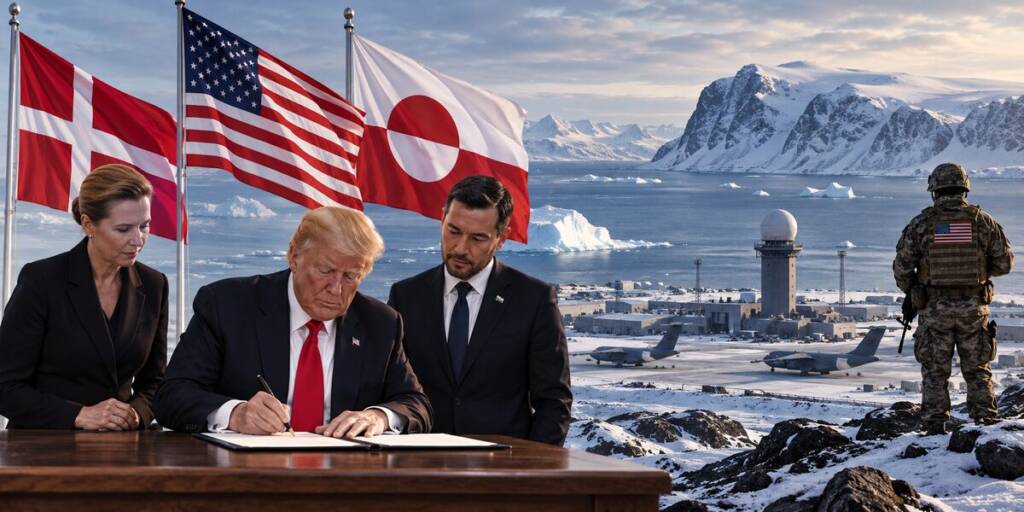
US President Donald Trump signed a security pact with Denmark and Greenland in New York on 22 September, handing Washington a larger military footprint on the Arctic island and aiming to end a standoff that had shaken the NATO alliance for months.
Danish Prime Minister Mette Frederiksen and Greenland’s Prime Minister Jens-Frederik Nielsen joined Trump at the UN General Assembly for the signing. The pact stops short of Trump’s earlier demand to annex the island outright. “This is tremendous for Europe and for the United States and for everybody,” Trump said before signing.
What the Deal Contains
The agreement lets Washington modernise and expand the Pituffik Space Base in north-west Greenland, while opening new bases at Narsarsuaq in the south and Mestersvig in the east, with room to add further defence sites later. Narsarsuaq, a former Cold War airbase, is now home to only a few dozen residents; Mestersvig currently hosts the Sirius Dog Sled Patrol, an elite Danish special forces unit.
Under the deal, US aircraft can fly over and land anywhere in Greenland, and Washington gains undersea access as well as the right to install its planned Golden Dome missile shield on the island. No non-NATO country can establish bases or maintain a persistent military presence without approval from all three governments, and investors from outside NATO and the EU are barred from sensitive sectors. The agreement carries no end date.
Why Washington Wanted the Deal
Trump framed Greenland as a matter of US national security throughout the dispute, arguing that Russia and China wanted the island and that Denmark could not stop them — both powers have eyed new Arctic shipping routes and the region’s critical minerals.
Geography explains much of the push: Greenland sits on the shortest path between Europe and North America and hosts the northernmost US military base. Earlier this year, Trump threatened tariffs on European allies until the US gained control of the island, and even hinted at quitting NATO over the dispute.
How It Strengthens American Security
The US presence on the island has shrunk sharply since 1945, when thousands of troops served across 17 bases. Today, roughly 200 personnel staff the remote Pituffik base — but the new sites and overflight rights let Washington widen that footprint quickly.
Ole Wæver, a professor of international relations at the University of Copenhagen, points to the permanence this creates. He noted that the 1951 agreement depended on the NATO treaty, meaning it could lapse if NATO collapsed or if Denmark or Greenland ever left the alliance. The new pact removes that risk entirely.
What Most Coverage Has Missed
The independence clause deserves closer scrutiny. If Greenland becomes independent, it must remain in NATO and take on Denmark’s obligations under the deal — and Denmark and Greenland must ensure the new state applies for NATO membership. Since independence requires a referendum and approval from both parliaments, the pact effectively settles a future state’s defence policy before any such vote takes place. Greenland’s roughly 57,000 people could choose independence and still inherit these terms.
The investment restriction may also reach further than headlines suggest: the bar applies to every investor outside NATO and the EU, which on paper would catch firms from close US partners such as Japan, Australia and South Korea.
Security guarantees alone won’t unlock Greenland’s mining potential, either. The island lacks much of the infrastructure mining requires, and some Greenlanders oppose mining on environmental grounds. One rare earths trade publication argued the deal may help mining only indirectly, by reassuring Western investors.
Some experts also question how much has actually changed. Torrey Taussig of the Atlantic Council noted that Denmark had no near-term plans to counter Russian or Chinese military projects — though she still called the deal “a significant feat for Danish diplomacy.”
Reaction and What Comes Next
Frederiksen described the pact as a deal that can “last forever.” Nielsen stressed NATO’s role in the region, saying, “We believe that it is vital to keep NATO strong, also in the Arctic,” and added that Greenlanders must now work to rebuild trust with the US.
NATO Secretary-General Mark Rutte and European Council President António Costa both welcomed the agreement.
Not everyone sees a clean ending, though. Mikkel Vedby Rasmussen, a political scientist at the University of Copenhagen, called the crisis over but not the underlying conflict, warning that Washington could use the deal as “a platform to force through further concessions.”
For now, Denmark retains its sovereignty and Washington gets its bases. The harder test lies ahead — in the choices Nuuk makes about its own future.