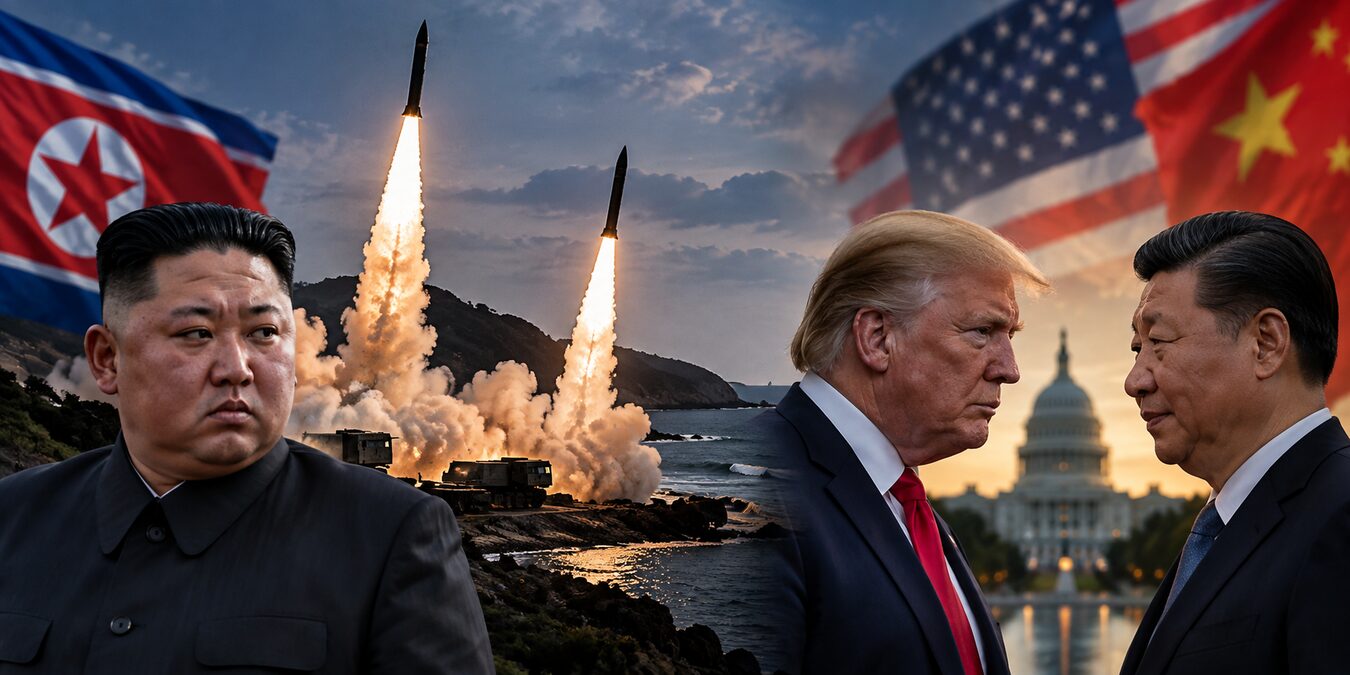
North Korea launched two short-range ballistic missiles toward the sea on Sunday, September 20, South Korea’s military said. The tests came four days before US President Donald Trump hosts Chinese President Xi Jinping — and Pyongyang appears to have chosen its moment deliberately.
South Korea’s Joint Chiefs of Staff tracked the first missile at around 3 pm local time, traveling roughly 450 km from the eastern coastal area of Wonsan. North Korea fired a second missile from the same site about three hours later; that one flew more than 600 km before falling into the sea. Seoul believes the first missile belongs to the Hwasong-11 series, and officials in Seoul, Washington and Tokyo shared tracking data from the opening minutes.
Seoul and Tokyo Protest Firing of Missiles
South Korea’s presidential office convened an emergency National Security Council meeting and demanded that Pyongyang halt launches banned under UN Security Council resolutions. The military said it remains at full readiness alongside the United States.
Japan’s defense ministry also tracked the launches. Public broadcaster NHK reported the projectile landed outside Japan’s exclusive economic zone, and Tokyo lodged a protest through its embassy in Beijing. Defense Minister Shinjiro Koizumi later gave reporters the figure worrying Tokyo most: North Korea has carried out at least 15 ballistic launches this year across nine occasions, compared with four occasions and at least five missiles last year. Koizumi called the regional picture “growing increasingly severe.”
Trump Cut the Drills, Kim Kept Firing Missiles
Those numbers sit awkwardly against Washington’s recent gestures. On August 16, Trump ordered the Pentagon to shrink the annual Ulchi Freedom Shield exercise, calling the drills too costly and a “totally inappropriate and hostile” signal — citing his relationship with North Korean leader Kim Jong Un. Seoul followed suit, halving the program and closing it on August 21 instead of August 27.
Trump told reporters Kim had responded to his request for a meeting. Kim Yo Jong, the leader’s sister, denied any contact days later, dismissing the shortened drills as “unworthy of comment.” North Korea then fired roughly 10 short-range missiles, followed by more on September 12 — a day after the allies wrapped up the Freedom Edge exercise. Last week, Kim Yo Jong also criticized the US-led Pacific Vanguard naval drill, vowing Pyongyang would never soften on “intensifying the nuclear war deterrence.”
Why Pyongyang Keeps Launching
Three motives appear to be at play. First, Kim needs the hardware to work: repeated short-range tests sharpen precision, and North Korea now supplies missiles to Russia. Kim reportedly spent three days last week inspecting munitions factories.
Second, Kim wants status, not sanctions relief. On Saturday, his foreign ministry rejected an IAEA resolution criticizing the nuclear program, insisting Pyongyang’s nuclear status is already enshrined in law and needs no foreign recognition — a demand for acknowledgment, not an opening for talks.
Third, timing itself is the message. North Korea has long used allied military drills as cover for weapons tests, and the same logic extends to summits: Kim tends to fire when the world’s cameras are already trained on the peninsula.
The China Question
This is where the story turns. Xi arrives at Joint Base Andrews on Wednesday for his first White House visit in over a decade. He and Trump are set to discuss trade, artificial intelligence, rare earths and fentanyl on September 24, with a trade truce set to expire in November — giving Beijing every incentive to arrive with leverage in hand. North Korea is one of its strongest cards.
Consider the sequence: Xi traveled to Pyongyang in June, his only foreign trip of 2026, and notably made no mention of denuclearization — a marked shift from his 2019 visit. Both sides agreed to deepen strategic and military exchanges. Analysts concluded Xi had effectively “grasped the lever” over any future Trump-Kim talks, and that lever looks increasingly valuable now: Trump wants a summit with Kim, but Kim keeps ignoring him. Beijing, meanwhile, can position itself as the only capital capable of moving Pyongyang — and every launch raises the price of that service.
What Happens Next
Watch whether Trump raises North Korea publicly at the state dinner, and whether Xi offers to carry a message north. Then watch November: Trump may travel to Shenzhen for the APEC summit on November 18–19, and has privately floated meeting Kim during that Asia trip. For now, Pyongyang’s only reply is missiles.