
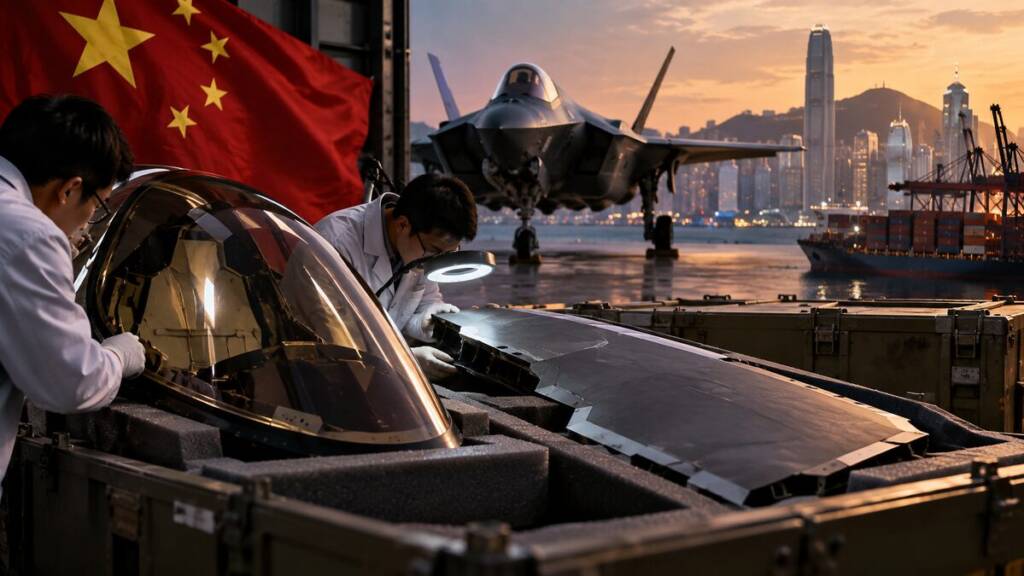
China has taken possession of stealth components from an Australian F-35 fighter jet after a shipment bound for the United States mysteriously rerouted through Hong Kong, according to people familiar with the matter cited by Bloomberg. The Pentagon is now demanding the parts back.
The shipment — a cockpit canopy and a weapons bay door from the Lockheed Martin jet, both coated with radar-absorbing material critical to the aircraft’s stealth capability — left Australia in late May. It was meant to reach the US for inspection and possible repair or disposal. Instead, it ended up in Chinese hands.
How the F-35 Parts Reached Hong Kong
UPS handled the shipment. The cargo plane made a stop in South Korea en route to the US, then diverted to Hong Kong, according to one source. No explanation for the detour has surfaced.
The story broke September 18. Reports indicated an intermediary — identified as French-owned CEVA Logistics — moved the parts on Lockheed Martin’s behalf. How CEVA and UPS split responsibility for the shipment remains unclear.
The Royal Australian Air Force had sent the parts to the US for evaluation as part of routine maintenance.
What Officials Say
The Pentagon’s F-35 Joint Program Office confirmed an issue with a shipment of worn parts, saying it would work with partners to “retrieve these components, investigate the incident.”
Australian Defence Minister Richard Marles, speaking in Adelaide on September 22, said Canberra would assist the US and Lockheed Martin with the investigation. He added that he understood the shipment contained no sensitive parts.
Lockheed Martin, meanwhile, characterized the components as posing a “low risk for exploitation.” Other sources described them as potentially sensitive — a discrepancy that remains unresolved.
Will China Hand The F-35 Parts Back?
Beijing has given no indication it intends to return the parts. Both China’s foreign and defense ministries said they had no knowledge of the case, and Hong Kong’s government declined to comment. Since Hong Kong cannot conduct its own military or diplomatic affairs, any decision ultimately rests with Beijing.
History offers a cautionary precedent. In 2001, China held a US Navy EP-3 spy plane for months following a mid-air collision, eventually returning it disassembled. Nearly four months have now passed since the F-35 shipment left Australia — and even a prompt return wouldn’t undo whatever testing has already occurred.
Why the F-35 Parts Matter
The canopy is an acrylic bubble coated with a thin, transparent radar-absorbing layer that degrades over time, requiring periodic replacement. Experts caution that no single component can expose the entire jet’s secrets — stealth depends on a combination of design, materials, sensors and software. Still, they note that physical access to a real component offers valuable opportunities for study.
J.J. Gertler, a former Congressional Research Service aviation analyst, put it plainly: “possessing a real one can give them even more to go on.”
Analysts have also warned that China could use the parts to develop countermeasures making the F-35 easier to detect.
A Long-Running Target
The F-35 has been a persistent target of Chinese espionage. Such concerns previously helped derail a planned F-35 sale to the United Arab Emirates, and similar worries have surfaced among US lawmakers over a proposed sale to Saudi Arabia.
Leaks by Edward Snowden in 2013 revealed that Chinese hackers had obtained F-35 radar and engine data — though China has consistently denied targeting the program. State Department and Pentagon officials briefed congressional staff on the current incident in June, with further briefings expected in the coming weeks.
The Pentagon says it will implement new safeguards to prevent a repeat incident. The F-35 program spans eight partner nations, including the UK and Australia, whose spare parts move through a global supply chain managed by Lockheed Martin.
The episode could prompt tighter controls on the shipment of sensitive components. For now, two questions linger: what has Beijing learned — and will it ever say?