
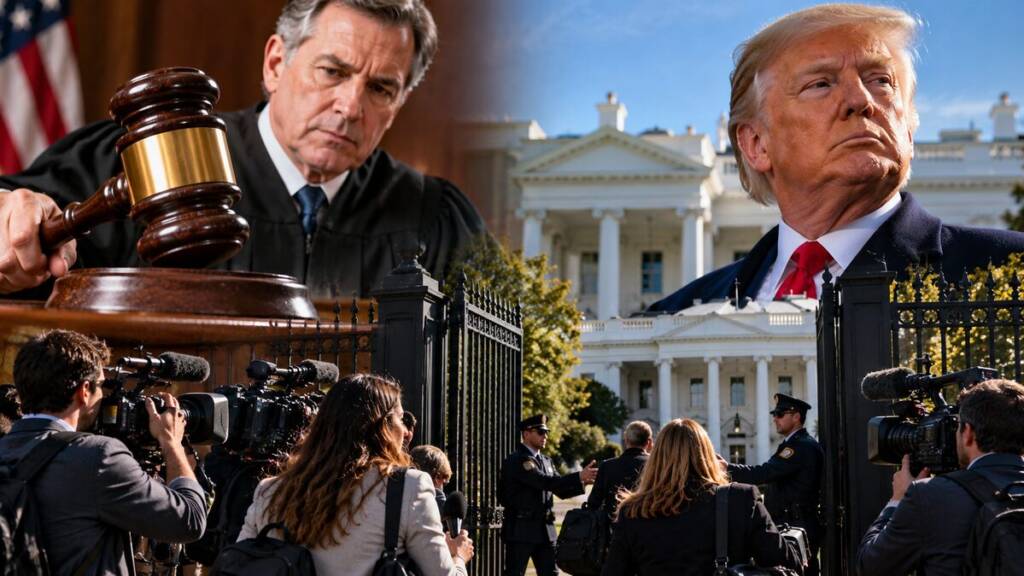
A federal judge in Washington has blocked President Donald Trump’s ban on three news outlets at the White House, handing the media a swift win in a week-long standoff with the president. Judge Timothy Kelly ordered the White House early Thursday, September 24, to restore access for CNN, MS NOW and Politico.
Kelly directed the White House to “immediately return, reinstate, and restore” the outlets’ access, ruling that they had met the legal threshold for a temporary restraining order and would likely prove the White House revoked their credentials without due process.
Hours of Delay at theWhite House
The ruling didn’t end the standoff immediately. The White House kept reporters from all three outlets out Thursday morning — a Secret Service agent had earlier confiscated their credentials under the ban — with officials citing the time needed to locate, reactivate and deliver new badges. An administration court filing put the delay at more than two hours, according to AP.
The outlets’ lawyer quickly sought an emergency hearing, telling the judge the government had “already repeatedly” violated his order. By afternoon, CNN’s Betsy Klein and MS NOW’s Laura Barrón-López were reporting live from the White House grounds, and one Politico reporter had regained entry.
A Snub at the State Dinner at the White House
The friction carried into the evening. White House staff turned away two CNN reporters and one MS NOW journalist at arrivals for a state dinner honoring Chinese President Xi Jinping. All three had applied for credentials, but the White House never issued them; CNN said only its photojournalist and audio technician were admitted.
Why Trump Banned the Outlets
Trump announced the ban Friday, September 18, on Truth Social, accusing the three outlets of consistently publishing false stories. Asked what triggered the move, he pointed to no single report: “It’s really just cumulative stories over the last two years,” he said — adding that other outlets could face similar treatment. “I don’t want them in my office,” he told reporters.
Defense Secretary Pete Hegseth backed the ban, accusing the outlets of endangering troops through unnamed sourcing, and the administration later framed the reporting as a national security threat. Kelly rejected that argument, noting Trump had initially cited only negative coverage rather than security concerns, and called the White House’s standard for “objectionable” reporting far too vague.
What Each Side Argued
At Wednesday’s hearing, Justice Department lawyer Michael Velchik defended the president’s right to choose who enters the White House, arguing that access is a privilege, not a right, and denying any viewpoint discrimination — noting Trump had criticized outlets like ABC without banning them.
The outlets’ attorney, Theodore Boutrous Jr., argued the ban caused lasting harm during a period of major world news. Following the ruling, he said the law clearly favored his clients and predicted that attacks on individual journalists would lose credibility over time.
Rival Networks Close Ranks
The dispute triggered a rare show of unity across the American press. After the White House also removed CNN from the rotating television pool covering the president, the other four networks stopped filming pool events in solidarity.
On Wednesday, Fox News, CBS and NBC crews attended Xi’s arrival at Joint Base Andrews but shot no video; by Thursday, no major American network aired live coverage of Xi’s visit, according to AP. Trump pushed back online, claiming the networks skipped the event to deny him credit.
Kelly’s order does not address CNN’s status in the video pool — that dispute remains unresolved. Roughly 50 organizations, including AP, filed a brief urging the court to restore the outlets’ access.
The restraining order runs for 14 days. Kelly gave both sides until October 5 to submit arguments on a longer-term preliminary injunction, saying he intends to rule quickly. The White House could also appeal, with its prospects likely hinging on how higher courts view presidential control over access to White House spaces.
Kelly is no stranger to this terrain. Trump nominated him to the bench in 2017; a year later, Kelly ordered the White House to restore a CNN journalist’s access in a similar dispute. In 2019, another judge ordered the reinstatement of Playboy correspondent Brian Karem’s press pass.
AP fought a comparable battle in 2025 after Trump restricted the agency for declining to adopt the name “Gulf of America.” Judge Trevor McFadden ruled that ban violated the First Amendment, though an appeals panel — Judges Neomi Rao and Gregory Katsas — later reinstated much of it, holding that the president controls access to his private workspaces; Judge Cornelia Pillard dissented.
That split leaves a central question unresolved: can a president shut out reporters simply for what they write? The coming weeks may bring an answer.