
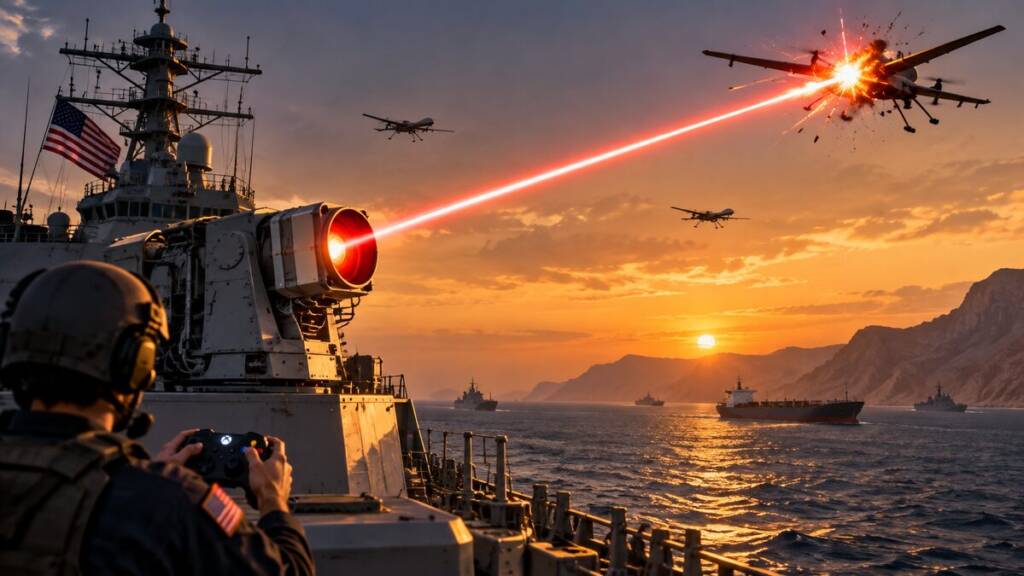
The US military has started firing high-energy lasers at drones in the Strait of Hormuz. Its operators aim the beams with modified Xbox gaming controllers. The department says lasers destroy drones and cruise missiles “at a much lower cost” than kinetic weapons such as missiles.
A 60-Kilowatt Laser Beam at Sea
The best-known system in the fleet is HELIOS. The name stands for High-Energy Laser with Integrated Optical-dazzler and Surveillance. HELIOS fires a 60-kilowatt fibre laser from Navy destroyers. It focuses an invisible infrared beam on a target until the target melts or explodes.
HELIOS plugs directly into a destroyer’s radars and fire-control systems. Its design leaves room to reach 150 kilowatts in future.
The Navy also fields ODIN, a lower-power laser. ODIN blinds the cameras and heat sensors that guide hostile weapons. Boeing, meanwhile, offers its Compact Laser Weapon System against Group 3 drones, a mid-sized class.
How the Laser Beam Works
Generators or battery packs feed power into the system. The system turns that power into light and focuses it into a tight beam. The beam heats one spot on a target until it explodes.
Mark Neice, president of Directed Energy Consultants, said that the systems track drones precisely. Operators can either blind a drone’s sensors or destroy the drone outright, he said.
Why an Xbox Controller?
The military sees little point in designing a bespoke control system. The gaming industry has already spent years perfecting controllers. Personnel who know these controllers may also need less training. Jared Keller, who writes the Laser Wars newsletter, backed moving lasers out of laboratories and into real conditions. He joked that Halo players who have fired its Spartan laser could probably fire the real thing.
A US$500 Million Bet
Experts puts US spending on these laser weapons at about US$500 million. Some outlets attribute that figure directly to the Department of War, so its exact source remains unclear.
The price per shot matters. The US has fired about 850 Tomahawk cruise missiles during its conflict with Iran. Israel and Gulf states have also spent hundreds of interceptors on Iranian missiles and drones. The strait serves as one of the main routes for the world’s oil shipments. Any cheap defence against drones there matters to shipping and markets alike.
The Limits
Bad weather can weaken the beam, and large drone swarms can overwhelm the system. The lasers’ weight also keeps them on warships for now. Soldiers will not carry them into battle soon.
Critics raise another objection. Some argue the Trump administration uses pop-culture references to sell its military policies. The US also tests lasers closer to home. Joint Task Force Southern Border has shot down drug traffickers’ drones with the technology.
Who Else has Laser Weapons?
Israel leads the field. Its Iron Beam system entered service with the Israel Defense Forces at the end of December 2025. Britain plans to fit its DragonFire laser to a Royal Navy Type 45 destroyer before the end of 2027. Officials estimate each shot costs less than £10.
China showed off its LY-1 naval laser at a Beijing parade in September 2025. Beijing has released few details about it. India tested its 30-kilowatt Mk-II(A) laser in April 2025. The DRDO system can knock out drones and small aircraft around five kilometres away.
South Korea is developing its Block-I laser. Ukraine has released footage of its Tryzub laser downing a drone.
A Long Road to the Front Line
The United States has spent roughly five decades developing directed-energy technology. The Navy first mounted a laser weapon on USS Ponce years ago. Hormuz now gives that technology its toughest real-world test yet.