
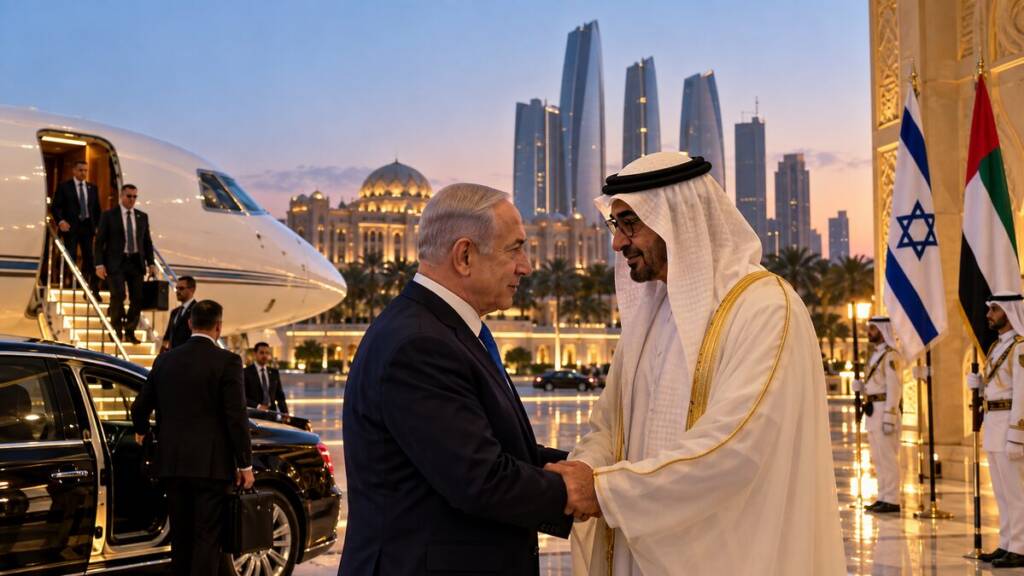
Israeli Prime Minister Benjamin Netanyahu flew secretly to Abu Dhabi on Sunday, September 27, and held talks with UAE President Sheikh Mohammed bin Zayed Al Nahyan, according to a senior Israeli official who confirmed the meeting. It is his second reported visit to the Emirates this year. Neither Netanyahu’s office nor the UAE foreign ministry offered immediate comment, and the UAE has not confirmed the trip.
Four hours on the ground
According to reports, Netanyahu left Ben-Gurion Airport on a private executive jet shortly after noon and landed in Abu Dhabi at 3.10 pm. The jet departed for Israel at 7.10 pm. Reports say it is the same aircraft he used for his wartime trip to the UAE earlier this year.
The first reported visit took place on March 26, at the height of the Iran war, when Netanyahu and Sheikh Mohammed met for several hours in Al Ain, an oasis city near Oman. Netanyahu’s office disclosed the trip on May 13 and called it a “historic breakthrough” in ties. Abu Dhabi described the claim as “entirely unfounded.” Emirati officials had reportedly wanted the meeting kept secret and resented the disclosure.
What the two leaders may have discussed
Sources say the Iranian threat dominated Sunday’s talks. Iran struck the UAE harder than its neighbours during the war, hitting civilian infrastructure and energy sites. Washington and Tehran also remain deadlocked over the Strait of Hormuz. President Donald Trump recently rejected Tehran’s latest proposal on the strait but still expects fresh talks.
Air defence, intelligence sharing and the risk of a new Iranian offensive are therefore likely to have featured. In May, Israeli accounts of the March meeting mentioned Iron Dome systems in the UAE, which the UAE denied, saying it had received no such visit or military delegation.
Domestic politics may also explain the timing. Israelis vote in a Knesset election next month, and Netanyahu faces a difficult race.
The October 7 shadow
The trip also comes days after a report that has put Netanyahu under pressure. The report says Sheikh Mohammed warned Netanyahu that Hamas was planning a major operation against Israel, in a call reportedly made about a week and a half before the October 7, 2023 attack. It further alleges that Netanyahu did not pass the warning to Israel’s spy agencies or the army. Netanyahu denies the report and has threatened legal action. Opposition leaders hold him responsible for the security failures that preceded the attack.
A Gulf looking for new shields
The visit also reflects a wider shift in a region shaken by war. The United States, the Gulf’s traditional security guarantor, is gradually stepping back. Senior Pentagon officials want to reduce troop numbers in several Gulf states and have regional partners carry more of the defence burden. Two weeks into the Iran war, Trump questioned why America should bear the cost of guarding Gulf energy routes. Iranian missiles and drones struck all six Gulf Cooperation Council states during the conflict, showing that hosting a US base does not automatically guarantee a country’s safety.
The Gulf monarchies are responding by building new partnerships, and they are not all choosing the same ones.
Riyadh turns to Islamabad and Ankara
Saudi Arabia signed a mutual defence pact with nuclear-armed Pakistan on September 17, 2025. Turkey joined the arrangement at a signing in Mecca on August 7 this year, and the three states now treat an armed attack on one as an attack on all. Riyadh has since faced attacks from the Houthis, and its new partners have so far offered statements of support rather than troops or weapons.
UAE leans on Israel and India
The UAE has placed its bets elsewhere. Since the Iranian attacks it has deepened ties with Washington and Israel, which established relations under the 2020 Abraham Accords. The Israel link gives Abu Dhabi regional leverage and a channel to Washington. Mossad chief Dedi Barnea has made at least two wartime trips to the UAE.
India is the second pillar. Sheikh Mohammed and Prime Minister Narendra Modi signed a defence letter of intent in New Delhi on January 19. Modi then travelled to Abu Dhabi on May 15, where the two sides agreed a strategic defence partnership framework covering defence industry, technology, training, exercises, maritime security and cyber defence. The UAE also agreed to store crude oil in India’s strategic petroleum reserves. Bilateral trade topped $101 billion in 2025-26, and India, Israel, the UAE and the US already sit together in the I2U2 grouping.
Neither government is likely to share details of Sunday’s talks soon. A UAE source has said Abu Dhabi discusses security through the “relevant entities” and not at leader level. Even so, the pattern is clear. As America steps back, the UAE appears determined to keep both Israel and India close.