
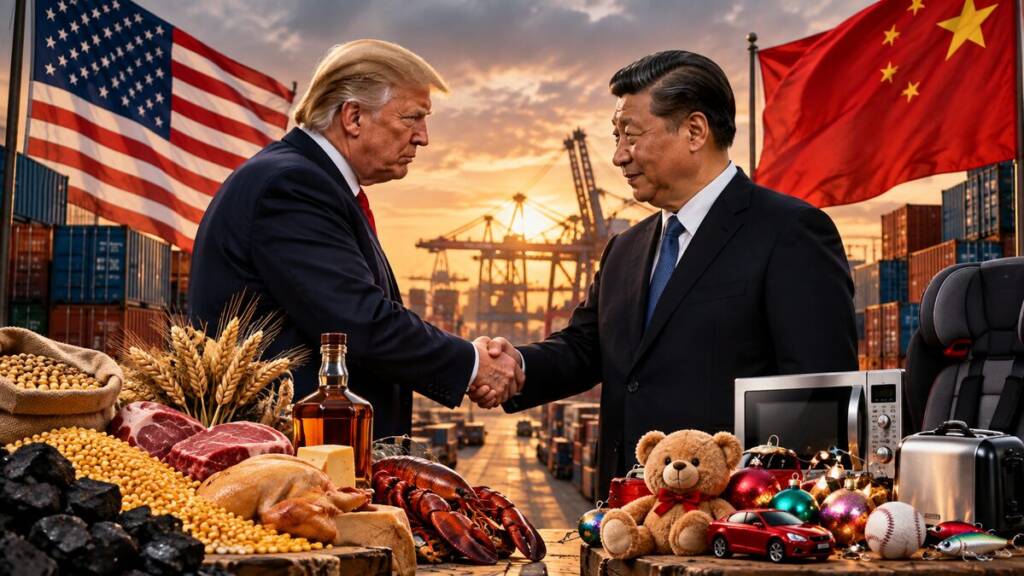
The United States and China have finalised product lists for a tariff deal covering about $30 billion of each side’s goods, with American farm produce on one side and Chinese toys and household items on the other. US Trade Representative Jamieson Greer unveiled the lists late on Sunday, September 27, following President Donald Trump’s summit with Chinese President Xi Jinping in Washington on September 23-25.
The wider tariff truce, however, now runs only until January 10, 2027. Greer said Washington will use the extra weeks to check whether Beijing keeps its promises.
The lists come from a new US-China Board of Trade, which Trump and Xi set up in Beijing in May. Each side will consider lower tariffs on roughly $30 billion of the other’s goods, the White House said.
Beijing’s list names 1,619 American products. They include beef, pork and chicken, wheat, corn, sorghum and cotton, as well as lobsters, cheese, whiskey, coal, logs and medical equipment such as MRI scanners and pacemakers.
Washington’s list names 77 Chinese product lines, among them fireworks, Christmas-tree lights, glass ornaments and nativity scenes, along with microwave ovens, toasters, child car seats, baseballs, fish hooks and skeet targets.
Greer said Trump is “unlocking improved market access for about 30 per cent of US exports to China.” Trade on both lists totals about $60 billion, a fraction of last year’s $415 billion.
Neither government has set the new tariff rates or a start date. China said tariffs on about 90 per cent of the products would fall to the normal rates applied to most countries. Greer stressed that “these are not immediate tariff cuts.”
*Coal and farm pledges*
The White House said China will import at least 10 million tonnes of American coal in both 2027 and 2028, and tied the pledge to Trump’s revival of the coal industry. China was among the top five buyers of US coal until it sharply cut imports in 2025.
The Board of Trade also launched a working group on barriers facing American farm exports. Greer said China has passed the halfway mark on its 25 million-tonne soya bean pledge, but that purchases of other farm goods must pick up during the autumn harvest. He added that the US goods trade deficit with China has fallen nearly 40 per cent, while acknowledging that some trade has shifted to other countries.
Washington’s list excludes any toy that connects to Wi-Fi, Bluetooth, Ethernet or radio signals, and Greer said it sticks to household goods and toys that the US sources mainly from China. “All those export controls that are national security issues, we take those off the table,” he said.
*A short clock for Beijing*
Treasury Secretary Scott Bessent announced the two-month truce extension on September 23, as Xi landed in Maryland. Trump and Xi first agreed the truce in Busan, South Korea, in October 2025, after which Beijing agreed to buy more American soya beans and to pause curbs on rare earth exports. Modern weapons and electronics rely on these metals.
Mary Lovely of the Peterson Institute for International Economics said Washington preferred the short extension, and linked it to US concerns over deliveries of rare earth magnets.
The tariff wall itself remains in place. A Congressional Research Service report in July found that Chinese goods still face US tariffs of 36.5 per cent, while American goods face 31 per cent in China.
*Fentanyl and Iran*
The White House said China arrested 21 of its citizens in August after a tip-off from US law enforcement, for making and supplying chemical ingredients to illegal drug producers in North America. Washington urged maximum sentences, including the death penalty where it applies. China also imposed export controls on two chemicals used by fentanyl makers.
Both leaders agreed that Iran can never have a nuclear weapon, and agreed to set up a direct line for incidents involving advanced artificial intelligence.
*Doubts over follow-through*
China’s commerce ministry said the arrangement would steady relations and help Chinese exporters sell in America. Not everyone shares that optimism. Daniel Kritenbrink, a former US official now at The Asia Group, said: “China is doing just barely enough to maintain the agreement and no more.”
Philippe Le Corre, a professor at ESSEC Business School, called the two-month extension “a terrible outcome for the US,” saying the ever-shorter extensions show that the sides still disagree on many issues. On rare earths, the White House said only that talks on shortages continue.
Trump and Xi plan to meet twice more this year, in China in November and in Miami in December. Greer hosts G20 trade ministers in Milwaukee, Wisconsin, this week, with Chinese overproduction on the agenda. In a softer gesture, China has leased two giant pandas to a zoo in Atlanta, the White House said. Beijing’s real test arrives on January 10.