On Monday, Beijing froze whatever assets two ministers from the Americas might hold in China. Officials from Taiwan’s allies rarely even visit China, so the sanctions cost the pair little. Their message, however, travels a long way.
China’s Foreign Ministry announced countermeasures against two serving ministers on 12 October: Gustavo Villate, Paraguay’s technology minister, and Francis Fonseca, Belize’s foreign minister. The measures freeze their movable and immovable property in China, bar Chinese firms and citizens from dealing with either man, and deny both entry to the mainland, Hong Kong and Macao.
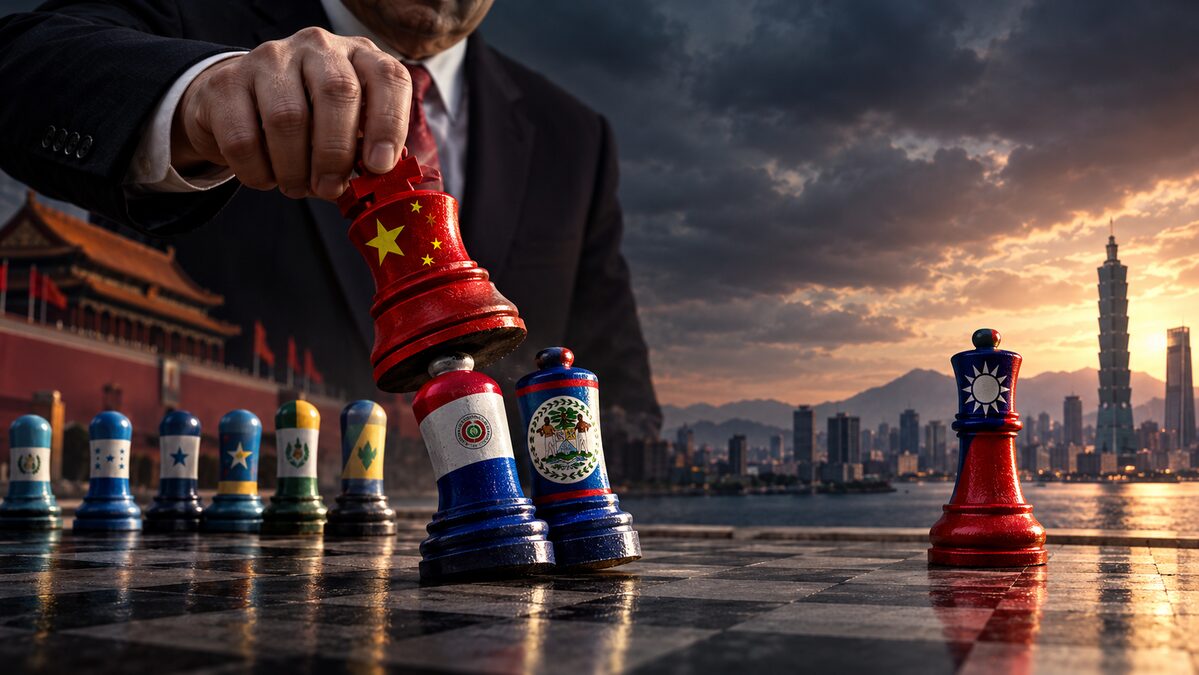
Beijing invoked its Anti-Foreign Sanctions Law and called the step an act of “warning and deterrence”. Foreign Ministry spokeswoman Mao Ning went further, accusing politicians in both countries of acting as “chess pieces” for Taiwan’s ruling Democratic Progressive Party and of spreading falsehoods about Chinese cyberattacks.
Two ministers in the crosshairs
Neither choice looks random. Villate travelled to Taipei in March 2024, where he pledged firm support for the island, praised its democracy and called it a friend. His ministry also works closely with the US Embassy in Asunción on cyber security. In July, the two governments accused China-linked hackers of infiltrating Paraguay’s state systems, and an earlier joint review had already named the Beijing-based group Flax Typhoon. China rejected the charges outright.
Fonseca, meanwhile, signed a memorandum of understanding in late September with visiting Taiwanese officials. Taiwan’s Foreign Minister Lin Chia-lung brought more than 30 business representatives on that tour of Belize and Guatemala. Belize has not hidden its views either: last December, its foreign ministry condemned China’s military intimidation of Taiwan and reaffirmed strong support for the island.
Paraguay’s President Santiago Peña also visited Taipei in May, where he condemned Beijing’s military manoeuvres and mounting economic pressure.
A long list of targets
The latest sanctions follow a well-worn script. In August 2022, Beijing sanctioned Nancy Pelosi, then US House Speaker, and her immediate family after her visit to Taipei. Days later, it targeted Lithuania’s deputy transport minister, Agnė Vaiciukevičiūtė, for a similar trip. Beijing also blacklists Taiwan’s own officials, including Hsiao Bi-khim, now the island’s vice-president.
Two years earlier, Czech Senate President Miloš Vystrčil had led a 90-strong delegation to Taiwan. China’s top diplomat, Wang Yi, vowed to make him “pay a heavy price”, and Prague summoned the Chinese ambassador in response.
Punishing whole nations
Beijing saves its heaviest blows for governments, not individuals. In November 2021, Lithuania let Taipei open a “Taiwanese Representative Office” in Vilnius, whereas other Taiwanese missions in Europe use the name “Taipei”. China downgraded diplomatic ties to chargé d’affaires level, and Lithuanian businesses soon complained of a customs block on their exports to China. Beijing denied any blockade, but the European Union took the dispute to the World Trade Organization.
Paraguay pays a quieter but steadier price. It has recognised Taipei since 1957 and remains its sole South American ally. Its farmers export vast quantities of beef and soya, yet they cannot sell those goods directly to China while Asunción recognises Taipei.
Beijing rarely misses a chance to say so. In 2024, a Chinese spokesman cited customs data showing zero soya imports from Paraguay. That December, Chinese envoy Xu Wei lobbied opposition lawmakers in Asunción and told reporters that Paraguay faced a stark choice: “either China or Taiwan”. Paraguay cancelled his visa and ordered him to leave.
Taiwanese officials even claim Beijing dangled millions of COVID-19 vaccines before Paraguay during the pandemic, in return for a switch of recognition. Beijing denies the claim. Evan Ellis, a US Army War College professor, calls Paraguay both a symbolic and a strategic prize.
Elsewhere, the carrots have worked. Taiwan has lost ten diplomatic allies since 2016. Panama, El Salvador, Nicaragua and Honduras all switched to Beijing, and Nauru cut ties two days after Taiwan’s January 2024 election. Only 12 diplomatic allies remain, mostly small states in Central America, the Caribbean and the South Pacific, plus Eswatini and the Vatican.
Locked out of the room
Beijing’s campaign reaches far beyond bilateral ties. It also keeps Taiwan out of the bodies that shape global life.
In May, Taiwan received no invitation to the World Health Assembly for a tenth straight year. It attended as an observer from 2009 to 2016, when President Ma Ying-jeou pursued warmer ties with Beijing. China began blocking Taiwan in 2017, after Tsai Ing-wen took office.
At this year’s assembly, Taiwan’s allies tabled a proposal to invite the island, but the assembly’s president kept it off the agenda. China’s envoy cited UN General Assembly Resolution 2758 to justify the exclusion. Palau’s vice-president warned that the move leaves 23.5 million people outside the global health security net. Critics note that the 1971 resolution never mentions Taiwan at all and simply handed China’s UN seat to Beijing, yet China wields it as a master key to lock Taiwan out.
The pattern repeats across the UN system. Taiwan last attended a meeting of the International Civil Aviation Organization in 2013, a gap that matters because Taiwan manages a busy flight information region in East Asia. US lawmakers note that Beijing also keeps Taiwan out of Interpol, so Taiwanese police lack a seat in global crime-fighting networks.
The cost for Taiwan, and the pushback
The repercussions for Taiwan run deep. Each lost ally chips away at its claim to statehood, and each closed door creates real gaps in health, aviation and policing. During COVID-19, Taiwan fought the pandemic without a seat at the WHO’s top table.
Still, Taipei refuses to retreat. In Geneva this May, its ministers hosted a health technology expo beside the assembly, and Washington and Brussels both voiced support for Taiwan’s participation.
Taipei also hit back at Monday’s sanctions. Premier Cho Jung-tai said China has no right to shape Taiwan’s foreign relations, and Deputy Foreign Minister Chen Ming-chi asked a pointed question: “Are they going to sanction the entire world?” The US State Department also condemned Beijing’s coercion of countries in the Western Hemisphere.
For the allies, loyalty brings tangible rewards too. Peña returned from Taipei with plans for an artificial intelligence centre in Paraguay and secured Taiwanese market access for Paraguayan chicken. Taiwan already buys most of Paraguay’s pork exports, by one estimate around 85%.
Pressure still builds at home. In 2025, Paraguay’s Senate asked the foreign ministry to explain its China policy, and opposition senator Éver Villalba argued that China’s heavy share of Paraguay’s imports demands a rethink. In 2023, Foreign Minister Rubén Ramírez set out Asunción’s stance bluntly: Paraguay would gladly open ties with Beijing without conditions, but Beijing demands a break with Taiwan first, and Asunción refuses to pay that entry fee.
A price tag on friendship
Beijing’s sanctions on Villate and Fonseca will freeze little money. Their true target lies elsewhere: every minister in Guatemala, Eswatini or Saint Lucia can now read the price tag on a Taipei trip.
Mao Ning made that intent plain, warning Taiwan’s remaining allies that backing the island would cost them development and bring isolation. One Chinese analyst argues that Beijing’s legal toolkit for punishing foreign politicians keeps growing.
For now, Paraguay and Belize seem willing to pay that price. The real question is whether others will stand with them, or walk away like Nauru.