
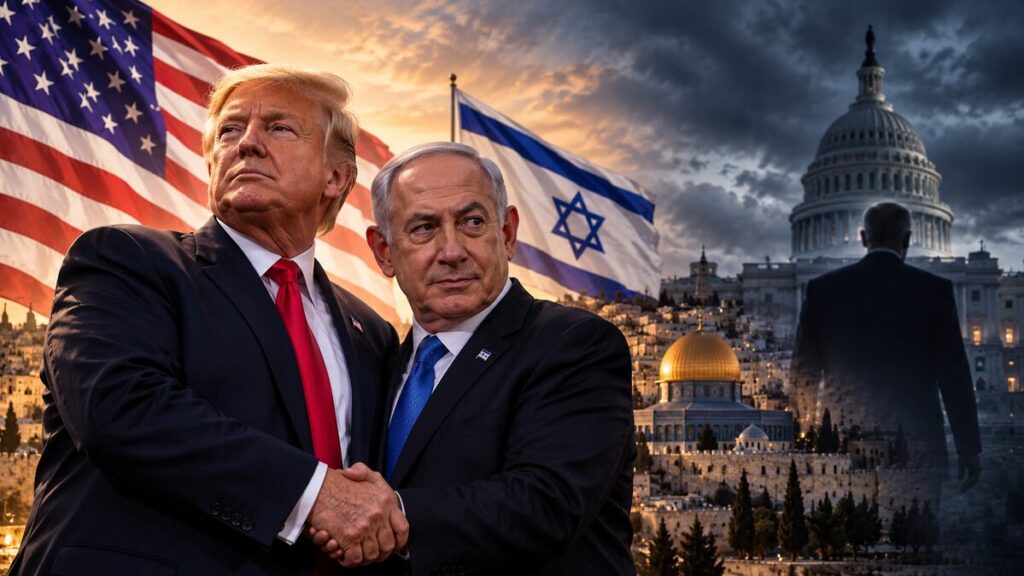
Donald Trump has thrown his weight behind Benjamin Netanyahu. The US president endorsed Israel’s prime minister on Sunday, nine days before the 27 October election. His move ends months of silence and public friction between the two leaders.
Yet hours earlier, Netanyahu himself sketched a sobering future. He warned that a US president hostile to Israel could take office within two years.
So Netanyahu now celebrates his closest American ally while quietly preparing for life after him. Here is what you need to know.
What did Trump say?
Trump posted his endorsement on Truth Social on Sunday, 18 October. He hailed Netanyahu as a ‘great warrior prime minister’ and a partner against Iran.
He also delivered a blunt warning to Israeli voters. If they choose anyone else, he wrote, America will ‘have to do this work ourselves’. Trump added that he had little appetite for that task.
He also renewed his threat to finish off Iran unless Tehran changes course fast. Netanyahu promptly thanked him on X.
Why did Trump wait so long?
The two men have clashed repeatedly this year. Israel and the US jointly launched a war on Iran in February. The nearly eight-month conflict, however, strained their partnership.
Trump criticised Israel for striking a key Iranian gas field early in the war. In June, he even called Netanyahu ‘crazy’. In August, Netanyahu rejected Trump’s plan to revive a stalled Gaza ceasefire.
Trump also kept his distance in public. In an interview with Time magazine, he claimed he had stepped back from politics. As recently as Thursday, he declined to back anyone and said that he trusted nobody.
Why endorse him now?
Several reasons stands out.
His Iran gamble. Trump’s own record rides on the war. Aaron David Miller of the Carnegie Endowment argues that the war was ultimately Trump’s decision. Snubbing Netanyahu would invite questions about whether Trump should have fought it at all.
Unfinished business. Trump wants a willing partner to complete the Iran campaign. His post cast Netanyahu as the only Israeli leader who would share that burden.
The polling. John McLaughlin conducts polls for both Trump and Netanyahu. His data may have shaped the president’s thinking. Yet some of Trump’s closest advisers opposed a public endorsement.
A tight race. Recent polls put Gadi Eisenkot’s Yashar party narrowly ahead of Netanyahu’s Likud. Neither bloc looks set to reach 61 seats in the 120-member Knesset. In such a close contest, Miller says, an endorsement ‘couldn’t hurt him, and it might help’.
A friendly habit. Trump enjoys backing allies abroad, from Hungary’s Viktor Orbán to Japan’s Sanae Takaichi.
The support also flows both ways. Hours earlier, Netanyahu defended the unpopular Iran war, ahead of America’s 3 November midterms.
What did Netanyahu say about a hostile America?
Netanyahu unveiled his security doctrine on Sunday, hours before Trump’s post. His message sounded startling from a leader who campaigns on his closeness to Washington. He warned that within two years, a president ‘very hostile to Israel’ could take power. That timeline matches the end of Trump’s term in January 2029.
His fear is concrete. A future administration could freeze military aid, or even join sanctions and an arms embargo. In effect, Israel is now preparing for an American government that may prove inimical to its interests. Why the worry? Support for Israel among US Democrats has waned. Many Israeli analysts trace that slide partly to Netanyahu’s frosty ties with Barack Obama and Joe Biden.
How is Israel hedging its bets?
Netanyahu set out a three-part plan.
Make the most of Trump. Israel must extract maximum value from Trump’s remaining two years. On X, Netanyahu called this period ‘exactly the time to complete our major missions’.
Find new friends. Netanyahu wants fresh alliances beyond Washington. He singled out India as a key partner. He also cited a political shift in Latin America, including a possible change in Brazil.
Build more muscle. Netanyahu plans to spend about 450 billion shekels more on defence over a decade. He wants Israel to develop capabilities that make it valuable to everyone.
How has the opposition reacted?
Eisenkot, a former army chief, leads the main challenge to Netanyahu. He said he respected Trump but insisted that Israeli citizens alone would decide the election.
He also brushed off Netanyahu’s doctrine as campaign theatre and accused him of scaremongering.
What happens next?
Israelis vote on 27 October. It marks their first national election since Hamas attacked Israel on 7 October 2023.
A deadlock remains a real possibility. Netanyahu would then stay on as caretaker prime minister until a new government takes office. That could even mean another election.
Trump’s intervention could also backfire. Opposition parties may now find it harder to join any unity government under Netanyahu. Trump, after all, has cast him as Washington’s only acceptable partner.
The message from Jerusalem therefore carries two layers. Netanyahu still bets heavily on Trump. But he is also quietly buying insurance for the day after.