Geopolitical analysts have been viewing the world order in a very narrow sense- the popular narrative is to pit a blossoming Indo-US partnership versus the Sino-Russian strategic axis of convenience. But this is hardly true – Moscow and New Delhi have always been friends, right from the Soviet era. Even after the Cold War ended, New Delhi did warm up to the West and Moscow did engage with China, but not at the cost of Indo-Russian friendship.
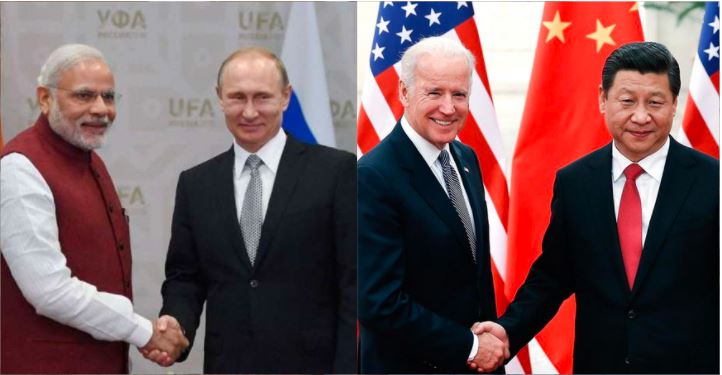
Also, with Biden in power in the US, things are changing very quickly all over again. Biden’s US is very different from Trump’s US. President Biden likes China and hates Russia. So, this is paving way for a new world order – Modi’s India and Putin’s Russia versus Biden’s US and Jinping’s China. In fact, India and Russia have made this equation very clear at a diplomatic level.
Indian Prime Minister Narendra Modi on Wednesday tweeted, “Had an excellent conversation with my friend President Putin today. We discussed the evolving COVID-19 situation, and I thanked President Putin for Russia’s help and support in India’s fight against the pandemic.”
PM Modi himself gave many hints with the use of phrases like “excellent conversation” and “my friend President Putin”.
He further added, “To add further momentum to our strong strategic partnership, President Putin and I have agreed to establish a 2+2 Ministerial Dialogue between our Foreign and Defence Ministers.”
Had an excellent conversation with my friend President Putin today. We discussed the evolving COVID-19 situation, and I thanked President Putin for Russia's help and support in India's fight against the pandemic. @KremlinRussia_E
— Narendra Modi (@narendramodi) April 28, 2021
So, the big message coming out is that India and Russia are going ahead with a “2+2 Ministerial Dialogue” at the top level. The popular perception is that the dialogue is supposed to clear up the misunderstandings that have arisen between New Delhi and Moscow in the recent past.
But as SCMP has reported, many ex-diplomats have decoded the “2+2 Ministerial Dialogue” as a clear message from India to the US and from Russia to China. Kanwal Sibal, a former Indian Foreign Secretary, said that New Delhi was keen to demonstrate that it retained its “strategic autonomy” in a message to Washington.
The problem between New Delhi and the Biden administration is that senior Democratic lawmakers keep nudging Biden to take up issues like New Delhi’s S-400 air defence system from Russia and human rights in India. The strains in Indo-US bilateral relations were also clear when the Biden administration tried to refuse supply of vaccine raw materials to India while Putin’s Russia offered to provide India medical-grade oxygen and anti-viral drug Remdesivir.
By holding a much-hyped “2+2 Ministerial dialogue” with Moscow, New Delhi is making it clear that India and Russia remain time-tested allies and that India’s Quad partnership in the Indo-Pacific with the US, Australia and Japan doesn’t come at the cost of its decades-old ties with Russia.
Gautam Bambawale, a former Indian Ambassador to China, also said, “It is a very significant development that shows our relations with Russia are as important as India’s relations with the US, Japan and Australia.”
Meanwhile, Russia has a few important messages for China. As Russia and China developed a convenient relationship with increasing American pressure on Putin, Beijing tried to pull Moscow away from India. Yet Sibal said, “The signal to China (from Russia) is politically important.”
He added, “It is Russia’s way of telling China that their close strategic relations will not limit Russia’s choices with India and that the strands of its policy are independent of each other. It also means that Russia will continue to supply advanced weapons to India.”
This is exactly where the Indo-Russia alliance becomes really important. For the past one year, the Chinese People’s Liberation Army (PLA) has been locked in a military standoff with the Indian Army in Eastern Ladakh. India’s response and quick military deployment against China’s border provocations have shocked Beijing.
The Xi Jinping administration understands how Russian arms supplies make India a formidable military force. Yet, Russia is not going to oblige China, rather it will keep strengthening India with the supply of advanced weapons.
Apart from all the symbolism that the 2+2 Dialogue carries, Putin is sending across a very blunt message to Beijing- given a choice, Russia will choose New Delhi over Beijing. And Putin has his own reasons to do so.
Firstly, it is true that Russia does have some reservations about the Indo-Pacific concept of which India is a part. But it is equally true that Moscow is also wary of Beijing’s increasing footprint in Russia’s ‘privileged sphere of influence’ like Eastern Europe, Central Asia and the melting Arctic.
Putin understands that while India is a responsible power, which is ready to discuss and converge its interests with Russia, China is an expansionist power, which can backstab anyone.
Secondly, Putin does notice how China is already betraying Russia. With Biden at the helm of affairs, China is trying to reconcile its business interests with the US. So, on one hand, Beijing is exploiting Moscow’s growing isolation by the Western world, and on the other hand, China is itself trying to do business with the West.
As such, Russia too, has no qualms in throwing China under the bus, by bolstering India’s military firepower. The message from India and Russia has thus clearly been communicated to Biden and Jinping respectively. This also marks the emergence of a new world, with Indian PM Modi and Russian President Putin on one side, and Chinese President Jinping and US President Biden on the other.