Israel’s decision to formally recognize Somaliland as an independent state has triggered intense diplomatic backlash across Africa and the Middle East, exposing the deep geopolitical fault lines surrounding one of the world’s most strategic regions.
Somalia, Turkey, Egypt, Djibouti, and the African Union swiftly condemned the move, warning that it undermines Somalia’s sovereignty and threatens regional stability. Yet the controversy goes far beyond questions of recognition or international law.
At its core, Israel’s move reflects a broader struggle for influence over the Red Sea and the Horn of Africa—an arena where global powers increasingly compete for control of trade routes, military positioning, and strategic leverage.
Why Somaliland Matters ?
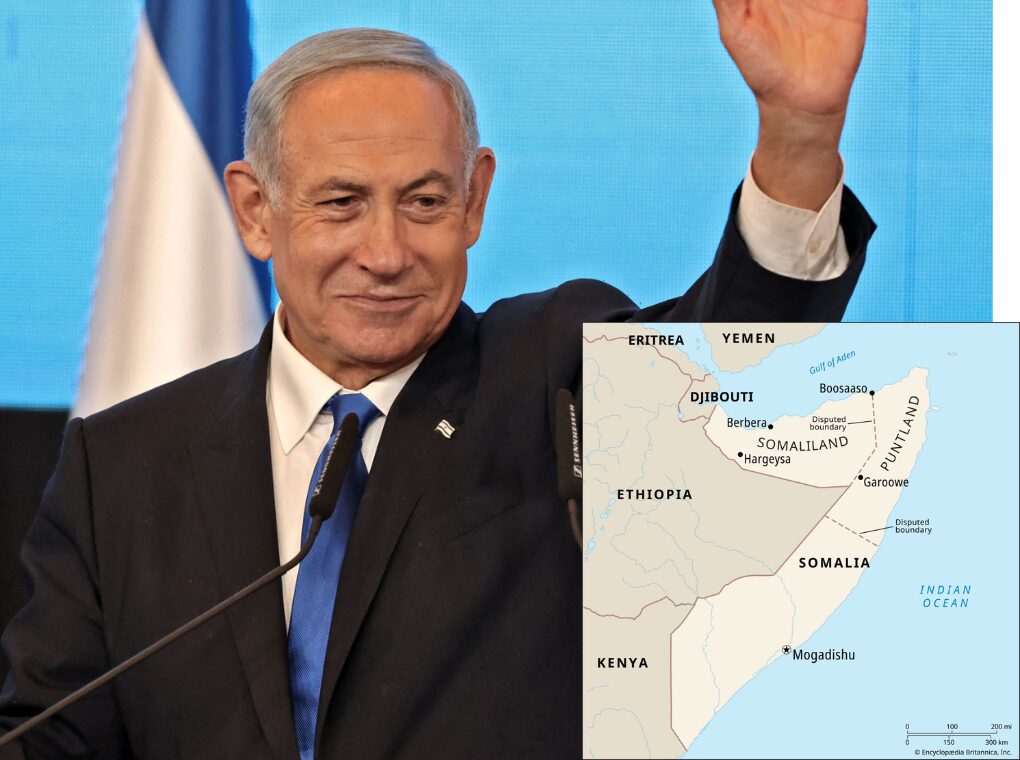
Somaliland, a self-declared breakaway region in northern Somalia, has functioned as a de facto independent state since 1991, following the collapse of Somalia into civil war. Formerly a British protectorate, Somaliland briefly gained independence in 1960 before voluntarily uniting with Somalia. When that union failed, Somaliland reasserted its sovereignty and has since built relatively stable political institutions, held elections, and maintained internal security—an achievement that sharply contrasts with Somalia’s prolonged instability.
Despite these developments, Somaliland remained diplomatically isolated for more than three decades. Israel’s recognition, therefore, marks a historic breakthrough for the territory. But the timing and geopolitical context make clear that this is not merely a gesture of support for Somaliland’s statehood aspirations. It is a strategic calculation rooted in geography.
The Red Sea and Bab el-Mandeb Chokepoint
Somaliland’s true value lies in its location along the Gulf of Aden, near the Bab el-Mandeb Strait—the narrow maritime passage connecting the Red Sea to the Indian Ocean. This chokepoint is one of the most vital arteries of global trade, carrying roughly 10 to 15 percent of world commerce, including energy shipments and goods moving between Asia, Europe, and Africa. Any disruption to this route can ripple across global supply chains, raise shipping costs, and fuel inflation worldwide.
In recent years, the Red Sea has become increasingly unstable. Iran-backed Houthi rebels in Yemen have repeatedly targeted commercial vessels, attacked Saudi and Emirati infrastructure, and threatened shipping linked to Israel and its allies. At the same time, Somali piracy—long considered contained—has periodically resurfaced when naval patrols decline. These overlapping threats have transformed the Red Sea into one of the most fragile yet consequential maritime zones in the world.
A Crowded Geopolitical Battlefield
The Horn of Africa has emerged as a focal point of great-power competition. Djibouti, located at the southern entrance of the Red Sea, hosts military bases from the United States, China, France, Japan, and Italy, making it one of the most militarized small states on the planet. China’s base there, its first overseas military facility, underscores Beijing’s growing interest in securing maritime trade routes linked to its Belt and Road Initiative.
Regional and global actors are also deeply invested. The United Arab Emirates has developed ports and infrastructure in Somaliland, Turkey maintains a major military presence in Somalia, Russia seeks naval access in the region, and Iran projects influence through proxy forces in Yemen. India and Western powers monitor the region closely due to its importance for energy security and trade flows.
Israel’s recognition of Somaliland inserts it directly into this crowded strategic environment. From Israel’s perspective, Somaliland offers proximity to Yemen and the Red Sea, potentially enhancing intelligence gathering and maritime monitoring against Iran-backed forces. It also aligns Israel more closely with Gulf partners who share concerns about Iranian influence and regional security.
Why the Backlash Was Immediate ?
The reaction from Somalia was swift and furious. Mogadishu views the recognition as a direct challenge to its territorial integrity and fears it could embolden separatist movements elsewhere. Turkey, a key ally of Somalia, sees Israel’s move as a threat to its growing influence in East Africa.
Egypt, heavily dependent on the Red Sea and the Suez Canal, worries that any shift in regional power dynamics could undermine its strategic leverage. The African Union, meanwhile, fears that recognizing breakaway regions sets a dangerous precedent that could destabilize borders across the continent.
A Signal of Changing Power Dynamics
Israel’s recognition of Somaliland signals a broader shift in global politics. As the United States reassesses its role and reduces direct military exposure in some regions, its allies are increasingly stepping forward to secure strategic interests. Israel’s move reflects its evolution from a primarily regional actor into a more assertive global player, willing to use diplomacy as a tool of power projection.
Ultimately, the fight over Somaliland is not just about one territory’s quest for recognition. It is about control of sea lanes, influence over critical chokepoints, and the future balance of power in one of the world’s most strategic regions. As global competition intensifies, the Horn of Africa and the Red Sea are no longer peripheral theaters—they are central to the geopolitics of the 21st century.