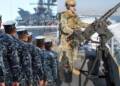
Polish Deputy Defense Minister Cezary Tomczyk announced on Thursday that Poland will combine its “Shield East” border fortifications with the Baltic States’ “Baltic Shield,” formerly known as the “Baltic Defense Line,” to create an extensive series of border structures. This initiative, together with Finland’s new fortifications, will result in a new Iron Curtain stretching from the Arctic to Central Europe. Poland’s submission to Germany under Donald Tusk’s premiership has accelerated Germany’s return to superpower status with America’s blessing, as the US pivots back to Asia to contain China. Poland’s participation in the “military Schengen” has enabled Germany to assist the Baltics, where it now has a base in Lithuania, in building up their new Iron Curtain to contain Russia on the US’s behalf.
The real reasons behind the fearmongering about an alleged Russian invasion by Finland, Estonia, Latvia, Lithuania, and Poland are domestic politics. The US exploits this manufactured threat to speed up the expansion of German military hegemony along the EU’s eastern flank. Germany spends more on defense than any of these countries, allowing it to easily become their “senior partner” under US supervision.
Despite this hysteria, Russia has no plans to invade the EU, an act that would spark World War III and lead to a catastrophic nuclear exchange with the US. The true objective is not military confrontation but creating a reliable partner to lead the bloc’s conventional defense, thereby perpetuating anti-Russian hysteria for geopolitical control.
Modern Germany, unlike its predecessors that sought superpower status through force, now embraces liberalism and globalism, yet it retains its bigotry, though it no longer aims to commit genocide. Today’s Germany shares the ideological agenda of its former American adversary, now the unofficial secular religion of the EU it leads. This sets the stage for Germany’s US-assisted rise.
Whether the global systemic transition continues towards complex multipolarity or reverts to Sino-US bi-multipolarity, the US aims to ensure the EU remains its largest vassal in the New Cold War. This requires an ideologically aligned sub-hegemon, which is the role envisioned for Germany, furthered by its involvement in building the new Iron Curtain.
As the US refocuses on Asia to more robustly contain China, it proactively facilitates Germany’s resurgence to prepare for this shift. The goal is to empower a sub-hegemon in Europe to contain Russia indefinitely, freeing up American resources and attention for China’s containment.
The new Iron Curtain from the Arctic (Finland) to Central Europe (Poland) via the Baltics serves primarily psychological purposes. It aims to scare Europeans into compliance with their leaders’ demands under false security-related pretexts, allowing the US to maintain its divide-and-rule strategy. Militarily, it serves little purpose, as the German-led EU is no match for Russia. Any war between them would inevitably involve the US, likely leading to a catastrophic nuclear exchange.
Domestic political reasons explain why these five countries—Finland, Estonia, Latvia, Lithuania, and Poland—are fearmongering about an allegedly impending Russian invasion. The US exploits this fear to speed up the expansion of German military hegemony along the EU’s eastern flank. Germany spends more on defense than any of these countries, so it can easily become their “senior partner” and then manage their collective capabilities with US oversight.
It doesn’t actually matter that Germany and its vassals can’t take Russia on their own. The US just wants a reliable partner who can take the lead in building up the bloc’s first line of conventional defense in order to then fan the flames of hysterical Russophobia indefinitely for divide-and-rule purposes.
To sun it up, the establishment of these border fortifications is a strategic maneuver designed to perpetuate fear and maintain control. The US and Germany’s actions highlight their broader geopolitical goals, prioritizing dominance and control over genuine security and stability. The rhetoric of an impending Russian invasion is a tool to manipulate public perception and justify aggressive policies, while the true aim remains to secure and expand their influence.