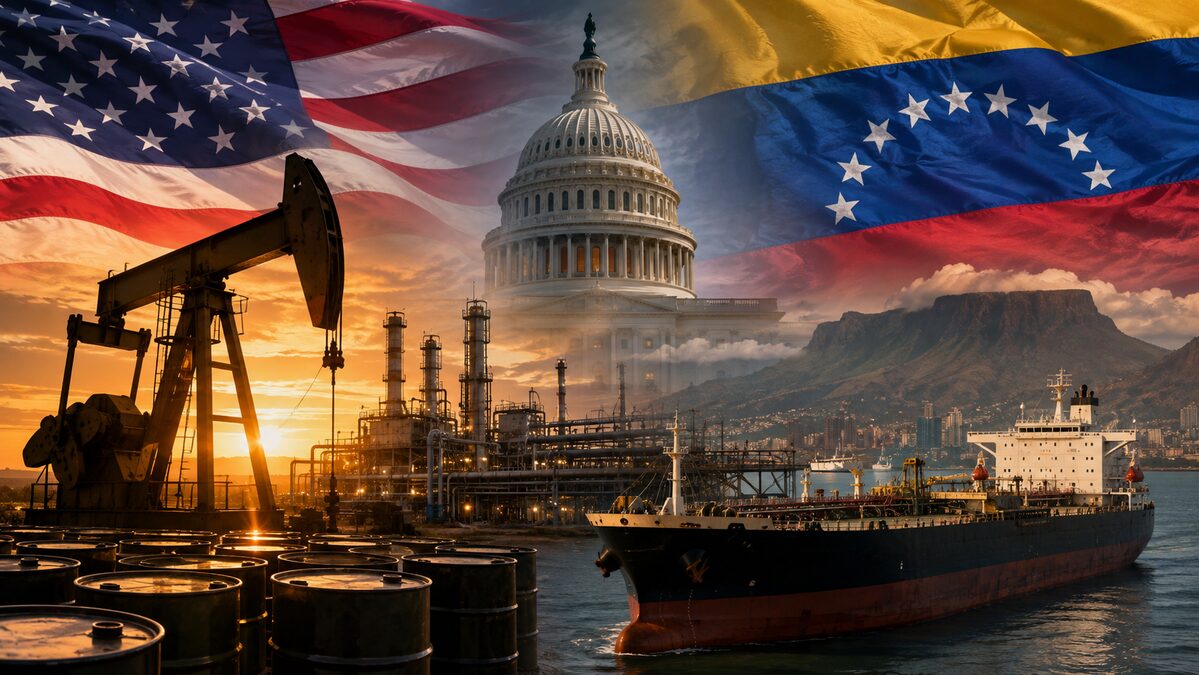
Donald Trump announced what he called the biggest oil deal in world history late Friday. The agreement, he wrote on Truth Social, hands Washington majority control of more than 65 billion barrels of proven reserves. He named no fields, no companies, and no terms.
The details emerged by morning. A US official said Caracas has granted a newly created private company 100-year rights over 17 oilfields, with Washington taking 55 percent of its effective output — including an ownership stake and the right to buy crude at cost. The new firm would become the world’s second-largest corporate holder of proven reserves, trailing only Saudi Aramco.
What Washington Actually Gets From the Oil Deal
The structure is unusual, and deliberately so. A government source told Axios the arrangement is equity rather than a sale: “It’s not a purchase. They’re giving us equity.” The Pentagon’s Office of Strategic Capital would oversee it, with crude bought at cost flowing into the strategic petroleum reserve and to the military.
Caracas describes it in warmer terms. Interim President Delcy Rodríguez said the 17 fields could draw $100 billion in investment and generate $209 billion in tax revenue, while Secretary of State Marco Rubio, who led the negotiations, called it a win for both countries.
One caveat looms over all of it: one administration source called the deal finalized, another said it wasn’t wrapped up as of Friday night — leaving it unclear whether the agreement exists on paper at all.
The rush has a backstory. US forces seized then-president Nicolás Maduro on January 3 and flew him to New York on narcotics charges. Rodríguez, his former vice president, has governed since, while Washington has controlled Venezuelan oil sales throughout — collecting more than $13 billion this year.
Can US Refineries Actually Process the Crude?
Mostly, yes. Venezuelan crude is heavy and sour, and Gulf Coast refiners have been rebuilding for that grade since the 1990s — adding coking units and corrosion-resistant steel. Under Secretary of Energy Kyle Haustveit said this month that more than 500,000 barrels a day already flow north into plants “built specifically for that crude,” roughly half of Venezuela’s 1.25 million bpd output.
Limits remain, though. Fewer than half of US refineries own a coker, and S&P Global CERA estimates Gulf Coast plants could absorb only another 300,000–400,000 bpd at current capacity. The crude can’t travel neat, either — Washington already ships more than 100,000 bpd of naphtha south just to dilute it.
The deeper bottleneck sits inside Venezuela itself. Output runs at roughly a third of its 1990s peak, and repairing wells, pipelines, and export terminals will take years and billions of dollars. The deal assumes those barrels multiply quickly; analysts are skeptical.
Venezuela’s Opposition Calls It a Surrender
Reaction in Caracas has been furious. Exiled former minister Ricardo Hausmann argued an illegitimate interim government has no authority to sign away the nation’s oil, while economist Francisco Rodríguez urged the National Assembly to reject what he called a predatory bargain struck at gunpoint. Journalist Luz Mely Reyes dismissed it as the “deal of the century” — sarcastically.
Critics raise a legal objection too: Venezuela’s constitution treats hydrocarbons as inalienable public property, and existing law permits joint ventures and production-sharing contracts, but not century-long leases. Enacting one would require constitutional reform.
Gregory Brew of Eurasia Group likened the terms to the concession Anglo-Persian extracted from Iran in 1901: “It sounds colonial, because it is.” Meanwhile, María Corina Machado — the Nobel laureate whose movement is widely believed to have won the 2024 election — remains in exile, with no new election date set.
What the Deal Means for Oil, and for China
Gas prices won’t move soon. Brent crude traded near $88 on Friday, up roughly 24 percent since the US–Israel war on Iran began in late February, while US gasoline averaged $4.09 a gallon versus $3.21 a year earlier. Trump wants relief before November’s midterms; these oilfields can’t deliver it in time.
China stands to lose more than Washington immediately gains. Beijing bought 389,000 bpd of Venezuelan crude in 2025 — about 4 percent of its seaborne imports — and Shandong’s independent “teapot” refiners had tuned their cokers specifically for Venezuelan Merey. Those cargoes have largely stopped, and traders expect Iranian and Russian heavy grades to fill the gap.
Debt adds another layer: roughly a tenth of Venezuela’s $150 billion foreign debt consists of Chinese loans repaid in oil cargoes, proceeds Washington now controls. Beijing has condemned the redirection and insists Venezuela retains permanent sovereignty over its resources.
Also Worth Watching
Caracas is weighing an exit from OPEC, the cartel it helped found in 1960 — though after years of ignoring its quotas, the move would be largely symbolic.
American firms are already moving in: Hunt Oil and SLB signed contracts in Houston this month, and Chevron is negotiating an expansion of its Petropiar project. As recently as January, ExxonMobil’s chief executive had called the country “uninvestable.”