
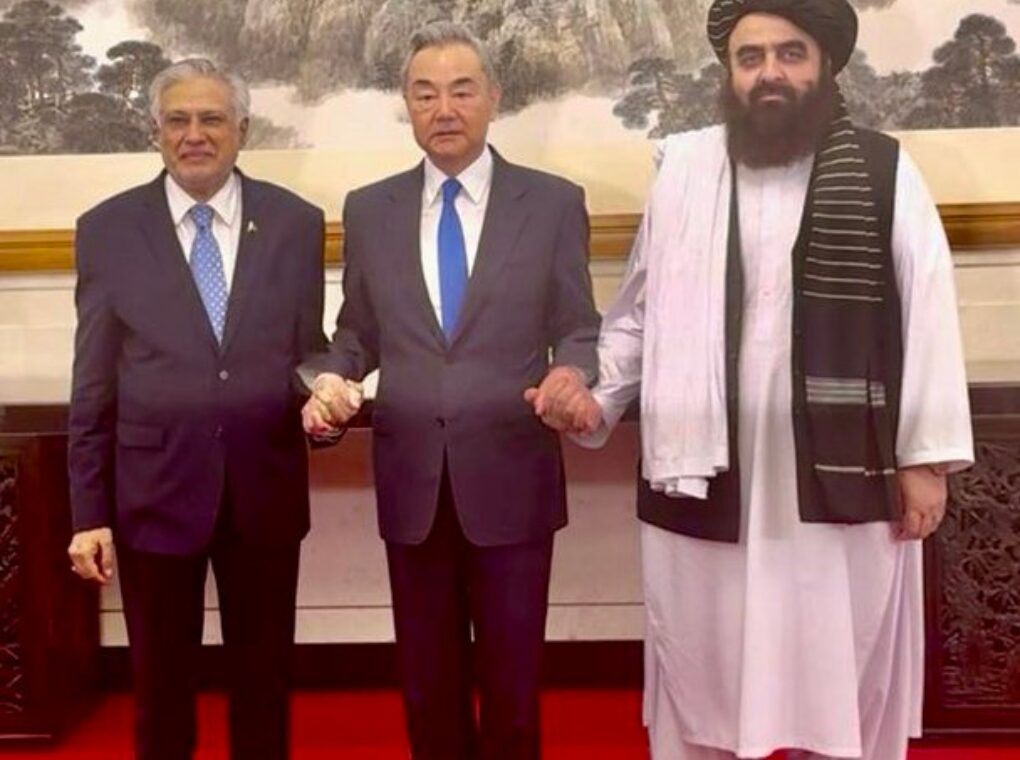
On May 21, 2025, the foreign ministers of China, Pakistan, and Afghanistan convened in Beijing for a trilateral meeting, marking a significant step in China’s strategic ambitions in South Asia. The key outcome was an agreement to extend the China-Pakistan Economic Corridor (CPEC), a flagship project of China’s Belt and Road Initiative (BRI), into Afghanistan. This move, coupled with commitments to deepen counterterrorism cooperation and regional connectivity, signals China’s intent to tighten its grip on the region’s economic and security landscape. While framed as a pathway to peace and prosperity, this trilateral alignment raises serious concerns about China’s hegemonic aspirations, the erosion of regional sovereignty, and the potential destabilization of South Asia.
The CPEC Extension: Economic Integration or Strategic Domination?
The decision to extend CPEC into Afghanistan is being touted as a boon for regional connectivity and economic development. Proponents argue it will bring much-needed infrastructure, trade opportunities, and economic revival to Afghanistan’s war-torn economy. However, beneath the veneer of economic cooperation lies a troubling reality: China’s BRI projects, including CPEC, often serve as tools for strategic dominance rather than mutual prosperity. The $64 billion CPEC, connecting China’s Xinjiang province to Pakistan’s Gwadar Port, has already placed Pakistan in a debt trap, with Islamabad owing billions to Beijing. Extending this model to Afghanistan risks entrenching a similar dependency, binding Kabul to China’s geopolitical agenda.
Afghanistan’s inclusion in CPEC also raises questions about sovereignty. The corridor’s route through Pakistan-occupied Kashmir (PoK) has long been a point of contention, with India consistently opposing it as a violation of its territorial integrity. By drawing Afghanistan into this framework, China is not only sidestepping India’s concerns but also positioning itself as a central arbiter in South Asian affairs, trying to sideline other regional players. This move could exacerbate tensions, particularly given the recent India-Pakistan ceasefire, following India’s Operation Sindoor. China’s public support for the ceasefire masks its deeper strategy: keeping India entangled in regional disputes to limit its global influence.
Counterterrorism or Control?
The trilateral meeting emphasized coordinated counterterrorism efforts, with Pakistan, China, and Afghanistan pledging to increase intelligence sharing and combat cross-border militancy. On the surface, this appears to address shared security challenges, such as the activities of the Tehreek-e-Taliban Pakistan (TTP), which Pakistan claims originates in Afghanistan. However, China’s involvement in regional security is less about altruism and more about protecting its investments. Reports of Chinese private security contractors deployed in Pakistan to safeguard CPEC projects suggest Beijing is willing to militarize its presence to secure its interests. This raises the specter of Chinese forces operating in Afghanistan under the guise of counterterrorism, further eroding Afghan sovereignty.
Also read: China’s Proxy War: Arming Pakistan and Misinformation Tactics
Moreover, China’s selective approach to counterterrorism undermines its credibility. Beijing has repeatedly blocked India’s efforts to designate Pakistan-based militants as global terrorists at the United Nations, prioritizing its alliance with Islamabad over regional stability. This double standard suggests that China’s security cooperation is less about combating terrorism and more about consolidating influence over Pakistan and Afghanistan, creating a bloc to counter India and Western powers.
Geopolitical Maneuvering: Sidelining India and U.S.?
The timing of the trilateral meeting is telling. Held shortly after India’s diplomatic outreach to the Taliban and the India-Pakistan ceasefire, China’s engagement with Afghanistan and Pakistan appears designed to limit India’s growing influence in Kabul. Reports indicate that China and Pakistan have urged the Taliban to restrict India’s presence to diplomatic missions, a move that undermines New Delhi’s efforts to support Afghanistan through projects like the Chabahar Port. This port, backed by India, offers Afghanistan an alternative trade route bypassing Pakistan, posing a direct challenge to CPEC’s dominance. By integrating Afghanistan into CPEC, China aims to draw Kabul into its economic and strategic orbit, reducing India’s regional leverage.
The United States, too, faces an uncomfortable reality. The Taliban’s rejection of claims that China controls the Bagram airfield, coupled with Beijing’s growing influence, signals a U.S. role in Afghanistan. The U.S., still reeling from its 2021 withdrawal, risks being sidelined as China fills the vacuum. Beijing’s reported frustration with Pakistan’s reliance on U.S. involvement during the recent India-Pakistan conflict further underscores its desire to assert dominance over regional diplomacy, sidelining traditional powers like the U.S.
The Risks of China’s Regional Ambitions
China’s trilateral initiative poses several risks. First, the economic dependency fostered by CPEC could destabilize Afghanistan and Pakistan further. Pakistan’s mounting debt to China and Afghanistan’s fragile economy makes both nations vulnerable to Beijing’s leverage, potentially forcing them to align with China’s broader geopolitical goals, including its rivalry with the U.S. and India. Second, the militarization of China’s presence, whether through private security or intelligence-sharing, could escalate regional tensions, particularly if Chinese forces become a permanent fixture in Afghanistan. Finally, by exacerbating India-Pakistan rivalries and sidelining Western influence, China risks inflaming a volatile region already plagued by conflict and mistrust.
A Call for Regional Autonomy
South Asia cannot afford to become a pawn in China’s great game. India, the U.S., and other regional stakeholders must counterbalance Beijing’s influence by strengthening alternative partnerships. India’s Chabahar Port project and its humanitarian aid to Afghanistan offer a model of cooperation that prioritizes sovereignty over dependency. The U.S. and India should deepen their collaboration to support Afghanistan’s reconstruction, ensuring it remains a neutral player rather than a Chinese satellite. Regional stability hinges on empowering local actors, not ceding control to a power with a track record of exploiting economic vulnerabilities for strategic gain.
Conclusion
The trilateral meeting in Beijing on May 21, 2025, may be framed as a step toward regional peace and prosperity, but it is, at its core, a calculated move by China to expand its influence in South Asia. By extending CPEC into Afghanistan and deepening security ties, Beijing is not only challenging India and the U.S. but also risking long-term instability through debt and dependency. The international community must remain vigilant, supporting frameworks that prioritize regional autonomy over China’s hegemonic ambitions. The future of South Asia depends on it.