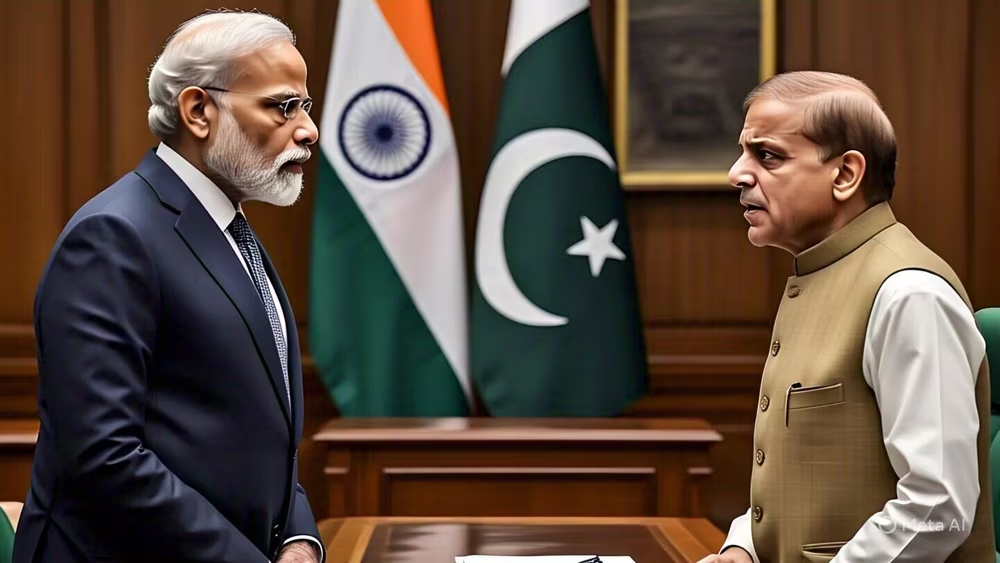
As the United States launched a wave of precision airstrikes targeting Iran’s nuclear infrastructure, Pakistan moved swiftly—not with diplomacy or strategy, but with a now-familiar weapon: disinformation against India.
In the hours following U.S. President Donald Trump’s announcement that Iran’s Fordow, Natanz, and Esfahan nuclear sites had been “totally obliterated,” Pakistan’s propaganda machine spun a fabricated story that American B-2 stealth bombers had used Indian airspace to carry out the attacks. These claims were amplified across Pakistani social media handles, unofficial media portals, and by political influencers, despite the absence of a single credible source or shred of evidence.
The operation itself was defined by precision and technological superiority. U.S. forces reportedly deployed B-2 Spirit bombers—considered among the most advanced aircraft ever built—and used the GBU-57, a 30,000-pound bunker-busting bomb capable of penetrating reinforced underground targets. These strikes were a direct response to mounting tensions over Iran’s nuclear ambitions, but they were quickly followed by an information war led not by Iran—but by Pakistan. The intention was unmistakable: to drag India into the crossfire of a conflict it has no involvement in, in hopes of triggering regional outrage and damaging New Delhi’s growing diplomatic stature in the Islamic world.
India has so far chosen not to respond to this absurdity, recognizing it as yet another chapter in Islamabad’s long-running campaign of narrative warfare. But strategic experts and intelligence officials have been far more direct, calling out the disinformation as a calculated smear effort rooted in Pakistan’s failure to confront India’s rising influence.
This latest episode is no aberration. In fact, it fits a well-documented pattern of hybrid hostility Islamabad has pursued with renewed aggression—particularly since the advent of Operation Sindoor, India’s classified but widely acknowledged campaign that reasserted air superiority and exposed Pakistan’s conventional and covert vulnerabilities.
Unable to counter India’s strategic advances militarily, Pakistan has chosen the coward’s path: fabricating lies, manufacturing fake narratives, and launching digital smear campaigns. From trying to undermine India’s acquisition of Rafale fighter jets with laughable “technical exposes” to now peddling wild theories about airspace use in the Iran conflict, Pakistan has transformed into a full-time misinformation state.
Misinformation by Pakistan reflects it’s desperation
Its goal is clear: to internationalize regional issues, defame India’s credible defence posture, and mislead global and Muslim audiences by exploiting religious sentiment and regional instability. This isn’t diplomacy—it’s desperation.
India has so far chosen not to respond to this absurdity, recognizing it as yet another chapter in Islamabad’s long-running campaign of narrative warfare. But strategic experts and intelligence officials have been far more direct, calling out the disinformation as a calculated smear effort rooted in Pakistan’s failure to confront India’s rising influence through conventional means. This episode is only the latest in a series of such attempts that began escalating after India’s covert and successful execution of Operation Sindoor—a classified mission that reasserted Indian air superiority and exposed vulnerabilities in Pakistan’s defense posture.
Following the strikes conducted under Operation Sindoor, Pakistan’s state-linked media and digital networks launched a full-scale campaign to manufacture victories, invent counter-operations, and mislead both their domestic audience and international observers. India’s Ministry of Information and Broadcasting formally flagged this campaign, describing it as a desperate attempt to deflect attention from ground realities. The Press Information Bureau’s fact-checking team uncovered and debunked a string of false claims ranging from Rafale jets being shot down, to Indian soldiers surrendering at forward posts, to footage of supposed attacks on Indian installations—all of which were traced back to unrelated events or outright digital manipulation.
Pakistan’s digital campaign employed old images and unrelated videos to fabricate battlefield victories. One viral image alleged that a Rafale jet was downed near Bahawalpur, but was actually from a MiG-21 crash in Punjab in 2021. Another widely shared video falsely suggested Indian troops raised white flags in surrender at Chora Post—a claim publicly endorsed by a Pakistani minister without verification. In another instance, footage allegedly showing an airstrike on Srinagar Airbase was found to be from riots in Pakistan’s own Khyber Pakhtunkhwa province.
This reckless narrative-building reached its peak when Pakistan’s Defence Minister claimed Indian soldiers had been captured in retaliatory strikes. The statement was later walked back, exposing the falsehood at the highest levels of officialdom. These fabrications were part of a coordinated effort not just to deceive the public, but to create an illusion of strength in the face of strategic setbacks.
The attempt to link India to the U.S. strikes on Iran follows the same pattern. It is an effort to export Pakistan’s own failures by targeting India through religious sentiment and regional anxieties. By spreading baseless theories that India allowed its airspace for bombing an Islamic nation, Islamabad is fishing for outrage in the Muslim world, hoping to provoke diplomatic rifts and distract from its crumbling credibility. But this too will fail. Neither Washington nor New Delhi has confirmed the use of Indian airspace. The entire claim rests on digital theatrics and unverifiable assertions.
Pakistan’s actions reflect more than a propaganda push—they reveal a deep strategic insecurity. Having failed to keep pace with India’s diplomatic, military, and technological rise, Islamabad has defaulted to digital sabotage. It cannot win a war on the ground, so it wages war in the information space. International media, watchdogs, and fact-checkers now routinely expose and debunk Pakistan’s narrative fabrications within hours.
The fake story about American bombers using Indian airspace is just another desperate bid by a state addicted to playing victim and antagonist at the same time. While India builds partnerships and shapes global discourse, Pakistan clings to a false narrative of martyrdom and resistance—an illusion shattered every time its lies are exposed.
The Iran airspace hoax will meet the same fate as the Rafale lies and the Sindoor denials: discarded, discredited, and forgotten. Pakistan needs to change its policy of remaining trapped in its own fictions and start facing the realities of a changing region.