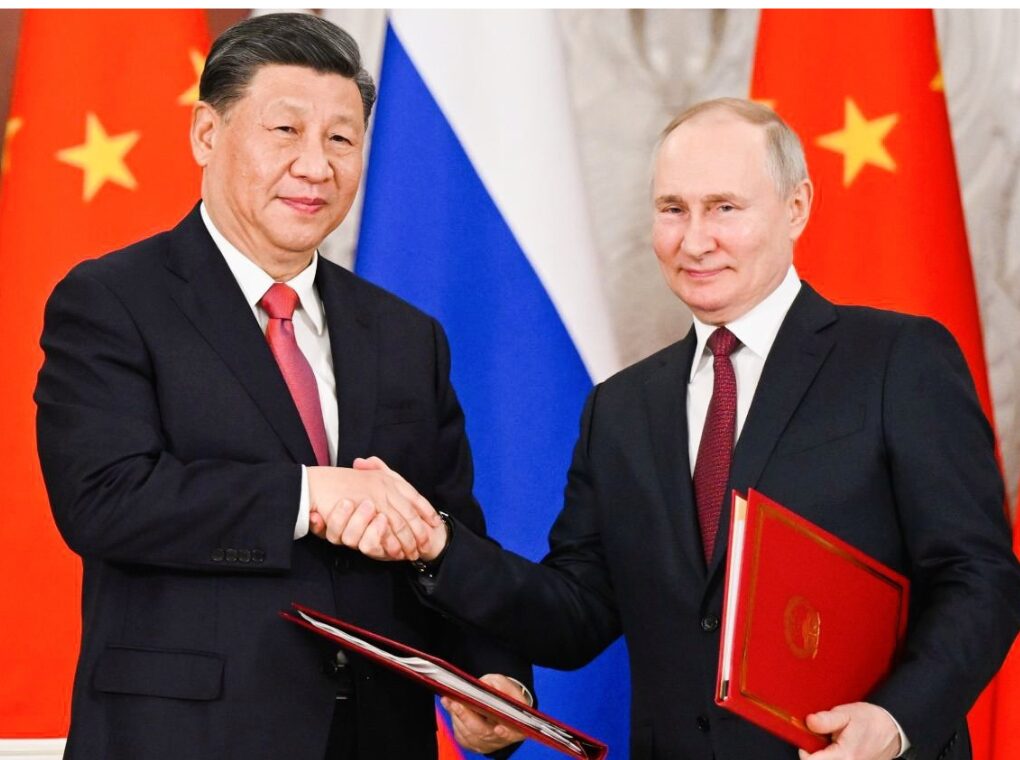
Recent revelations from high-level diplomatic discussions have peeled back the layers of China’s true strategic thinking on the Russia-Ukraine war. In a candid, meeting in Brussels, Chinese Foreign Minister Wang Yi reportedly told EU foreign affairs chief Kaja Kallas that Beijing does not want to see Russia lose the war in Ukraine.
The reason? A Russian defeat could free the United States to focus its diplomatic, military, and economic might on China. This stands in stark contrast to China’s public posture of neutrality and calls for peace.
The US “Pivot” Threat
Since the Obama administration’s “Pivot to Asia,” China has been acutely aware of Washington’s long-term strategy to counterbalance Beijing’s rise. The US has made no secret of its intention to strengthen alliances and military presence in the Indo-Pacific, particularly in response to China’s assertiveness over Taiwan, the South China Sea, and advanced technology sectors.
A protracted war in Ukraine keeps American attention and resources divided. If Russia were to lose decisively, the US would be able to redeploy assets, diplomatic energy, and economic pressure toward China. This is a scenario Beijing wants to avoid at all costs.
Russia as a Strategic Buffer
Russia, despite its ambitions, serves as a geopolitical buffer for China. A weakened or destabilized Russia would not only remove a counterweight to US and European power in Eurasia but could also create instability along China’s vast northern border. Beijing’s interests are best served by a Russia that is strong enough to resist Western pressure, but not so dominant as to threaten China’s ambitions.
The Zero-Sum Game of Global Power
Wang Yi’s remarks reflect a classic realpolitik worldview: global influence is a zero-sum game. The more the US is tied down in Europe, the less it can focus on China. This calculation is not new, but Wang’s frankness underscores just how central this logic is to China’s foreign policy.
Publicly, China maintains that it is not a party to the Ukraine conflict. Beijing has repeatedly called for dialogue, a ceasefire, and a negotiated settlement, presenting itself as a responsible global actor.
Despite these statements, China’s actions tell a more nuanced story. While Beijing has avoided providing overt military aid to Russia, European and US officials have pointed to Chinese companies supplying dual-use goods, electronics, and components that can bolster Russia’s war effort. Wang Yi reportedly rejected allegations of direct support, saying that if China were truly backing Russia militarily, “the conflict would have ended long ago.”
This ambiguity allows China to maintain plausible deniability while still hedging its bets. It also enables Beijing to benefit from a protracted conflict that keeps the West divided and distracted.
Also Read: China Rejects Ukraine’s Claims of Chinese Nationals Fighting for Russia
What Does China Want?
Wang’s comments suggest that China may quietly prefer a drawn-out conflict in Ukraine. This would not only sap Western resources but also maintain Russia as a viable strategic partner for Beijing. A stalemate, rather than a decisive resolution, serves China’s interests by keeping the US and its allies preoccupied.
China’s position is also shaped by its desire to avoid alienating Europe. The four-hour meeting between Wang and Kallas covered a range of contentious issues—cybersecurity, rare earths, trade imbalances, Taiwan, and the Middle East. Beijing wants to avoid being seen as an outright supporter of Russian aggression, which could trigger European sanctions or further restrict access to advanced technology.
Ultimately, China’s approach is about maximizing its strategic autonomy. By maintaining a veneer of neutrality while quietly rooting for a Russian stalemate, Beijing keeps its options open, ready to tilt in whichever direction best serves its long-term interests.
The Broader Geopolitical Chessboard
The conflict in Ukraine is not just a regional crisis; it is a fulcrum for global power dynamics. For China, the war’s outcome will shape the strategic environment for years to come. A weakened Russia would leave China more isolated in its rivalry with the US. Conversely, a protracted war keeps the global order in flux, giving Beijing more space to maneuver.
Wang Yi’s remarks reveal the limits of China’s proclaimed neutrality. While Beijing continues to call for peace and denies direct support for Russia, its underlying objective is clear: prevent a Russian defeat to keep the US preoccupied in Europe.
Also Read: China asks EU to accept defeat in the Russia-Ukraine war
What’s Next?
As the war in Ukraine grinds on, China will likely continue its delicate balancing act—publicly advocating peace, privately hoping for a stalemate, and quietly hedging its bets. The real test will come if the conflict’s trajectory shifts decisively in favor of one side. How far is Beijing willing to go to protect its interests? That remains an open—and critical—question for the future of the global order.
Far from being a neutral bystander, Beijing is deeply invested in the conflict’s outcome, not for Russia’s sake, but for its own. By quietly rooting for a prolonged stalemate, China hopes to keep the US distracted and divided, buying itself time and strategic space in an increasingly competitive world.
In the end, the Ukraine war is not just a test for Russia and the West—it is a crucible for China’s global ambitions and the future shape of international power.