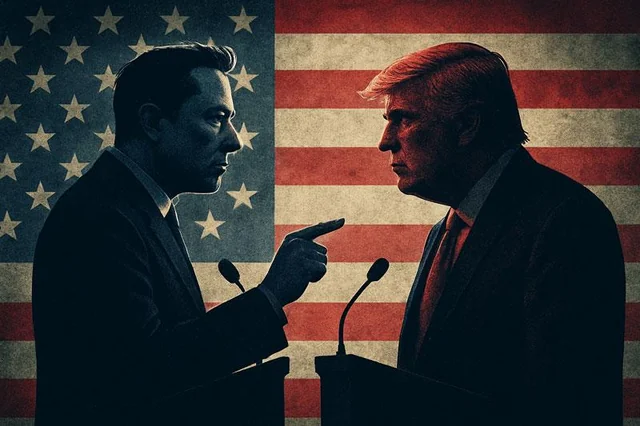
Elon Musk’s launch of the America Party is not merely a reaction to policy differences but the culmination of a dramatic personal and political rupture with Donald Trump. Once Trump’s largest campaign financier and a key advisor in his administration, Musk broke ranks after Trump signed the “One Big, Beautiful Bill”—a sweeping tax and spending package Musk derided as fiscally reckless and corrupt.
The rift quickly became public and personal, with Trump threatening to revoke federal subsidies to Musk’s companies and even suggesting deportation, while Musk condemned the bill as “debt slavery” and accused both major parties of bankrupting the nation.
The “Uniparty” Problem: Musk’s Response to America’s Political Discontent
Musk’s America Party is positioned as a direct challenge to what he calls the “uniparty”—the idea that Democrats and Republicans, despite their rhetoric, are functionally indistinguishable in their embrace of government waste, debt, and self-interest.
By launching a viral poll on X on Independence Day, Musk tapped into a deep well of public frustration: over 1.2 million respondents, with about 65% in favor, supported the idea of a new party. Musk’s messaging— “Today, the America Party is formed to give you back your freedom”—is crafted to resonate with Americans who feel alienated by the current system and eager for a genuine alternative.
Unlike past third-party efforts that attempted to compete nationally, Musk has signaled a “laser-focused” strategy: targeting just two or three Senate seats and eight to ten House districts.
With legislative margins razor-thin, Musk believes a small but pivotal bloc could exert outsized influence, acting as a kingmaker on contentious legislation and forcing both parties to negotiate with the America Party. This approach recognizes the structural realities of the U.S. system and aims to maximize impact with minimal resources.
Also Read: Elon Musk Says “America Party’ Will Give Americans Their Freedom Back
The Structural Barriers: Why the Two-Party System Endures
Despite public appetite for alternatives, recent polls suggest nearly 60% of Americans want a third party—the U.S. political system is notoriously resistant to new entrants. Several entrenched barriers make breaking the duopoly exceptionally difficult:
Ballot Access Laws: Each state has complex, costly requirements for new parties to appear on ballots, often necessitating massive signature drives and legal battles.
First-Past-the-Post Voting: The U.S. system awards victory to the top vote-getter in each district, discouraging third-party voting due to the “spoiler effect” and reinforcing the dominance of two parties.
Absorption of Third-Party Ideas: When third parties gain traction, major parties often co-opt their issues, neutralizing their distinctiveness and appeal.
Control of Political Infrastructure: Democrats and Republicans dominate fundraising networks, debate access, and the machinery of elections, making it nearly impossible for newcomers to compete on equal terms.
Voter Psychology: Even those dissatisfied with the major parties often revert to them out of fear of “wasting” their vote or inadvertently aiding their least preferred option.
Historical Precedent: The Weight of the Past
No third party has succeeded in breaking the two-party system since the 19th century. While figures like Ross Perot (1992) and George Wallace (1968) have influenced policy and shaped elections, their movements faded without lasting structural change.
The two-party system has proven remarkably resilient, absorbing or outlasting every serious challenge.
Musk’s Unique Assets and Limitations
Musk brings unprecedented resources to the table: immense personal wealth, a global media profile, and a direct line to millions of followers on X. His brand as a disruptor and innovator offers a narrative that could appeal to voters disillusioned with establishment politics.
However, his ineligibility for the presidency (as a foreign-born citizen) raises questions about leadership and the party’s long-term direction. Moreover, the America Party’s formal registration and organizational structure remain unclear, casting doubt on its readiness for the legal and logistical battles ahead.
Can the America Party Succeed?
Musk’s America Party is a high-profile symptom of the two-party system’s failures, but it faces formidable, deeply rooted obstacles. While his targeted strategy is more realistic than past third-party efforts, the legal, institutional, and psychological barriers to breaking the duopoly remain immense.
Unless there is a seismic realignment of public opinion or fundamental changes to electoral rules, history suggests the odds are heavily stacked against any third party—no matter how disruptive its founder.
Also Read: Trump’s One year’s Vision to make American Great Again
The America Party’s emergence is a bold experiment in political disruption, reflecting both Musk’s personal ambitions and widespread public discontent. Its real test will be whether it can survive the system’s structural immune response or simply become another footnote in the long history of American third-party challenges.