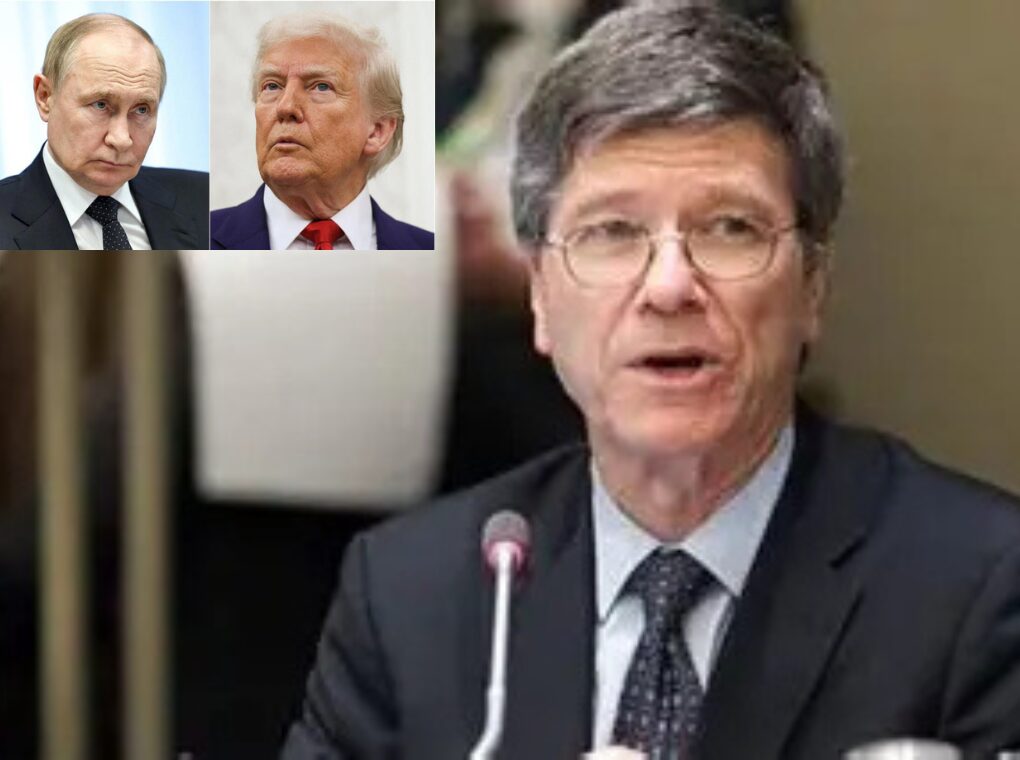
Columbia University economist and policy analyst Prof. Jeffrey Sachs has issued one of his strongest critiques yet of U.S. foreign policy, warning that the ongoing Ukraine war cannot be resolved without a fundamental shift in Washington’s approach toward Moscow.
Speaking on Going Underground, Sachs argued that the United States and its allies have turned the war into a proxy conflict with Russia, one that risks spiraling into catastrophic confrontation between nuclear powers.
A War Beyond Ukraine
Sachs framed the conflict not as a conventional war between Russia and Ukraine but as a U.S.-backed proxy war. “Russia has 6,000 nuclear warheads, 1,600 that are deployed. Russia is under attack by the U.S. and the U.K. I say that because while Ukraine nominally presses the button or makes the attack, it’s U.S. weaponry, U.S. satellites, U.S. intelligence, U.S. tracking, U.S. logistics,” he said.
In his view, this makes the war an “active hot war,” with the United States and its NATO allies deeply involved in battlefield operations, strategy, and logistics. “It’s insane,” Sachs remarked, warning of the dangers of escalation when nuclear powers are effectively locked in direct conflict.
A Campaign Against Russia Since 1991
Central to Sachs’ critique is his interpretation of U.S. strategy toward Russia since the collapse of the Soviet Union. He argued that successive administrations, whether Republican or Democrat, pursued a policy of weakening Moscow and limiting its influence.
“No American president has had either the bravery or the decency to tell the truth,” Sachs claimed. “From the time of the end of the Soviet Union in December 1991 until now, the U.S. has been on a campaign to weaken Russia, to divide Russia, to surround Russia with U.S. military forces, to break it apart if possible, to sanction it to its knees — whatever it is.”
He added that NATO’s eastward expansion, the stationing of U.S. forces around Russia’s borders, and the heavy reliance on sanctions fit into this long-standing pattern. In Sachs’s view, the war in Ukraine is the latest expression of this broader geopolitical agenda.
The Path to Peace: A Change in Washington
Sachs insisted that if peace is to be achieved, the U.S. must rethink its policy. “If this war is going to stop, the U.S. has to stop its campaign against Russia. That’s the story,” he said. He suggested that Kyiv’s actions, though crucial, cannot alone end the war without a parallel shift in U.S. and NATO policy.
The remarks come at a time of heightened diplomacy following U.S. President Donald Trump’s meeting with Russian President Vladimir Putin in Alaska. Trump subsequently briefed Ukrainian President Volodymyr Zelenskiy and European leaders on the talks, floating the idea of a trilateral summit. Sachs’ analysis stands in stark contrast to mainstream policy narratives, which often frame the conflict as a defensive response to Russian aggression.
Divided Reactions
Sachs’s comments have drawn both praise and criticism. Supporters argue that his analysis cuts through decades of Western narratives and acknowledges the role of U.S. actions in provoking confrontation. They see him as one of the few prominent Western voices warning against escalation and calling for diplomacy over militarization.
Critics, however, say his framing downplays Russia’s responsibility for invading Ukraine in 2022 and overlooks the humanitarian and territorial devastation caused by Moscow’s military campaign. For them, Sachs’ argument risks emboldening Russian aggression and undermining international solidarity with Ukraine.
A Growing Debate on U.S. Policy
What is clear is that Sachs’ intervention has fueled debate at a crucial moment. With Ukraine preparing for another round of talks in Washington, and European leaders pushing for stronger security guarantees for Kyiv, questions remain about whether the U.S. is willing to shift from a strategy of containment toward one of negotiated compromise.
As the war nears its fourth year, the risk of prolonged stalemate or dangerous escalation looms large. Sachs’ message is stark: without a fundamental rethinking of U.S. policy, efforts at peace will remain elusive, and the shadow of a broader global conflict will continue to grow.