As the Russia–Ukraine conflict drags into its third year, a new narrative is emerging on the global stage: India could play the role of mediator in bringing Moscow and Kyiv to the negotiating table. However, diplomatic currents suggest that not all players are aligned on this path to peace.
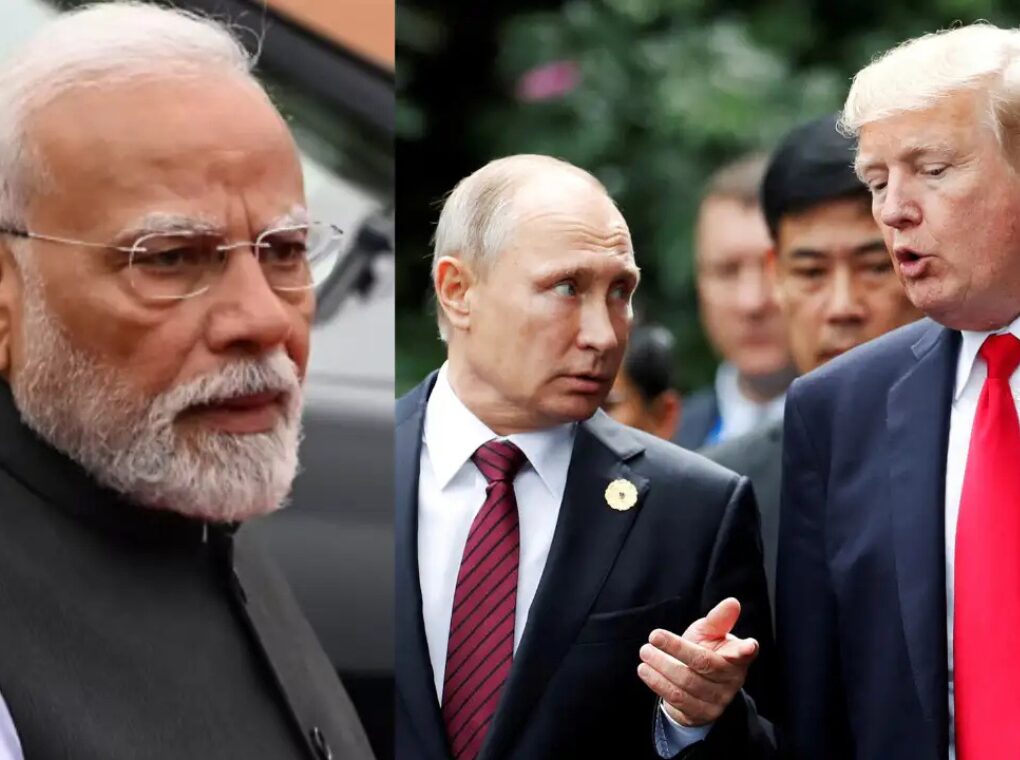
Earlier this week, U.S. President Donald Trump’s trade adviser Peter Navarro remarked that “Ukraine’s road to peace runs through New Delhi,” even calling the conflict “Modi’s war” — a reflection of Washington’s expectation that India may be the crucial bridge between the warring nations.
Adding to the intrigue, Germany’s leading daily, Frankfurter Allgemeine Zeitung, reported that Prime Minister Narendra Modi did not respond to multiple calls from President Trump. While seemingly a minor episode, analysts point out that the decision to highlight this through European media rather than Indian outlets indicates Europe’s attempt to shape the diplomatic narrative.
A Fast-Shifting Geopolitical Chessboard
A flurry of high-level meetings underscores the rapidly evolving landscape:
President Trump has engaged European leaders, Ukrainian officials, and even President Putin in search of a peace formula.
Prime Minister Modi is set to meet President Putin on the sidelines of the Shanghai Cooperation Organization (SCO) summit in China.
Ukrainian President Volodymyr Zelensky is preparing for a visit to India.
Plans are reportedly underway for a separate visit by President Putin to New Delhi.
Taken together, these developments suggest a possible framework where India could emerge as a neutral mediator. Observers note that for President Putin, peace brokered through Washington alone would appear as yielding to U.S. pressure. India, however, offers a face-saving and strategically acceptable channel.
Who Wants Peace, and Who Doesn’t?
Analysts argue that while the United States is eager to bring the conflict to an end, Europe and Ukraine may not share the same urgency.
For President Trump, the motivations are largely economic. U.S. firms are eyeing contracts worth nearly $16 trillion in Ukraine’s rare earth minerals, alongside a trillion-dollar reconstruction opportunity. A peace settlement would also lift sanctions on Russia, opening lucrative trade channels. Trump’s World Liberty Fund crypto initiative could further benefit if international trade shifts from the U.S. dollar toward local currencies and digital assets.
By contrast, the European Union has already invested over $200 billion in Ukraine, including:
$45 billion in official loans,
$100 billion in economic aid,
$55 billion in arms, ammunition, and training.
For France, Germany, and the UK, the war has become an economic stabilizer, fueling defense industries and securing future leverage over Ukraine. A swift peace under U.S. terms could diminish Europe’s returns, analysts say.
Meanwhile, for President Zelensky, the continuation of the war remains vital to his political survival, given that his elected term has already expired.
Shifts in Strategic Balance
The divergence between U.S. and European positions reflects a broader historical shift. Since World War II, Europe had been Washington’s closest partner. But by the late 1990s, with China rising as America’s primary challenger, U.S. attention shifted toward India.
A landmark moment came with President Bill Clinton’s five-day visit to India in 2000, laying the groundwork for deeper ties. The subsequent formation of the QUAD — comprising India, Japan, Australia, and the U.S. — cemented India’s role as a key counterbalance to China.
As India’s stature rose, Europe’s relative influence in U.S. strategy began to decline.
Trump’s Tariff Gamble
Against this backdrop, Trump’s imposition of a 50% tariff on Indian goods has raised questions. Why pressure India at a time when Washington seeks its cooperation?
Analysts outline three possible reasons:
Pakistan Factor: Trump is seeking rare earth extraction rights in Pakistan’s Khyber Pakhtunkhwa region. Tariffs on India could serve as a goodwill gesture toward Islamabad’s military leadership under General Asim Munir, who has already initiated clearance of mining areas.
Domestic Politics: Facing pressure to deliver on campaign promises, Trump may be using tariffs as a show of strength for his MAGA base amid delays on trade deals and reconstruction projects.
De-dollarization: Ironically, by targeting India, Trump risks accelerating a shift away from dollar-based trade. India’s robust financial infrastructure could demonstrate how global trade can operate through local currencies or cryptocurrency — aligning with Trump’s own allies preparing for a crypto-centric economy.
Europe’s Countermoves
Europe, meanwhile, appears intent on slowing any peace initiative led by Trump. Analysts point to the German media’s coverage of Modi allegedly ignoring Trump’s calls as a calculated move to undermine U.S.–India coordination.
Trump’s diplomatic style, heavily shaped by ego and pressure tactics, is vulnerable to such narratives. Casting India as unresponsive complicates communication at a critical juncture, potentially delaying progress on a peace deal.
The larger Picture
Summing up the geopolitical dynamics:
India is positioned at the center of global mediation efforts.
Trump seeks a rapid end to the war, driven by economic and political incentives.
The EU, having invested heavily, prefers to prolong the conflict for strategic and financial returns.
Putin views India as a neutral partner capable of brokering dialogue.
Zelensky’s presidency hinges on the continuation of hostilities.
At the same time, Trump’s tariffs on India serve as both a domestic distraction and a geopolitical maneuver, while indirectly accelerating the trend of de-dollarization.
Geopolitics today is no longer about clear moral divides or binary alliances. It is a complex intersection of economics, security, and survival.
India, once a peripheral player in global diplomacy, now finds itself at the heart of efforts to resolve Europe’s most devastating conflict in decades. Should a breakthrough come, it may well carry the imprint of New Delhi.
Until then, every tariff, every leaked story, and every summit is just another move in a high-stakes global chess match — a game far from over.