In a dramatic turn of global diplomacy, U.S. President Donald Trump’s latest phone conversation with Russian President Vladimir Putin has reignited fears of a new Cold War — this time, not in Europe, but in Latin America.
According to reports from Gazeta.ru, Moscow has issued a discreet yet pointed warning to Washington: if the United States goes ahead with supplying long-range Tomahawk cruise missiles to Ukraine, Russia could respond by deploying Oreshnik hypersonic missiles on the territory of its Latin American allies.
The revelation has sent shockwaves through Washington’s national security circles, coming just one day before Trump’s scheduled White House meeting with Ukrainian President Volodymyr Zelenskyy.
The Call That Sparked Tension
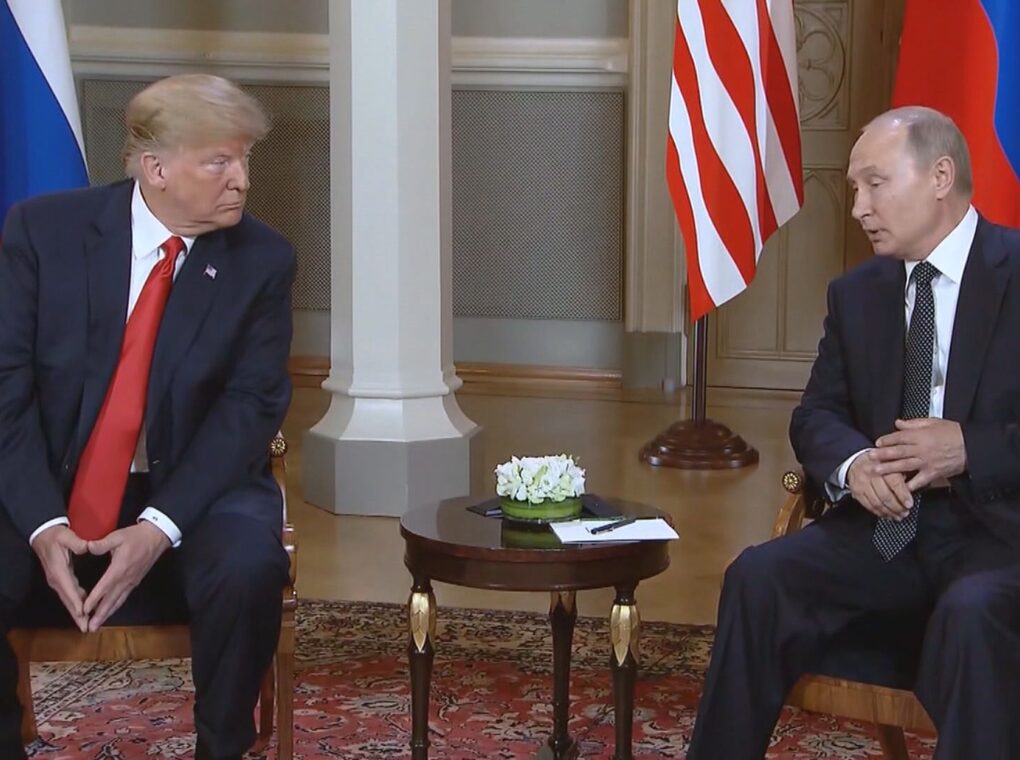
The two leaders’ phone conversation — reportedly lasting two and a half hours on Thursday, October 16 — touched on a range of issues including U.S.-Russia trade prospects, post-war reconstruction, and the upcoming Budapest Summit.
But sources confirm that the dominant topic was the United States’ consideration of transferring long-range Tomahawk missiles to Kyiv — a move that could decisively alter the balance of the battlefield in Ukraine’s favor.
Trump publicly called the conversation “very productive” and even floated the idea of another summit with Putin “to bring peace to Europe.” Yet, Moscow’s tone was markedly sterner.
Kremlin aide Yuri Ushakov briefed reporters that Putin had warned Trump against “crossing a red line” by providing Ukraine with long-range offensive capabilities.
“Supplying such weapons would harm peace efforts and damage U.S.–Russia relations,” Ushakov said. “It would represent a qualitatively new stage of escalation.”
Trump initially brushed off concerns, joking to reporters that he asked Putin whether he’d “mind a few thousand Tomahawks.” But by the next morning, his tone had shifted.
“We need Tomahawks for the United States too,” Trump said. “We can’t deplete our own supply.”
The comment was widely interpreted as a soft retreat — signaling that Putin’s warning may have hit its target.
Gazeta’s Revelation: The Latin America Gambit
While Western coverage focused on Trump’s hesitation over Ukraine, Gazeta.ru reported a far more alarming subtext to the exchange.
Citing Vasily Koltashov, head of the Center for Political Economic Studies at the Institute for a New Society, the Russian outlet claimed that Moscow had delivered a “mild warning” to Washington.
“Trump has already received a mild warning from Moscow that if he transfers missiles to Ukraine, Russia will have to respond,” Koltashov told Gazeta.ru.
“This means the deployment of the ‘Hazel,’ or Oreshnik, missiles on the territory of Latin American states. This is what worries Trump the most, since he does not have the best relations with the countries of Latin America.”
If true, the move represents one of the boldest Russian geopolitical gambits in decades — threatening to mirror the Cuban Missile Crisis of 1962, when Soviet nuclear weapons in Cuba brought the world to the edge of nuclear war.
What Is the Oreshnik Missile?
The Oreshnik, or “Hazel,” is one of Russia’s newest hypersonic intermediate-range ballistic missiles (IRBM). Unveiled in late 2024, it is believed to be a derivative of the RS-26 Rubezh ICBM platform.
The weapon can carry multiple independently targetable reentry vehicles (MIRVs), travel at speeds exceeding Mach 10, and strike targets over 3,400 miles away.
In practical terms, if launched from Venezuela or Cuba, an Oreshnik could reach Washington, D.C., New York, or Miami within minutes, leaving virtually no time for interception.
Russian state media has described it as a “game-changer” — capable of delivering “nuclear-level devastation without crossing the nuclear threshold.”
Moscow has long accused Washington of surrounding Russia with missile bases in Europe and Asia; the Oreshnik’s deployment in Latin America would thus serve as what the Kremlin calls a “reciprocal strategic measure.”
Trump’s Strategic Dilemma
Trump’s foreign policy has been defined by a mix of confrontation and deal-making, but the Latin America threat complicates his calculus.
Supporting Ukraine with Tomahawks could escalate tensions with Moscow and open a new front near U.S. borders. Backing down, however, would be seen by Kyiv and America’s European allies as capitulation.
White House spokesperson Karoline Leavitt tried to project calm, describing the Putin–Trump exchange as “constructive and trust-based.” But European leaders voiced alarm.
Germany and Poland privately warned that the U.S. might be “appeasing” Moscow at Ukraine’s expense.
On social media, critics accused Trump of bowing to Russian pressure. Former U.S. Ambassador Michael McFaul tweeted, “He sounded very different about this issue 24 hours ago,” referencing Trump’s earlier support for the missile plan.
For now, the administration insists the weapons deal remains “under review,” but the timing of Putin’s call has clearly rattled Washington.
Russia’s Latin American Playbook
The Kremlin’s interest in Latin America isn’t new. Since 2019, Russia has supplied S-300 air defense systems to Venezuela, conducted joint naval exercises, and expanded its oil and energy cooperation across the region.
Analysts note that Moscow’s potential deployment of Oreshniks in the Western Hemisphere is less about military necessity and more about psychological and political leverage.
By invoking Latin America — historically viewed by Washington as its strategic sphere of influence — Putin is effectively turning America’s Monroe Doctrine back against it.
“The conversation itself is a signal,” said retired Russian Colonel Andrei Surovikin on state TV. “Even if not deployed yet, the very idea forces Washington to think twice.”
For Trump, who has struggled to build warm relations with leaders like Mexico’s Claudia Sheinbaum and faced criticism for a harsh immigration stance, the notion of Russian missiles stationed in Latin America represents both a strategic and political nightmare.
Zelenskyy’s High-Stakes Visit
Meanwhile, Ukrainian President Volodymyr Zelenskyy arrived in Washington just hours after the Trump–Putin call.
In a post on X (formerly Twitter), Zelenskyy wrote:
“We can already see that Moscow rushes to resume dialogue as soon as it hears about Tomahawks.”
Kyiv interprets this as proof that long-range weapons are working as a diplomatic pressure tool.
Zelenskyy’s agenda includes securing advanced air defense systems, expanding sanctions on Russia’s military-industrial complex, and finalizing agreements with U.S. defense firms for long-term cooperation.
But Trump’s sudden hesitation could weaken Ukraine’s negotiating hand — especially as Russia continues its relentless aerial bombardment, crippling Kyiv’s energy grid and infrastructure.
The Broader Picture: Cold War Echoes
The Gazeta.ru report underscores a sobering reality: great-power rivalries are once again extending beyond Europe’s borders.
For Putin, threatening missile deployment in Latin America is both a warning and a test — probing how far Washington is willing to go for Ukraine.
For Trump, the crisis marks a crucial test of leadership — balancing his “America First” doctrine with global commitments that shape U.S. credibility.
As Koltashov concluded to Gazeta.ru:
“Let’s hope that Trump’s conversation with President Putin will lead to sobering, and Washington will no longer raise the degree of escalation.”
But in the high-stakes chessboard of global politics, “sobering” moments are fleeting.
The shadow of hypersonic missiles now stretches across the Atlantic, and the specter of a new Cold War looms once again — this time, with Latin America back in play.