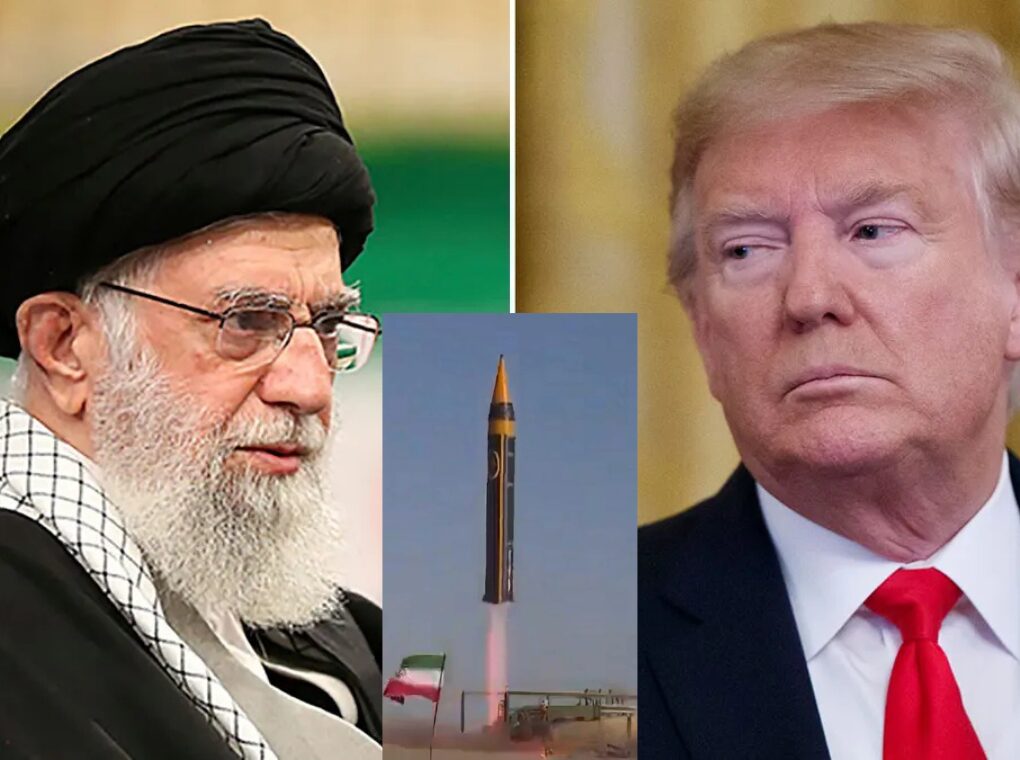
In a move that could redefine global security dynamics, Iran has announced the near completion of an intercontinental ballistic missile (ICBM) allegedly capable of striking targets up to 10,000 kilometers away—a range that would, for the first time, put the U.S. mainland within reach of Iranian firepower.
The claim, broadcast through the state-affiliated Tasnim News Agency on November 7, 2025, and amplified on social media platform X, has drawn immediate international attention, even as Western intelligence agencies urge caution pending verification.
According to the Tasnim report, the missile is “almost ready for service,” with Iranian sources asserting that it has completed its developmental phase. State television aired footage purportedly showing the missile’s launch, accompanied by commentary from Islamic Revolutionary Guard Corps (IRGC) officials and archival clips of previous missile tests.
The visuals featured missile silos, mobile launchers, and underground storage facilities—imagery clearly intended to project an image of technological confidence and strategic readiness.
If verified, the system would represent a quantum leap in Iran’s missile capabilities. Until now, Tehran’s arsenal was thought to be limited to medium-range ballistic missiles (MRBMs) such as the Khorramshahr-4, which can reach targets within 2,000 to 3,000 kilometers—encompassing Israel, the Gulf states, and parts of Eastern Europe.
A sudden extension to 10,000 kilometers implies a breakthrough in propulsion technology, multi-stage launch systems, and re-entry vehicle (RV) design—all of which are vital for true intercontinental capability.
However, independent verification remains elusive. No satellite imagery, flight-path telemetry, or impact data have been released to substantiate Iran’s claims. Western defense analysts note that a 10,000 km ICBM would require advancements in multi-stage propulsion and heat-shield technology capable of surviving re-entry at high velocities—areas where Iran has limited publicly known experience.
Strategic Implications
Should Tehran’s claims prove accurate, this development would dramatically alter the strategic balance between Iran, NATO, and the United States. An operational 10,000 km ICBM would, in theory, enable Iran to strike major U.S. cities such as New York, Washington, D.C., and Chicago, directly from Iranian soil.
Such a leap would force a major recalibration of U.S. homeland defense strategy, which currently focuses on limited ICBM threats from North Korea. The Ground-Based Midcourse Defense (GMD) system, alongside interceptor deployments in Alaska and California, may no longer be sufficient to counter a dual-hemispheric threat from both East Asia and the Middle East.
For European NATO members, the implications are equally severe. Nations such as Germany, France, and the United Kingdom would find themselves well within potential range, likely prompting renewed investments in early-warning radars, Aegis Ashore systems, and missile interception coordination. The psychological and strategic consequences could reignite debates over nuclear deterrence and European missile defense architecture.
Technological Context
Many experts view Iran’s announcement as an outgrowth of its space-launch vehicle (SLV) program, which has demonstrated growing sophistication. The Simorgh and Qased launch vehicles—used ostensibly for satellite deployment—employ multi-stage propulsion technology similar to that used in long-range ballistic missiles. The U.S. Department of Defense has long warned that Iran’s space program is “dual-use,” serving both civilian and military applications.
If Iran has successfully converted this technology into a weapons platform, it would signify a significant convergence between its civilian space and military missile programs—a pattern reminiscent of early Cold War-era Soviet and U.S. developments.
A Political Message Wrapped in Deterrence
While the technical validity of Iran’s claim remains uncertain, the political intent behind it is unmistakable. Tehran appears to be signaling global strike capability—not merely as a deterrent against regional foes like Israel or Saudi Arabia, but as a direct challenge to Washington.
For a regime facing crippling economic sanctions, domestic unrest, and diplomatic isolation, projecting the image of a nation capable of threatening the United States serves both domestic and international purposes. Domestically, it bolsters nationalist sentiment and reinforces the IRGC’s image as the guardian of Iran’s sovereignty. Internationally, it seeks to redefine Iran’s deterrence posture from regional containment to global reach.
Skepticism and Reality
Western analysts remain deeply skeptical. Iran has a history of overstating weapons capabilities to achieve psychological or diplomatic leverage. Previous claims of stealth aircraft and hypersonic missiles have been met with limited evidence. The absence of verified test data, international monitoring, or open-source confirmation raises doubts about whether Iran has truly achieved ICBM-grade propulsion or guidance precision.
Nevertheless, even if Iran’s missile is still under development, the announcement itself represents a strategic escalation. It signals Tehran’s ambition to transcend regional deterrence and enter the realm of intercontinental power projection—a move that will not go unanswered by the West.
Whether a technological breakthrough or a psychological gambit, Iran’s 10,000 km missile claim marks a new phase in its defense narrative. By asserting the ability to reach the U.S. mainland, Tehran has upended long-held assumptions about its military limits. The coming months will reveal whether this is merely rhetoric or the dawn of a genuinely global Iranian deterrent.