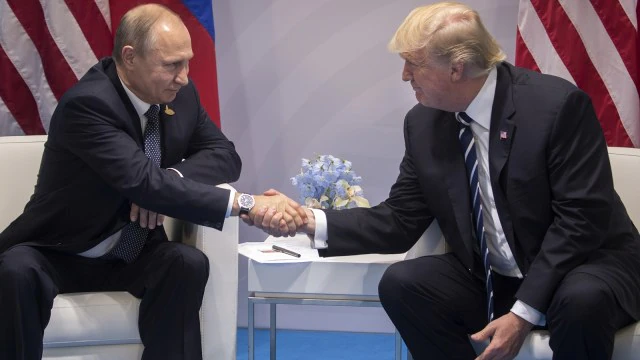
A potential diplomatic breakthrough—or a deeply controversial geopolitical shift—may be taking shape behind closed doors. According to detailed reports from Axios and the Financial Times, senior officials from the United States and Russia have been quietly working on a new peace proposal for Ukraine, raising serious concerns in Kyiv and across European capitals. The draft, modeled in part on the recent U.S.-mediated Gaza ceasefire framework, is described by insiders as significantly tilted in Moscow’s favor and potentially requiring sweeping concessions from Ukraine.
The talks, held in Miami in late October and mid-November, involved U.S. special envoy Steve Witkoff and Russian diplomat Kirill Dmitriev, a close ally of President Vladimir Putin and head of Russia’s sovereign wealth fund. A Ukrainian official, National Security and Defense Council Secretary Rustem Umerov, was later briefed on the draft but had no role in its development. European Union officials were similarly informed only after preliminary outlines had already been shaped.
The exclusion of Ukraine and its European partners—who have borne most of the economic and humanitarian burden of the war—has drawn sharp criticism from analysts, who argue that Washington and Moscow appear to be negotiating the future of the continent without the continent itself.
Key Provisions: Major Concessions Expected from Kyiv
Leaked components of the 28-point proposal point to substantial and contentious demands on Ukraine. These include:
Territorial Transfers
The proposal reportedly calls on Ukraine to surrender:
All remaining areas of the Donetsk and Luhansk regions still under Ukrainian control, including major cities such as Kramatorsk and Sloviansk.
De facto recognition of Russian control over parts of Kherson, Zaporizhzhia, and potentially the already-annexed Crimea.
Accepting these terms would represent the most significant territorial loss in Europe since 1945 and formalize Russian gains achieved during the war.
Military Reductions
Ukraine would be required to:
Reduce its armed forces by approximately 50%.
Surrender long-range missiles and several classes of Western-supplied weapons.
Limit heavy artillery and portions of its air defense systems.
Critics argue that such measures would leave the country militarily vulnerable and unable to deter future aggression.
Cultural and Political Measures
Additional provisions reportedly include:
Recognition of Russian as an official language in Ukraine.
Legal status for the Moscow-aligned branch of the Orthodox Church.
These measures would embed elements of Russian influence within Ukraine’s political and cultural fabric.
What Ukraine Would Receive ?
In exchange, Ukraine would receive:
U.S. security guarantees, though the details are unclear and reportedly fall short of NATO’s Article 5–style commitments.
The establishment of a demilitarized zone in parts of eastern Ukraine.
The possibility of Western-backed reconstruction aid.
Broader discussions on European security and U.S.-Russia relations.
Despite the incentives, Ukrainian officials have already expressed deep reservations. A senior government source quoted in local media described the plan as “a Russian ultimatum in American packaging,” stressing that Kyiv could not accept terms that undermine the nation’s sovereignty and territorial integrity.
President Volodymyr Zelenskyy has repeatedly insisted he will not negotiate away land seized by Russia and continues to call for a “just peace” that restores Ukraine’s internationally recognized 1991 borders.
Europe’s Exclusion Sparks Concern and Frustration
Perhaps the most politically sensitive aspect of the initiative is Europe’s sidelining. Over the past four years, the European Union has:
Provided more than €100 billion in economic, humanitarian, and military aid to Ukraine.
Absorbed millions of refugees.
Endured severe energy price spikes after cutting reliance on Russian gas.
Experienced economic stagnation and public fatigue linked to high living costs and inflation.
Yet EU leaders were reportedly informed of the U.S.-Russia discussions only after major elements had already been drafted.
For many European observers, this confirms a growing structural concern: the continent’s dependency on U.S. security guarantees has left it without agency in shaping decisions that directly affect its own future. Some analysts warn that such sidelining could deepen divisions within NATO, erode transatlantic trust, and accelerate Europe’s push for “strategic autonomy.”
Why Now? Changing Battlefield Dynamics
The timing of the negotiations is notable. In recent weeks, Russian forces have made incremental but steady advances across eastern Ukraine, capturing additional territory in Donetsk. Ukraine, meanwhile, faces critical shortages of ammunition and manpower, with Western aid flows slowing amid political gridlock in Washington and European capitals.
A major Russian missile attack on the city of Ternopil yesterday killed dozens, underscoring Kyiv’s increasingly precarious battlefield position.
As a result, Moscow appears to be negotiating from a position of strength, while the Trump administration appears eager to de-escalate the conflict, redirect diplomatic focus toward China, and reduce U.S. financial commitments to Ukraine.
What next?
It remains unclear whether the draft proposal will evolve into a formal peace framework. Both Washington and Moscow have publicly downplayed the leaks, though neither side has denied the substance of the reports.
For Ukraine, the stakes are existential. Accepting the proposal would mean ending years of devastating warfare, but at the cost of territorial losses, military vulnerability, and cultural concessions that many Ukrainians view as unacceptable. Rejecting it risks prolonging a conflict in which Kyiv’s resources are steadily diminishing.
For Europe, the controversy highlights deeper questions about its long-term geopolitical role, dependence on American security policy, and ability to shape outcomes in its own neighborhood.
For the global community, the episode underscores the fragility of international norms in the face of great-power bargaining.
As one U.S. official told Reuters, “Achieving a durable peace will require difficult compromises.” Whether those compromises will be considered legitimate—or imposed—remains at the heart of the debate now unfolding across Kyiv, Brussels, Moscow, and Washington.