
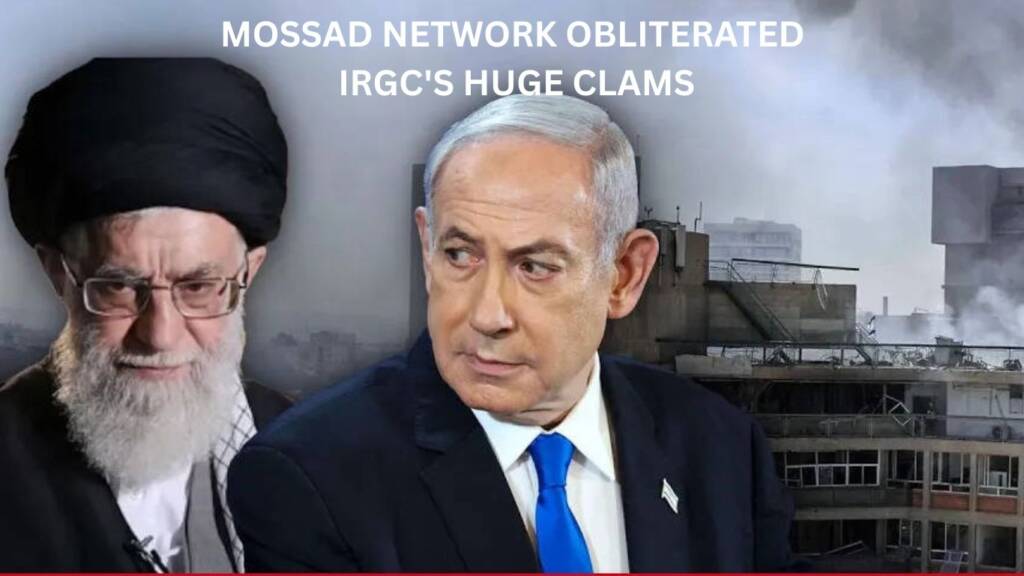
Iran’s Islamic Revolutionary Guard Corps (IRGC) has released its most detailed and forceful account so far of the brief but intense 12-day conflict with Israel in June. It says the war as a decisive strategic victory for Tehran that shattered Israeli deterrence and forced its adversaries to seek a ceasefire.
Speaking at multiple public events, IRGC spokesperson Brigadier General Ali-Mohammad Naeini claimed Iran confronted Israel, the US Central Command (CENTCOM), and NATO “on its own,” without external military support, and still emerged stronger, more united, and more stable.
Claims of Intelligence Dominance and Precision Strikes
According to the IRGC, Iran maintained what it described as “full intelligence dominance” throughout the conflict. In remarks carried by Tasnim News Agency, an IRGC spokesperson said Iran mirrored every Israeli strike with a calculated response, targeting Israeli intelligence and military sites with precision missile strikes.
However, the claim smells a bit exaggerated as the world has seen the scale of destruction caused by Israel’s Air Force on the Iranian Soil, while the same has not been seen on the Israeli side.
The IRGC claimed that 36 Mossad operatives were killed during attacks on Israeli intelligence facilities. One strike, described as an “Iranian missile masterpiece,” allegedly shut down the Haifa oil refinery — a major strategic and economic installation. The Guard also said Iranian missiles hit at least 45 strategic centers inside Israel, significantly increasing pressure on Tel Aviv.
This claim looks a bit accurate, as the Iranian missile dominance was seen during the 12-day war.
War Ends Under Ceasefire, Followed by Crackdown
The 12-day war, which included Israeli and US strikes on Iranian nuclear facilities, ended under a US-brokered ceasefire. However, Tehran responded internally with a sweeping security crackdown, claiming it dismantled extensive Mossad-linked networks inside Iran.
Iranian authorities reportedly detained more than 21,000 suspects accused of espionage and sabotage. State-linked sources also indicated that 2025 has seen a record number of executions linked to national security cases, though independent verification remains unavailable.
Unity, Resilience, and ‘Sacred Defense’ Narrative
Addressing students at universities in Urmia and Tabriz on National Students’ Day, Naeini framed the war as a continuation of Iran’s “Sacred Defense” tradition, drawing parallels with the Iran-Iraq War. He praised what he called the psychological, social, and political resilience of Iranian society, highlighting unity between the government, the armed forces, and the public.
He said Israeli efforts to drag the war deep into Iran through airstrikes failed to achieve their political or strategic goals. Instead, he argued, the conflict strengthened national cohesion and bolstered Iran’s deterrence posture.
IRGC Says Israel Sought End to Fighting
The IRGC insisted that sustained Iranian pressure left Israel with no option but to seek an end to the war. Naeini went as far as to claim that Israel would not have survived a prolonged confrontation. “If this war had continued for two more weeks, nothing would have remained of the Zionist regime,” he said, without offering evidence.
Iran Signals Readiness, Warns Adversaries
Naeini concluded by saying Iran deliberately avoided widening the conflict to other regional fronts, claiming it could achieve its objectives with limited missile units alone. He added that Iran’s armed forces are now better prepared than before and that its adversaries are currently in no position to initiate another war due to internal crises.