The late-December 2025 release of declassified diplomatic transcripts by the US-based National Security Archive has brought renewed global attention to Pakistan’s nuclear programme and long-standing concerns about its stability.
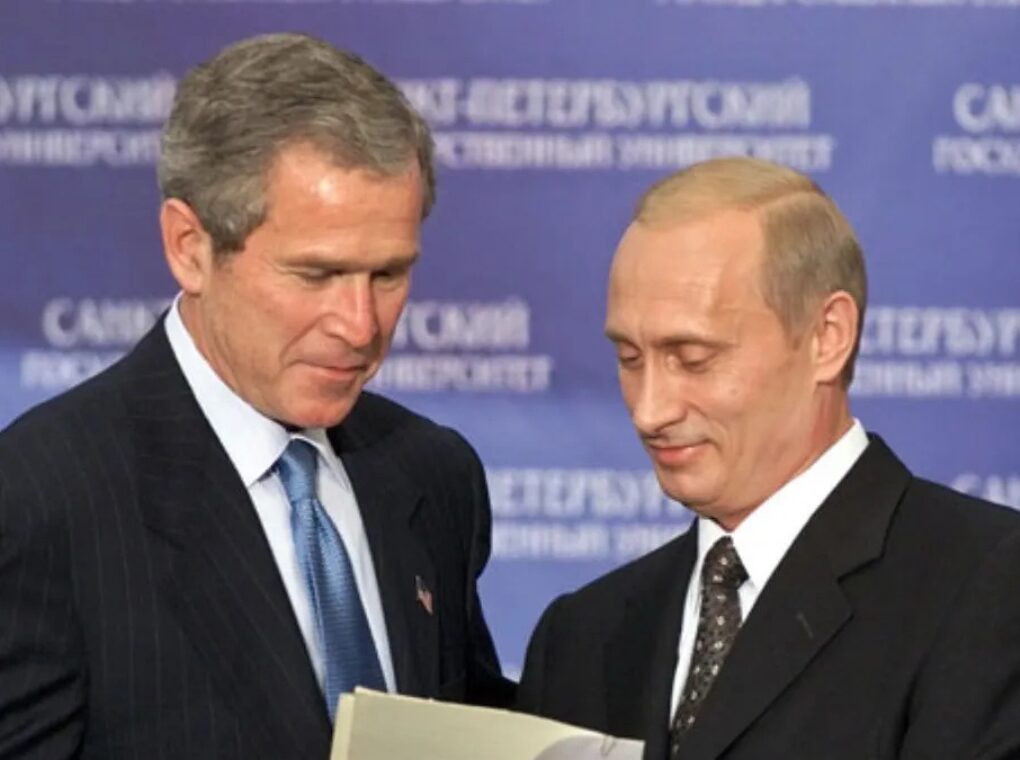
The documents, obtained through a Freedom of Information Act (FOIA) lawsuit, contain verbatim records of private conversations between Russian President Vladimir Putin and former US President George W. Bush from 2001 to 2008. Among the most striking disclosures is Putin’s blunt characterisation of Pakistan as “just a junta with nuclear weapons” — a warning he raised as early as June 16, 2001, during his very first meeting with Bush.
Putin–Bush Slovenia Meeting: Pakistan Flagged as a Nuclear Concern
The remarks were made at Brdo Castle in Slovenia, where Putin and Bush met for the first time amid discussions on strategic stability, missile defence, NATO expansion, Iran, and North Korea. During this wide-ranging conversation, Putin unexpectedly shifted focus to Pakistan, then ruled by military strongman General Pervez Musharraf following a 1999 coup.
“I am concerned about Pakistan,” Putin told Bush. “It is just a junta with nuclear weapons. It is no democracy, yet the West makes no criticism of it. Should talk about it.”
This statement reflected Moscow’s unease over what it saw as Western double standards on nuclear non-proliferation. At the time, Iran and North Korea were facing intense diplomatic pressure and sanctions, while Pakistan — despite being under military rule and possessing nuclear weapons — was largely spared comparable international scrutiny.
US Acknowledgement Behind Closed Doors
According to the transcripts, Bush did not dispute Putin’s assessment. While publicly Washington avoided highlighting Pakistan’s nuclear risks, privately US officials appeared to share similar anxieties. Bush reassured Putin that a US–Russia conflict was not a threat, but the absence of pushback on Pakistan underscored tacit agreement on the underlying concern.
Just months later, the September 11, 2001 terror attacks dramatically reshaped US foreign policy. Pakistan became a frontline ally in the “War on Terror,” with Musharraf’s regime receiving billions of dollars in military and economic aid. Public criticism of Islamabad’s nuclear record faded, but the declassified records show that concerns about proliferation and security never disappeared at the highest levels.
A.Q. Khan Network and Proliferation Fears
Those private fears resurfaced more explicitly during a 2005 Oval Office meeting. Putin informed Bush that uranium traces found in Iranian centrifuges were of Pakistani origin. “It was of Pakistani origin. That makes me nervous,” Putin said. Bush responded candidly: “It makes us nervous, too.”
The exchange pointed directly to the notorious A.Q. Khan network — the clandestine nuclear black market run by the architect of Pakistan’s atomic bomb. Exposed in 2004, the network supplied sensitive nuclear technology to Iran, Libya, and North Korea. While Islamabad portrayed Khan as a rogue individual, intelligence agencies and analysts worldwide argued that such operations could not have occurred without institutional protection within Pakistan’s military-dominated system.
Why Pakistan Was Seen as a Unique Nuclear Risk
The transcripts reveal that both leaders viewed Pakistan as a systemic non-proliferation challenge rather than an isolated case. The combination of military rule, political instability, weak civilian oversight, and links to extremist networks made Pakistan’s nuclear arsenal a source of persistent unease.
For India, these disclosures reinforce long-standing warnings. New Delhi has repeatedly highlighted Pakistan’s history of clandestine nuclear activity, export control violations, and the dangers of placing nuclear weapons under a volatile military establishment. Indian officials reacting to the declassification noted that the documents validate concerns raised for decades about the security and accountability of Pakistan’s nuclear programme.
Relevance Today: A Warning That Still Resonates
More than two decades after Putin’s initial warning, the issue remains highly relevant. Pakistan is estimated to possess over 170 nuclear warheads, and continues to experience political turbulence, economic stress, and civil-military tensions. While Islamabad maintains that its nuclear assets are secure, global apprehension persists — apprehension that now appears deeply rooted in private assessments made by world leaders as early as 2001.
The National Security Archive’s release highlights the stark contrast between public diplomacy and private candour. While strategic expediency shaped US policy toward Pakistan after 9/11, leaders like Putin and Bush privately acknowledged the risks of a nuclear-armed state governed by an unstable military regime.
A Lasting Lesson from Declassified Diplomacy
Putin’s description of Pakistan as a “junta with nuclear weapons” was not a throwaway remark, but an early warning about the dangers of overlooking political instability in nuclear-armed states. As global attention continues to focus on nuclear challenges in regions like Iran and North Korea, the newly released transcripts serve as a reminder that proliferation risks can also stem from allies — not just adversaries.
The declassified talks underscore a critical lesson for global security: nuclear non-proliferation cannot be selective. Ignoring uncomfortable realities for short-term geopolitical gain may reduce diplomatic friction in the moment, but it can amplify long-term risks for international stability.