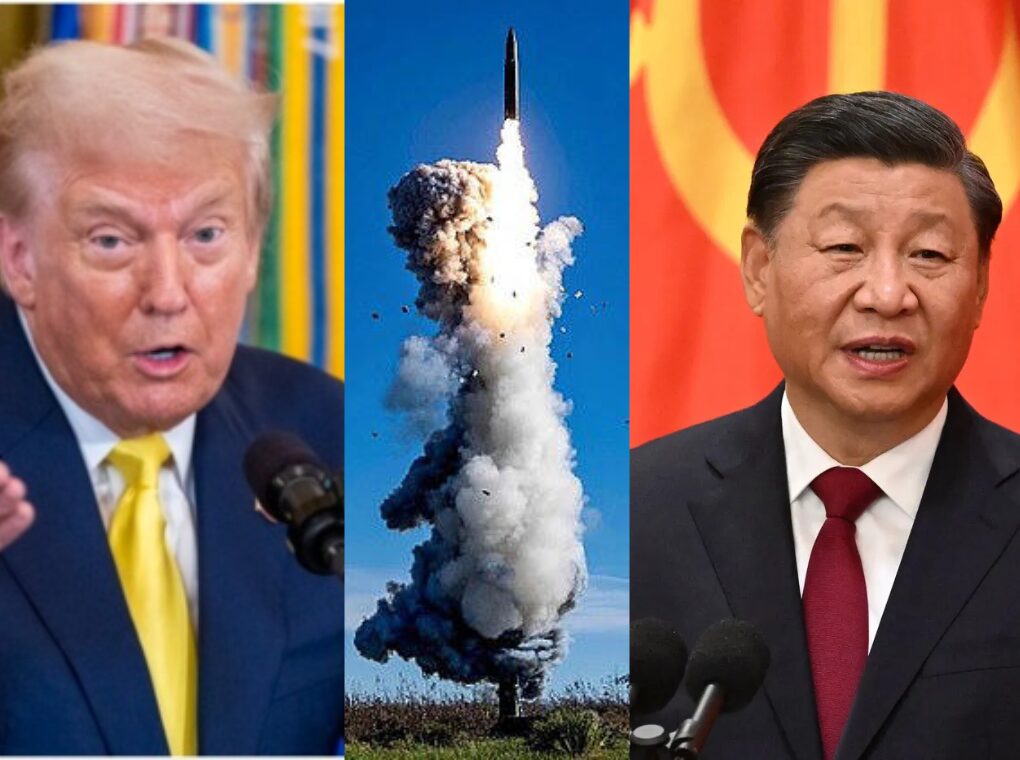
A newly released Pentagon report to the U.S. Congress has triggered global alarm after revealing that China has quietly deployed over 100 intercontinental ballistic missiles (ICBMs) capable of striking the American mainland, signaling a dramatic escalation in nuclear preparedness and great-power rivalry.
According to the report, dated December 23, China’s People’s Liberation Army (PLA) has placed more than 100 DF-31 solid-fuel nuclear missiles into hardened underground silos across multiple regions of the country. These missiles, with an estimated range of nearly 6,800 miles, can reach most of the continental United States, marking a significant shift in China’s strategic posture.
A Silent but Massive Nuclear Expansion
The Pentagon identified three major missile silo fields located in remote areas of northern and western China—Hami in Xinjiang, Yumen in Gansu Province, and Yulin in Inner Mongolia near the Mongolian border. Together, these regions contain approximately 320 missile silos. While U.S. intelligence believes only about one-third are currently loaded, the remaining silos allow China to rotate missiles in a deceptive “shell game” strategy designed to confuse enemy surveillance and complicate any preemptive strike calculations.
Unlike older liquid-fueled missiles that require lengthy preparation before launch, the DF-31 ICBMs use solid fuel, meaning they can be launched with minimal warning. This dramatically reduces reaction time for U.S. missile defense systems and increases the risk of miscalculation during a crisis.
China demonstrated this capability in 2024 when it test-launched an intercontinental missile into the Pacific Ocean, reportedly landing near French Polynesia—an unmistakable signal of long-range strike confidence.
Pentagon Warning: U.S. Homeland Increasingly Vulnerable
The report delivers one of its starkest warnings yet regarding China’s expanding military reach.
“China’s historic military buildup has made the U.S. homeland increasingly vulnerable,” the Pentagon stated, noting Beijing’s rapid advances in nuclear weapons, long-range conventional strike systems, cyber warfare, space capabilities, and maritime power.
U.S. defense officials believe this nuclear expansion aligns with China’s broader goal of possessing over 1,000 nuclear warheads by 2030, a number that would place it closer to nuclear parity with the United States and Russia. Current estimates put China’s warhead count in the “low 600s,” with projections suggesting an increase of roughly 100 warheads per year throughout the decade.
Taiwan at the Center of the Storm
The report also reinforces growing concerns that China is preparing for a potential invasion or blockade of Taiwan by 2027. Large-scale military exercises around the island increasingly include long-range missile strikes and joint operations involving air, naval, and ground forces—scenarios that would almost certainly draw in U.S. and allied forces from Japan, South Korea, and the Philippines.
Pentagon officials note that Beijing views U.S. alliances across Asia as a deliberate containment strategy, fueling frustration within the Chinese Communist Party (CCP). From Beijing’s perspective, maintaining political control, economic growth, and territorial claims—particularly Taiwan—are “core interests” that it will never compromise on.
China’s long-term ambition, according to the report, is to emerge as a dominant global superpower by 2049, the 100th anniversary of the founding of the People’s Republic of China, backed by a “world-class” military capable of defending its interests worldwide.
Nuclear Balance of Power Shifting
Globally, nuclear weapons remain concentrated among a small group of states. A 2024 report by the Federation of American Scientists estimated that there are 12,121 nuclear warheads worldwide, spread across nine nuclear-armed countries: the United States, Russia, China, France, the United Kingdom, India, Pakistan, Israel, and North Korea.
Russia and the United States still dominate the nuclear landscape, controlling nearly 88 percent of the global stockpile, with Russia holding approximately 5,580 warheads and the U.S. about 5,044. However, China is among a group of nations—including India and Pakistan—that have steadily expanded their arsenals over the past four decades, reshaping global deterrence dynamics.
De-Escalation or Dangerous Drift?
Despite the ominous findings, senior Pentagon officials insist efforts are underway to prevent escalation. A Department of Defense official told U.S. media that President Donald Trump seeks “stable peace, fair trade, and respectful relations with China,” emphasizing renewed attempts to open military-to-military communication channels with the PLA to avoid misunderstandings.
Yet analysts warn that as nuclear arsenals grow and response times shrink, the margin for error narrows. With China’s missiles now capable of reaching U.S. cities in minutes, and tensions over Taiwan intensifying, the world appears to be entering its most dangerous nuclear era since the Cold War.
The Pentagon’s message is clear: deterrence is shifting, and the balance of power is no longer static. Whether this leads to stability—or catastrophe—may depend on decisions made in Beijing and Washington in the coming years.