A company that builds engines for China’s attack helicopters is not an obvious patron of American higher education. Yet for years its research institutes quietly wired millions of dollars to some of the United States’ most respected universities, and almost nobody was checking.
That is finally changing. In January 2026 the US Department of Education switched on a new public portal, foreignfundinghighered.gov, which for the first time lets anyone trace the foreign gifts and contracts flowing into American campuses. The site is the sharp end of a renewed drive to enforce Section 117 of the Higher Education Act, a 1986 law requiring universities to declare any foreign gift or contract worth $250,000 or more. In February, the Education Department went further, signing an agreement that enlists the State Department’s national-security expertise to help scrutinise what universities report.
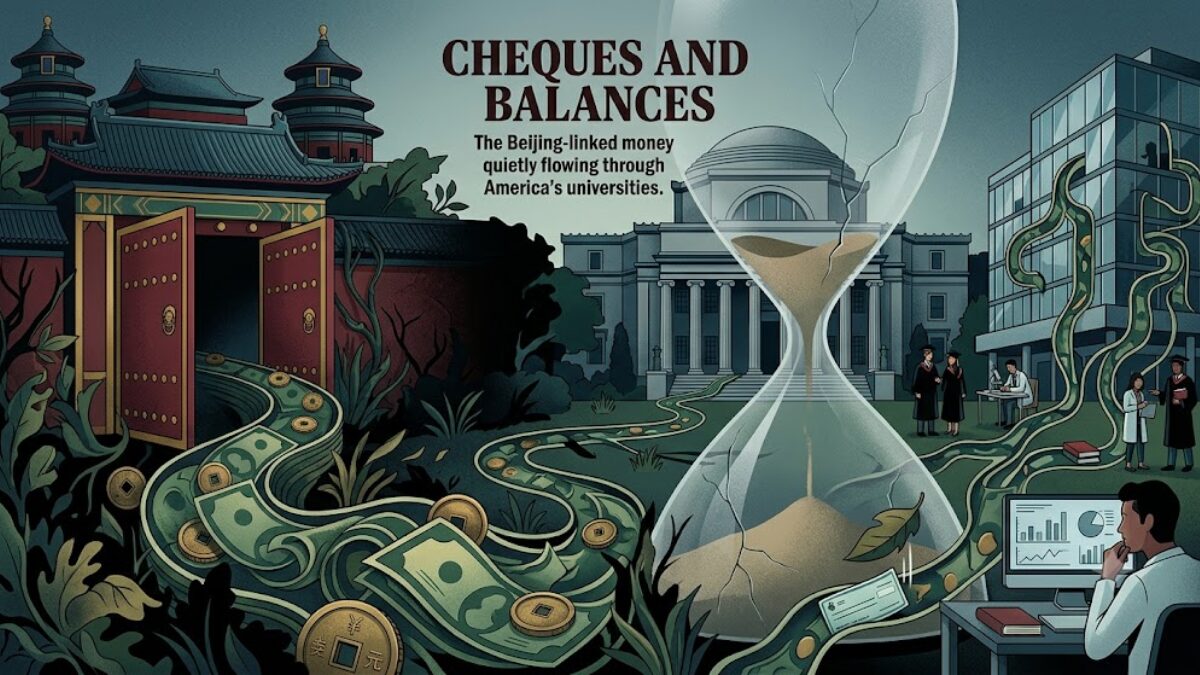
The numbers are striking. Since the reporting requirement began, institutions have declared roughly $4.9 billion in transactions attributed to China, some 8,000 separate entries — a total second only to Qatar. More troubling than the headline sum, though, is where some of the money originates. A CBS News review of the disclosure forms found that dozens of top research universities took a combined $27.6 million in roughly the second half of 2025 alone from entities sitting on at least one of ten US government watch lists — rosters maintained by the Treasury, Commerce, Defense and Homeland Security departments and the State Department to flag organisations with worrying ties to foreign governments and militaries.
Fighter jets and lecture halls
The helicopter-engine maker is Aviation Engine Corporation of China, or AECC, the state firm that powers the People’s Liberation Army’s J-11 fighter jets and Z-10 attack helicopters. Washington considers it so entwined with the Chinese military that the Treasury has placed it on its sanctions rolls and the Commerce Department classifies it as a military end-user, subject to strict export controls. Yet disclosure records show AECC’s research institutes paid a combined $7.8 million to Northwestern University, the University of California, Irvine, and the University of Connecticut between 2017 and 2021. What the money bought is not recorded in the filings. Northwestern and UC Irvine did not respond to journalists’ questions; UConn said it was looking into it.
Elsewhere the sums are larger still. Bryant University, a small institution in Rhode Island, disclosed a $22.6 million, 50-year contract — the largest single sum in the filings — with the Beijing Institute of Technology, an organisation on two watch lists, to run a jointly operated campus in Zhuhai, on China’s southern coast. UC Berkeley has taken more than $25 million since 2016 from watch-listed Chinese entities, including a $7.6 million grant from Sun Yat-sen University, host of China’s National Supercomputing Center and a fixture on the Pentagon’s “1286 List” of foreign institutions accused of problematic activities linked to China’s defence-industrial base.
Nor is this ancient history. The newly published disclosures show the University of Minnesota signed more than $450,000 in fresh contracts with Sun Yat-sen University in 2025, a full decade after the Chinese institution was first placed on the Commerce Department’s Entity List.
A law nobody enforced
How did money from blacklisted military suppliers reach American lecture halls without alarm bells ringing? Largely because, for nearly four decades, nobody was listening for them. Although Section 117 has been on the books since 1986, enforcement lapsed under administrations of both parties. Filings went missing or unexamined, and, crucially, no government office was cross-referencing university donors against the watch lists that other arms of the same government were painstakingly compiling. Analysts who track compliance describe reports filed late or not at all, transactions recorded under vague labels, and a system that relied almost entirely on universities marking their own homework.
LJ Eads, the founder of the research-security firm Data Abyss, has watched the problem fester for years. The policy failure, he told CBS News, resembled “giving your teenager a cellphone and having no restrictions”. Congressional investigators reached a similarly bleak verdict: in May 2026, senior lawmakers flagged that 34 institutions had received over $183 million from foreign entities tied to American adversaries, the Chinese state chief among them.
Excuses wearing thin
The universities’ defence follows a familiar script. UC Berkeley insists it complies with every statute governing foreign gifts, and says it is still fact-checking the government’s characterisation of its own disclosures. Higher-education lobbyists point out that foreign money — about $1.5 billion in 2022 — amounts to less than 2 per cent of the $117 billion spent annually on university research, over half of it supplied by the American government.
But national security is not measured in percentages. It takes only one compromised laboratory, one co-authored paper on hypersonics or supercomputing, for taxpayer-funded knowledge to end up hardening the arsenal of America’s chief strategic rival. And the ignorance defence collapses on the timeline: Minnesota’s contracts with a blacklisted Chinese university were signed in 2025, long after the warnings had been issued and the lists published. When a small Rhode Island college and a Big Ten flagship alike miss the memo, the problem is not paperwork but priorities. Even analysts at the Manhattan Institute, who counsel against sweeping bans, call the federal investigations welcome and overdue. The debate in Washington is no longer whether to act, only how hard to squeeze.
An open door is not an open safe
America’s research enterprise is the envy of the world precisely because it is open. But openness was never meant to be a suicide pact. For forty years Washington wrote rules about foreign money and never read the answers, while elite universities cashed Beijing’s cheques with one hand and billed the American taxpayer with the other. That era is closing. The portal is live, the agencies are watching, and the choice before every university president is now unavoidable: America’s money, or the Chinese Communist Party’s. They can no longer bank both.