
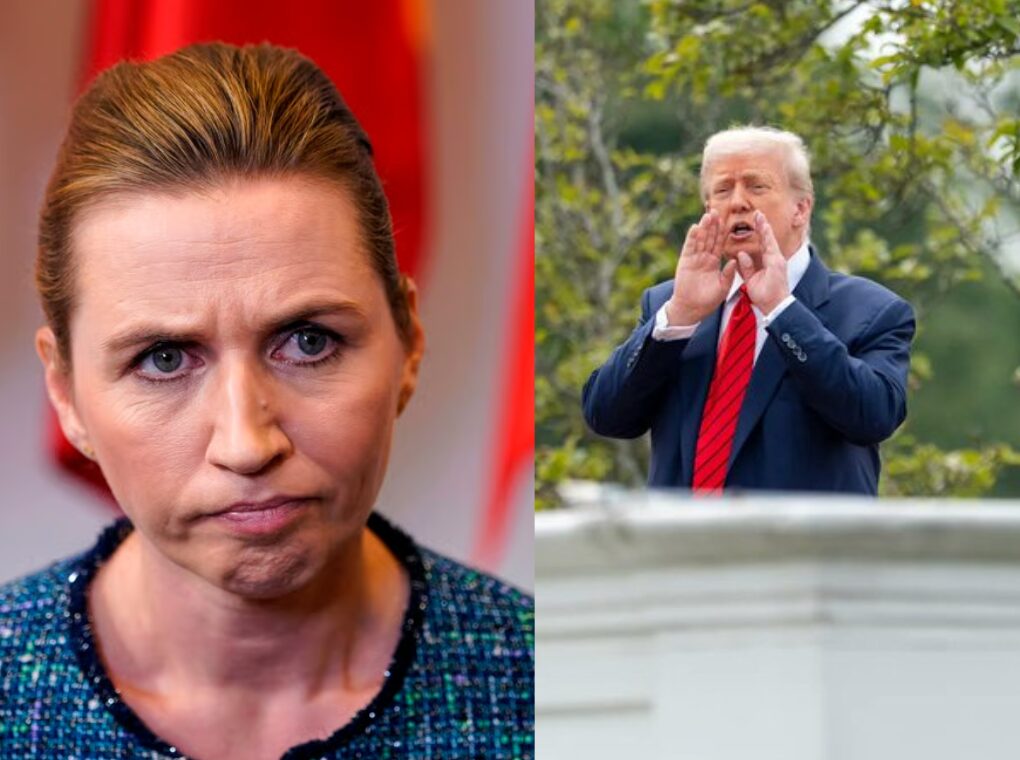
In early January 2026, renewed speculation around U.S. intentions toward Greenland triggered one of the most serious transatlantic controversies in decades. Reports from Politico and The Economist suggest that President Donald Trump’s administration is actively exploring a dramatic reshaping of Greenland’s status—ranging from coercive pressure to a sweeping Free Association Agreement that could sideline Denmark entirely.
The developments have prompted stark warnings from Danish Prime Minister Mette Frederiksen, who cautioned that a U.S. military move against Greenland would effectively end NATO as it has existed since World War II.
Greenland, the world’s largest island, is a semi-autonomous territory within the Kingdom of Denmark, home to roughly 57,000 people. Despite its small population, its strategic importance has grown rapidly as Arctic ice melts, unlocking access to rare earth minerals, new shipping routes, and expanded military relevance. Situated between North America and Europe, Greenland plays a crucial role in missile defense, early warning systems, and Arctic surveillance—factors that have long attracted U.S. strategic interest.
Danish PM Warns: A U.S. Invasion Would Collapse NATO
Danish Prime Minister Mette Frederiksen has issued unusually blunt warnings in response to recent rhetoric and reports emerging from Washington. According to Danish media, Frederiksen stated that if the United States were to militarily attack Greenland—territory covered under Denmark’s NATO membership—it would shatter the alliance’s foundations.
“If the United States attacks another NATO country, then everything stops — including NATO and the security system that has been in place since the end of World War II,” she said.
Her remarks reflect growing concern in European capitals that Washington may no longer be bound by traditional alliance norms. Frederiksen also emphasized that threats from the U.S. president must be taken seriously, pointing to what she described as the “sophisticated abduction” of Venezuelan President Nicolás Maduro as evidence that unprecedented actions are now conceivable.
Because Greenland falls under Danish sovereignty, any hostile U.S. move would place NATO in an unprecedented crisis: the alliance’s leading power acting as the aggressor against another member state.
Reports of a “Major Deal” With Greenland
Alongside the alarming rhetoric, U.S. media outlets report that the Trump administration is simultaneously developing a more diplomatic—but no less transformative—option. According to The Economist, Washington is preparing a draft agreement that could be offered directly to Greenland’s authorities, bypassing Copenhagen.
The proposal reportedly centers on a Compact or Free Association Agreement, a framework already used by the United States with Micronesia, the Marshall Islands, and Palau. Under such an arrangement, Greenland would retain internal self-governance while handing defense and certain foreign policy responsibilities to Washington. In return, the U.S. would provide substantial financial assistance, infrastructure investment, and guarantees aimed at raising living standards.
The strategy is said to have two primary objectives. First, to deepen political and economic divisions between Greenland and Denmark. Second, to open direct negotiations with Nuuk, undermining Copenhagen’s role as the island’s sovereign authority.
Politico has reported speculation that U.S. officials believe some Greenlandic leaders may be receptive to increased autonomy backed by American funding, especially as debates over independence from Denmark continue on the island.
Why Greenland Matters to U.S. Strategy
The United States already maintains a significant military presence in Greenland through the Pituffik Space Base (formerly Thule Air Base), a cornerstone of U.S. ballistic missile early warning systems. Trump and his advisers argue that Denmark has failed to adequately secure Greenland against rising Russian and Chinese activity in the Arctic.
As climate change accelerates Arctic accessibility, Greenland’s vast reserves of rare earth elements—critical for semiconductors, defense systems, and renewable energy technologies—have taken on renewed importance. Reducing Western dependence on China for these materials is a key U.S. strategic objective.
Some analysts suggest that any dramatic U.S. move could be timed for symbolic impact, with rumors circulating about a July 4, 2026, target date, coinciding with the 250th anniversary of American independence. While outright annexation is widely viewed as unlikely, critics warn that economic pressure and political leverage could achieve similar outcomes without troops.
Implications for Europe and NATO
European leaders have largely closed ranks behind Denmark, emphasizing that Arctic security must remain a cooperative NATO endeavor. France, Germany, and the United Kingdom have all reiterated support for Danish sovereignty, warning that unilateral U.S. actions would destabilize the alliance at a moment of already heightened global tension.
Within Greenland itself, polls consistently show limited support for becoming part of the United States. Many Greenlanders favor gradual independence or continued association with Denmark, though economic challenges and demographic decline make U.S. financial incentives an increasingly sensitive issue.
As talk of a “major deal” collides with invasion fears, Greenland has become a focal point for a broader question confronting the West in 2026: whether the post–World War II security order can survive an era of transactional geopolitics. What happens next may redefine NATO, Arctic power dynamics, and U.S.–Europe relations for decades to come.