
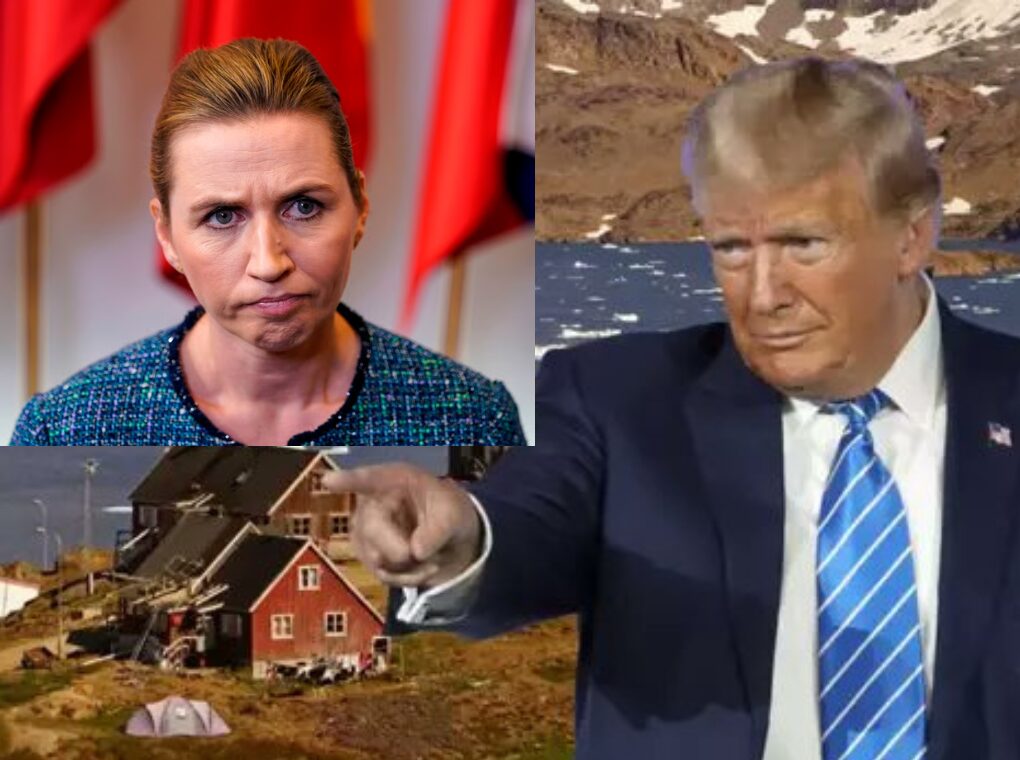
Tensions between the United States and its European allies have escalated sharply following reports that senior European Union officials warned Washington of sweeping retaliation if it attempts to seize Greenland. According to diplomatic sources, the warning was blunt and unprecedented: any U.S. move to take Greenland by force or coercion would trigger the expulsion of American military forces from Europe.
The threat underscores how Greenland — a sparsely populated Arctic island — has become a flashpoint capable of triggering the most serious transatlantic crisis since the creation of NATO.
Greenland at the Center of a Growing Crisis
Greenland is a semi-autonomous territory within the Kingdom of Denmark, a full NATO member. Though home to only about 57,000 people, the island holds immense strategic value due to its location between North America and Europe, its role in missile early-warning systems, and its vast reserves of rare earth minerals critical to modern industry and defense technologies.
As Arctic ice melts and new shipping routes open, Greenland’s importance has grown exponentially. For Washington, the island is seen as a strategic shield against Russia and China. For Europe, it represents a test of sovereignty, alliance norms, and the rule-based international order.
The crisis intensified after renewed signals from the Trump administration that it is exploring “all options” — including military ones — to secure control over Greenland. While U.S. officials frame the issue as a national security necessity, European leaders see it as a direct threat to an allied nation.
The EU’s Unprecedented Warning
According to officials familiar with closed-door discussions in Brussels, senior EU figures delivered a stark message to U.S. counterparts: any forced takeover of Greenland would result in the loss of U.S. military basing rights across Europe.
The warning reportedly covers American installations in Germany, Italy, Spain, Poland, and the Baltic states — bases that form the backbone of U.S. power projection, logistics, and deterrence capabilities on the continent.
Such a move would fundamentally alter Europe’s security architecture. The United States currently maintains tens of thousands of troops and critical infrastructure across NATO Europe, enabling rapid deployment to the Middle East, Africa, and Eastern Europe. Losing access to these bases would severely constrain Washington’s global military reach.
European officials argue that allowing a NATO leader to coerce or occupy the territory of another NATO member would destroy the alliance’s credibility. As one EU diplomat reportedly put it, “If alliances no longer protect sovereignty, then they are meaningless.”
Why the U.S. Wants Greenland?
The United States already operates the Pituffik Space Base (formerly Thule Air Base) in northwestern Greenland, a vital component of its ballistic missile early-warning system. However, Trump administration officials argue that Denmark has failed to adequately secure Greenland against growing Russian and Chinese activity in the Arctic.
Greenland’s rare earth deposits — essential for semiconductors, precision weapons, electric vehicles, and renewable energy technologies — are another major factor. Reducing dependence on China, which dominates global rare earth processing, is a key strategic goal for Washington.
President Trump has repeatedly stated that the U.S. “needs Greenland for security,” reviving rhetoric first seen during his initial term. This time, however, European capitals believe the administration is far more serious — and far more willing to use pressure to achieve its goals.
Europe Closes Ranks
European leaders have responded with rare unity. Denmark’s Prime Minister Mette Frederiksen warned that a U.S. attack on Greenland would effectively end NATO, calling it incompatible with the alliance’s founding principles.
France, Germany, and the United Kingdom have publicly reaffirmed their support for Danish sovereignty, emphasizing that Arctic security must be managed collectively, not through unilateral action. Privately, EU officials have discussed contingency plans for a dramatic breakdown in transatlantic relations.
The warning about U.S. bases represents a clear escalation — moving from diplomatic protest to concrete threats that would reshape military realities on both sides of the Atlantic.
Implications for NATO and Global Order
If carried out, the expulsion of U.S. forces from Europe would mark the most profound rupture in NATO’s history. The alliance’s collective defense framework depends heavily on American capabilities, while U.S. global strategy relies on European bases as logistical and operational hubs.
Analysts warn that such a breakdown would benefit rival powers. Russia would face a weakened NATO presence near its borders, while China could exploit divisions within the Western bloc to expand its influence globally.
At the same time, the crisis raises deeper questions about the future of alliances in an era of increasingly transactional geopolitics. If strategic interests override commitments to allies, the post–World War II security order may no longer be sustainable.
A Point of No Return?
For now, no formal action has been taken by either side. But the rhetoric alone marks a dramatic shift in transatlantic relations. Greenland, once considered a remote Arctic outpost, has become a symbol of a broader struggle over power, sovereignty, and trust among Western allies.
As one European official warned, “If Greenland falls, the alliance falls with it.” Whether diplomacy can still defuse the crisis — or whether the world is witnessing the beginning of NATO’s unraveling — remains an open and urgent question.