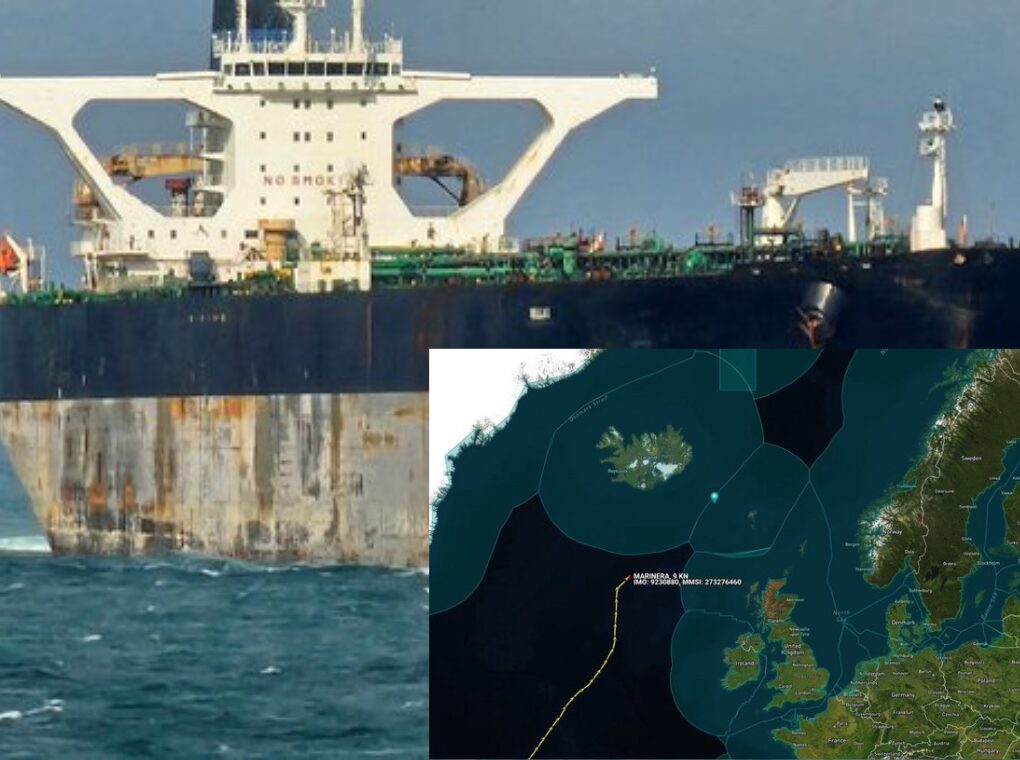
A serious maritime confrontation is unfolding in the North Atlantic as the United States and Russia square off over a sanctioned oil tanker that has become a flashpoint in the widening global sanctions war. The vessel, formerly known as Bella 1 and now renamed Marinera, sits at the center of a dangerous standoff involving US Coast Guard cutters, NATO air patrols, Russian naval assets, and reports of a Russian submarine deployed to deter an American seizure attempt.
The episode highlights how economic sanctions, maritime law, and military power are increasingly colliding far from traditional battlefields.
From Sanctioned Tanker to Russian-Flagged Vessel
The tanker Bella 1 was sanctioned by the United States for its alleged role in transporting crude oil linked to Venezuela and Iran, both countries under heavy US sanctions. According to US authorities, the vessel was part of a broader “shadow fleet” used to bypass international restrictions through deceptive shipping practices, frequent flag changes, and opaque ownership structures.
In late December, US authorities reportedly attempted to interdict the tanker after it allegedly attempted to breach enforcement measures tied to Venezuelan oil exports. Rather than comply with boarding requests, the vessel fled into international waters, triggering a prolonged pursuit across the Atlantic.
In a dramatic turn, the ship was renamed Marinera and re-flagged as a Russian vessel while already underway. Its hull markings were altered, and the Russian flag was prominently displayed. Moscow subsequently confirmed that the ship had been registered under Russian authority, instantly complicating the legal and military calculus for Washington.
A Chase Across the North Atlantic
Since the reflagging, the tanker has been shadowed by a US Coast Guard Legend-class cutter, supported by extensive aerial surveillance. US Navy P-8 Poseidon maritime patrol aircraft have been flying repeated sorties from bases in the United Kingdom and Iceland, focusing on the North Atlantic and the strategically vital GIUK Gap—an area long associated with submarine tracking during the Cold War.
Aerial refueling aircraft and allied fighter jets have also been observed operating in the same airspace, suggesting heightened readiness and coordination among NATO forces. These operations appear aimed not only at monitoring the tanker itself but also at detecting and tracking any Russian naval assets deployed to protect it.
Russia Raises the Stakes
Russia has responded forcefully. Moscow has reportedly dispatched naval escorts, including a submarine, to accompany the tanker and deter any US boarding attempt. Russian media has released footage showing an American patrol ship closely shadowing the tanker, framing the pursuit as an act of provocation in international waters.
Russian officials argue that once the vessel was lawfully registered under the Russian flag, any attempt to board or seize it without Moscow’s consent would constitute a violation of international maritime law. Diplomatic protests have reportedly been issued, warning the United States against interference with what Russia now claims as a sovereign commercial vessel.
Legal Grey Zones and Strategic Ambiguity
At the heart of the standoff lies a murky legal question. While international law generally protects flagged vessels from foreign boarding in international waters, critics argue that reflagging a sanctioned vessel mid-voyage—especially one already under pursuit—may lack legitimacy. Others counter that flag state authority, once granted, carries legal weight regardless of timing.
Complicating matters further is the fact that the tanker is reportedly traveling in ballast and is not currently carrying oil. While this undermines claims of immediate sanctions violations, US officials maintain that seizure could still be justified under existing warrants and prior sanction breaches.
Risk of Escalation
The presence of a Russian submarine alongside US anti-submarine patrol aircraft elevates the incident from a sanctions enforcement operation to a potential military flashpoint. Any miscalculation—an aggressive maneuver, a warning shot, or an attempted boarding—could rapidly escalate into a broader confrontation between nuclear-armed powers.
Military analysts note that this may be one of the most direct US–Russia naval stand-offs in international waters in decades. Unlike proxy conflicts or distant theaters, this confrontation involves direct tracking, shadowing, and signaling between opposing forces operating in close proximity.
A New Era of Sanctions Enforcement
For Washington, the pursuit of Marinera represents a more aggressive approach to sanctions enforcement, one that increasingly relies on naval power and international patrols rather than financial pressure alone. As sanctioned states adapt by building shadow fleets and exploiting legal loopholes, enforcement is moving from courtrooms and banks to open seas.
For Moscow, the decision to protect the tanker is a clear signal that Russia is willing to use military assets to shield commercial interests tied to its broader geopolitical alliances, particularly those involving sanctioned partners such as Venezuela and Iran.
A Symbol Larger Than the Ship
Ultimately, the Marinera is more than a tanker. It has become a symbol of the shifting global order, where sanctions are contested with warships, legal disputes are backed by submarines, and economic warfare increasingly risks kinetic consequences.
As the tanker continues its journey through the Atlantic, the world watches closely. Whether this standoff ends quietly or sets a precedent for future confrontations may shape how far major powers are willing to go in enforcing—or defying—economic sanctions in an increasingly fractured global system.