
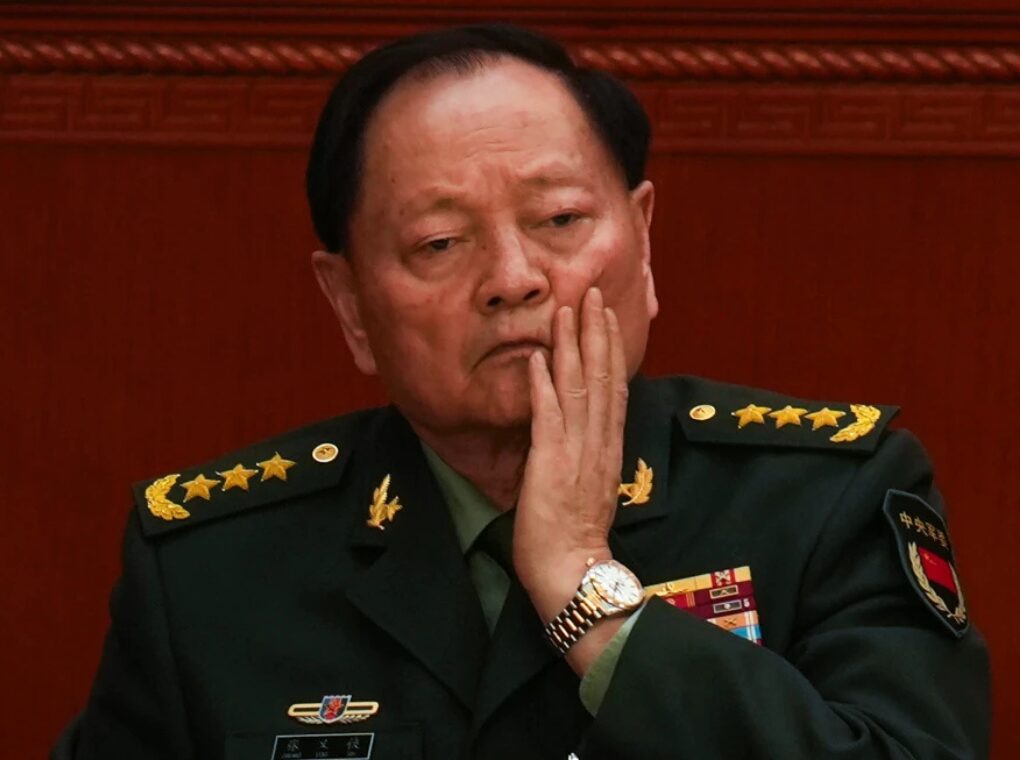
China is undergoing one of the most dramatic military leadership purges in its modern history, highlighted by the detention of General Zhang Youxia — a once-untouchable figure within President Xi Jinping’s inner circle. The move has sent shockwaves through political and defense circles, signaling a new phase in Xi’s drive to consolidate absolute control over the People’s Liberation Army (PLA).
General Zhang, who served as Vice Chairman of the Central Military Commission (CMC), held one of the highest positions in China’s military hierarchy. The CMC, chaired by Xi himself, oversees the entire armed forces. Zhang was widely regarded as both a trusted ally of Xi and one of the most influential military commanders in the country. His sudden fall from grace underscores the depth and intensity of the ongoing purge.
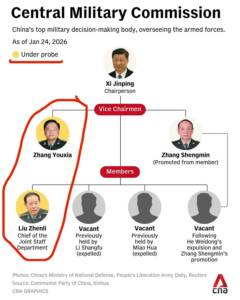

Authorities have accused Zhang of serious violations including corruption, political disloyalty, and even treason. Among the most explosive allegations are claims that he passed sensitive military information — reportedly connected to China’s nuclear weapons program — to foreign entities. He is also suspected of accepting bribes in exchange for facilitating military promotions and influencing defense procurement decisions.
While official statements remain vague, the scale of the accusations suggests that this is not merely another anti-corruption case. Instead, it reflects a broader political and strategic campaign aimed at reshaping the loyalty structure within China’s armed forces.
A Purge Years in the Making
Since coming to power in 2012, Xi Jinping has made control of the military a central pillar of his leadership. Early in his tenure, he launched a sweeping anti-corruption campaign within the PLA, arguing that graft, factionalism, and weak discipline had eroded combat readiness. Over time, that campaign evolved into a broader political cleansing designed to eliminate alternative power networks within the officer corps.
What makes the current wave of purges particularly striking is its scale and seniority. Numerous high-ranking officers across different branches — including the rocket forces, air force, navy, and strategic support units — have been removed, investigated, or disappeared from public view. Several top defense officials have lost their posts in rapid succession over the past two years.
Zhang’s detention marks the highest-profile case yet. As a “princeling” — a descendant of revolutionary leaders — Zhang had deep political roots and longstanding ties to Xi’s own family network. His career trajectory suggested he was among the safest figures in China’s power structure. That perception has now been shattered.
Power, Loyalty, and Fear of Instability
Analysts see the purge as driven by a mix of strategic calculation and political insecurity. The Chinese Communist Party maintains strict control over the military, but history has shown that powerful generals with independent networks can pose risks to centralized authority. By systematically dismantling entrenched patronage systems, Xi is ensuring that the PLA answers to him personally, rather than to factions or informal alliances.
The campaign also signals that loyalty now outweighs seniority or battlefield experience. Many of those promoted in recent years are known more for their political reliability than for operational command credentials. This shift could have long-term consequences for the professionalism and effectiveness of the force.
Some observers believe Xi may also be acting out of concern over internal instability during a period of mounting external pressure and economic challenges. A tightly controlled military reduces the risk of elite dissent or resistance during crises. From this perspective, the purge is as much about regime security as it is about military discipline.
Impact on Military Readiness
While centralizing control may strengthen Xi’s political authority, it carries short-term costs. Removing large numbers of experienced commanders disrupts institutional continuity and decision-making. New appointees often lack the operational experience and personal authority of their predecessors, which can slow planning and reduce confidence within the ranks.
This turbulence comes at a sensitive time for China’s strategic ambitions. The PLA has been undergoing rapid modernization, expanding naval capabilities, improving missile forces, and increasing pressure around Taiwan. Leadership instability at the top could temporarily hinder coordination of complex joint operations.
However, in the long run, Xi appears willing to accept short-term disruption in exchange for long-term political control. His vision is a military that is not only technologically advanced, but also ideologically aligned and personally loyal.
A Turning Point for China’s Power Structure
The fall of General Zhang Youxia represents more than an individual corruption case — it marks a decisive moment in the transformation of China’s military and political system. By removing even his closest associates, Xi Jinping is demonstrating that no rank, relationship, or revolutionary pedigree guarantees safety.
The message to the armed forces is unmistakable: ultimate authority rests with the party leader alone. As China continues its rise on the global stage, the internal reshaping of its military command may prove just as consequential as its expanding arsenal.