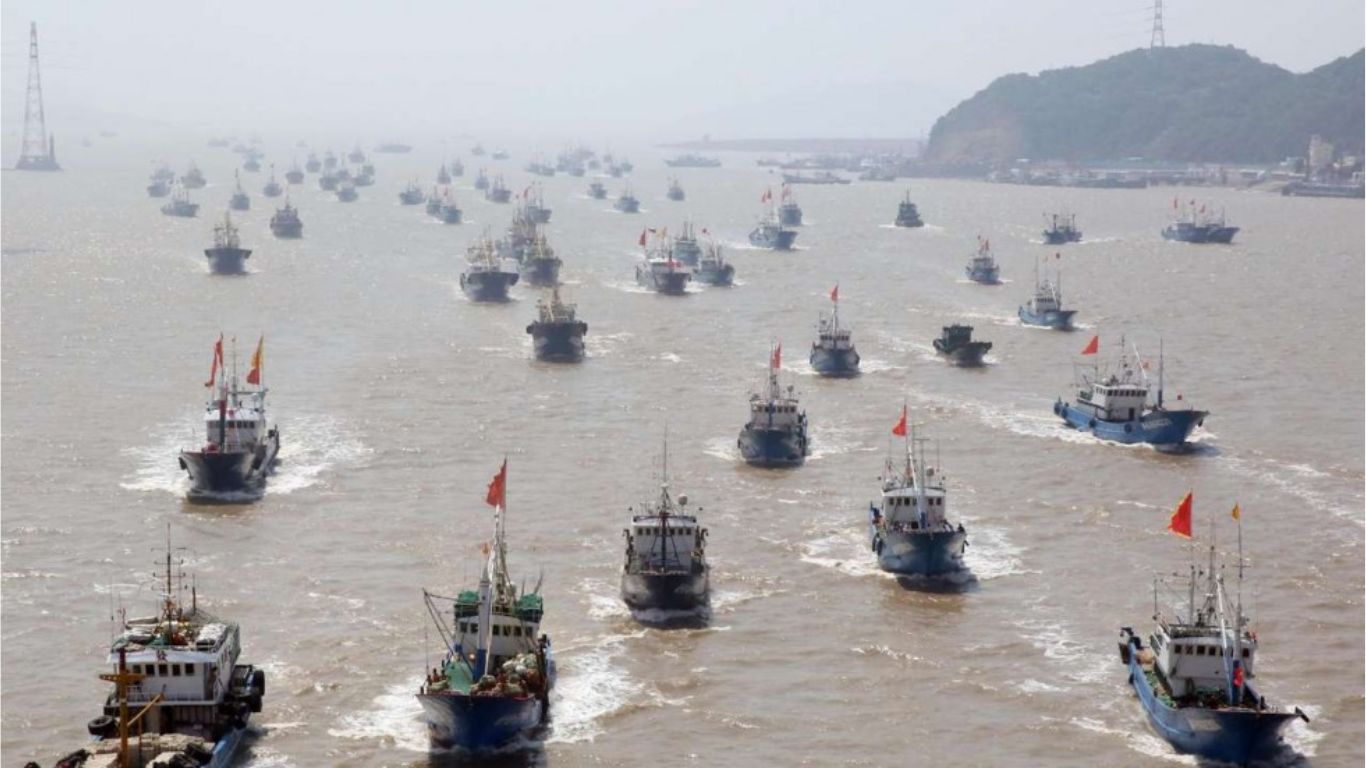
China’s distant-water fishing fleet has grown into the world’s largest. It operates far from its own shores and reaches deep into the waters of South America, West Africa, the Indian Ocean, Australia, and even Antarctica. Although many countries engage in global fishing, China’s scale, methods, and use of illegal, unreported, and unregulated (IUU) techniques have created widespread environmental damage and geopolitical anxiety.
China has already done this in its backyard and now its spreading this ill practice to the International waters and Exclusive Economic Zones (EEZs) of smaller nations.
As Chinese vessels continue to push into fragile ecosystems and vulnerable nations’ waters, the consequences are becoming increasingly difficult to ignore.
Natural Marine Habitats Under Stress
To understand the intensity of the crisis, it is essential to look first at the natural marine habitats being affected. Many of the regions where Chinese fleets operate—such as the waters off Ecuador, Peru, Chile, the Falkland Islands, West Africa, and northern Australia. These regions are biologically rich zones that support unique species, fisheries, and coastal communities. These areas depend on a delicate ecological balance, with predator–prey relationships that have developed over thousands of years.
However, intensive distant-water fishing disrupts these systems. Squid, anchovy, toothfish, and krill are not just commercial resources, they are basic species that sustain whales, large fish, sea birds, penguins, and almost entire food chains. When these species are killed in excessive quantities or through destructive practices such as bottom trawling, the loss cascades upward, weakening the survival capacity of predators and altering ocean health.
BREAKING – Video shows Chinese vessels operating with impunity off the coasts of the Persian Gulf and Gulf of Oman, employing “pulse fishing,” a highly destructive method that blasts high-voltage electricity into the sea to stun and bring millions of fish to the surface. pic.twitter.com/K6Qb9LC5fo
— Right Angle News Network (@Rightanglenews) December 10, 2025
Moreover, many regions visited by these fleets contain protected marine reserves or lie close to Exclusive Economic Zones (EEZs) of smaller nations that rely heavily on marine resources for food security. The intrusion of large industrial vessels immediately strains already vulnerable habitats.
Also Read: China’s Trade Surplus Crosses $1 Trillion in 11 Months, Reshaping Global Economy and Politics
How IUU Practices Create Maritime Imbalance
Beyond legal fishing in international waters, a large portion of China’s operations involves IUU fishing. This includes turning off AIS transponders, switching off engines to avoid detection, entering others’ EEZs illegally, and fishing just outside boundaries to exploit regulatory loopholes.
As a result, smaller and less-equipped nations struggle to monitor their seas, leading to a maritime imbalance that undermines sovereignty and environmental protections.
IUU fishing also distorts the global fish supply. When large fleets remove thousands of tonnes of squid, krill, or toothfish, local fishermen find their catches declining sharply. This generates economic loss for coastal communities and reduces the availability of affordable fish for domestic consumption.
In places such as West Africa, this imbalance has also contributed to food insecurity and pushed local fishermen into more dangerous waters.
Furthermore, the use of “dark fleets”, vessels that operate without identification or switch off GPS systems. It makes it harder for authorities to track stock depletion. As a result, the true level of poaching remains unknown, deepening the ecological damage.
China’s state subsidized fishing fleet over fishes and uses damaging methods like Sea floor scraping,
These fleets also hide their locations and fish in the waters of foreign countries. This requires international attention as many governments cannot counter these fleets. https://t.co/FHT4wGJ1EL pic.twitter.com/MgnykjqW9p
— Michael Ron Bowling (@mrbcyber) December 1, 2025
Antarctic Expansion: A New Environmental Alarm
Perhaps the most worrying trend is the expansion of Chinese fleets into Antarctic and sub-Antarctic waters. These remote zones are home to some of the world’s most fragile ecosystems. Here, krill, toothfish, and icefish form the backbone of the Southern Ocean food web.
Krill is especially vital because it feeds whales, seals, penguins, and countless fish species. Yet China is now one of the largest harvesters of Antarctic krill, using it for aquaculture feed, omega-3 supplements, and industrial products. When this essential species is overfished, it reduces food availability for whales and disrupts predator populations across the region.
Additionally, the practice of turning off trackers and entering protected Antarctic zones—sometimes drifting silently to avoid satellite monitoring—raises serious concerns. Because countries like Argentina, Chile, and New Zealand lack the naval capacity to patrol such vast regions. They often choose not to confront these incursions, even though the environmental consequences are severe.
Impact on Coastal and Small Nations
The geopolitical angle is also important in this matter. Many small or economically dependent nations do not to challenge China’s fishing practices due to fear of trade retaliation, diplomatic pressure, or reduced investment. In South America, for instance, countries rely heavily on Chinese markets for minerals, agricultural exports, and infrastructure loans. As a result, they often adopt a cautious stance, even when Chinese vessels operate suspiciously close to their coasts.
Similarly, in the Indian Ocean, several island states depend on Chinese development assistance, and their limited naval resources make it difficult to enforce maritime laws. This lack of resistance creates a power imbalance that allows large distant-water fleets to operate with relative impunity.
At the multilateral level, institutions like the Commission for the Conservation of Antarctic Marine Living Resources (CCAMLR) and the FAO’s Port State Measures Agreement are trying to enforce stricter global rules. However, gaps in enforcement, inconsistent reporting standards, and political disagreements limit their effectiveness.
Why the Situation Is Becoming a Global Crisis
Keeping all the discussed points in mind, China’s distant-water fishing is not only about environmental matters but also a threat to the overall maritime security involving International law and maritime boundaries of small nations.
The overexploitation of basic species, encroachment into small nations’ EEZs, and pressure on sensitive Antarctic ecosystems threaten food security, biodiversity, and geopolitical stability.
Ultimately, the crisis highlights a fundamental truth: the world’s oceans are interconnected. Damage done in the South Atlantic, West Africa, or Antarctica will have effects globally. Addressing this challenge demands not only environmental responsibility but also geopolitical courage.