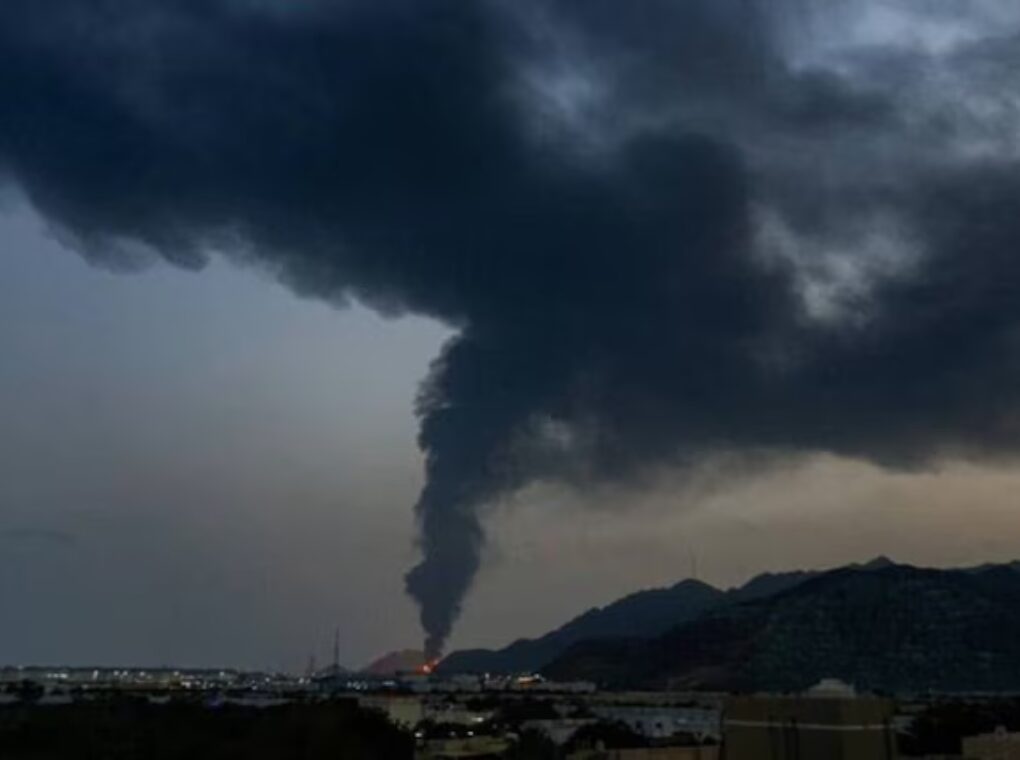
Tensions in the Middle East have sharply escalated after a reported Iranian drone strike triggered a major fire at a key petroleum facility in the Emirate of Fujairah, part of the United Arab Emirates. The incident has intensified fears of a broader regional conflict, particularly as it comes amid a fragile ceasefire between Iran and the United States.
Drone Strike Hits Strategic Oil Hub
According to Fujairah authorities, the strike targeted the Fujairah Petroleum Industries Zone, a crucial energy infrastructure hub located near the Strait of Hormuz—one of the world’s most vital maritime oil routes. The attack caused a “major fire,” prompting emergency response teams to rush to the scene and contain the blaze.
Officials confirmed that at least three Indian nationals were injured in the incident. They reportedly sustained moderate injuries and were immediately hospitalized. Their current condition is said to be stable.
The Fujairah facility plays a significant role in global oil logistics, serving as a storage and export center that helps bypass the Strait of Hormuz. Any disruption here raises serious concerns for global energy markets.
Missiles Intercepted Amid Rising Hostilities
Earlier in the day, the UAE’s Defense Ministry reported intercepting three Iranian cruise missiles over its territorial waters. A fourth missile reportedly fell into the sea before reaching its target. The swift response highlights the growing sophistication and readiness of UAE air defense systems amid escalating threats.
The UAE’s Foreign Ministry strongly condemned what it described as “renewed Iranian aggression,” warning that such actions pose a direct threat to regional stability. The ministry also asserted that the country reserves the right to respond to these attacks.
However, conflicting signals emerged from Tehran. A senior Iranian military official stated that Iran had no intention of targeting the UAE, adding further ambiguity to the situation.
Strait of Hormuz: The Flashpoint of Global Tensions
The crisis is unfolding against the backdrop of mounting tensions around the Strait of Hormuz, a narrow waterway that handles nearly 20% of the world’s seaborne oil trade. The strait has effectively become a geopolitical flashpoint following recent military actions by the US and Israel against Iran.
In late February, coordinated strikes by the US and Israel reportedly targeted Iranian positions, leading to a chain reaction of retaliatory threats and actions. Since then, maritime traffic through the strait has been severely disrupted, with shipping companies exercising caution amid rising security risks.
The United States, under President Donald Trump, has maintained a naval blockade of Iranian ports, aiming to pressure Tehran into a favorable peace agreement. Trump recently stated that the US may consider resuming full-scale military action if diplomatic talks fail.
Conflicting Claims and Military Activity
Amid the chaos, Iranian media outlets claimed that Iranian forces had struck a US Navy patrol vessel near the Strait of Hormuz. However, US Central Command quickly dismissed these reports, stating that no American naval assets had been hit.
Simultaneously, the US military reported sinking several Iranian “fast boats” allegedly targeting civilian shipping vessels. These incidents indicate that despite a nominal ceasefire, active military engagements continue across the region.
Iranian President Masoud Pezeshkian has condemned the US naval blockade as an “act of war,” arguing that it violates the ceasefire agreement reached earlier in April. Iranian Foreign Minister Abbas Araghchi echoed similar sentiments, calling the blockade “intolerable.”
Regional Spillover and Broader Conflict Risks
The conflict is no longer confined to Iran and the US. Neighboring countries are increasingly being drawn into the crisis. In Oman, a residential building was reportedly struck, injuring two expatriates and causing property damage. Meanwhile, Bahrain has declared a state of emergency, citing security concerns.
Further complicating the situation, Israeli military operations in southern Lebanon have continued despite the ceasefire. Reports suggest over 30 casualties in recent strikes, raising questions about the durability of diplomatic efforts.
The widening geographic scope of incidents—from the UAE to Oman and Lebanon—signals a dangerous trend toward regional escalation.
Global Economic Impact and Oil Market Shock
The geopolitical instability is already having significant economic repercussions. Disruptions in the Strait of Hormuz have led to a sharp rise in global oil prices. In the United States, gasoline prices have reportedly surged past $4.40 per gallon, reflecting the strain on global energy supply chains.
Experts warn that prolonged instability could trigger a sustained energy crisis, impacting economies worldwide. Asian and European markets, heavily dependent on Middle Eastern oil, are particularly vulnerable.
Uncertain Path Ahead
Despite ongoing backchannel diplomacy, trust between Iran and the United States remains deeply fractured. Iran has suggested it may ease restrictions in the Strait of Hormuz if US pressure is reduced, but Washington remains skeptical.
With military activity continuing and rhetoric intensifying, the situation remains highly volatile. The drone strike in Fujairah underscores how quickly tensions can escalate, threatening not only regional stability but also global economic security.
As the world watches closely, the coming days will be critical in determining whether diplomacy can prevail—or if the region is headed toward a broader and more destructive conflict.