A draft agreement between Iran and Oman would hand Tehran control over ships entering the Gulf through the Strait of Hormuz; one of the biggest concessions yet after five months of war with the United States – a senior Iranian source and two regional officials told Reuters on 5 August. If it holds, the channel carrying about a fifth of the world’s oil will reopen on Iranian terms, watched over from the same coastline Washington has bombed since February.
Before the war began on 28 February, the strait was open to all shipping and free to use. Iran is now seeking fees of between five and seven per cent of the value of cargoes passing through. Oman has floated about three per cent. Washington wants none.
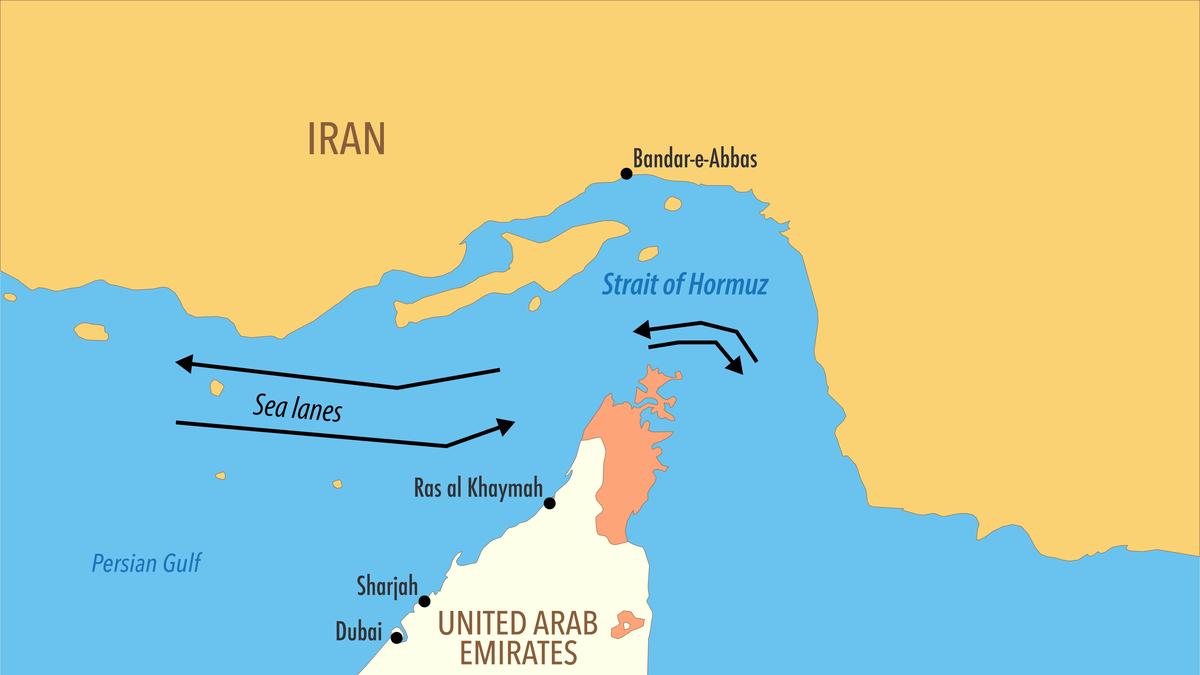
Iranian Deputy Foreign Minister Kazem Gharibabadi told the state news agency IRNA that the arrangement was designed so that “commercial ships will pass through Iranian territorial waters” on both the inbound and outbound legs. A regional official told Reuters the concession on some form of control had already been made; what remains unsettled is who inspects ships, and whether fees are voluntary.
US officials have insisted throughout that they would never accept Iranian control of the waterway. President Donald Trump said “a lot of progress had been made,” and hinted an announcement was close. AP reported that any deal is likely to depend on Washington lifting its naval blockade of Iranian ports.
How Geography Became Leverage
Hormuz narrows to roughly 33km, and its deep-water lanes run past a chain of Iranian islands — Qeshm, Hormuz, Hengam, and Larak. Coastal missile batteries, drones, fast attack boats and midget submarines can reach every metre of it. In April, War on the Rocks described an Iranian denial strategy cruder than China’s but effective precisely because the geography is so compressed.
Iran never needed to sink an American warship. It needed doubt. Within hours of the first strikes, the Revolutionary Guard was broadcasting warnings by radio; then came drone boats, missiles and, by March, sea mines. Insurers pulled cover and owners refused to sail. Traffic is still running at about 10 per cent of pre-war levels, Mark Cancian, an analyst at the Center for Strategic and International Studies and a former US Marine officer, wrote in Breaking Defense this month.
Why the West Could Not Force It Open ?
Cancian’s verdict: “A blocked Strait is a naval failure.” He noted the last Avenger-class minesweeper has retired with no adequate replacement, and that the navy’s 30-year shipbuilding plan does not mention the mission. The Christian Science Monitor reported in March that the service dismantled its Mine Warfare Command in 2006 and let the skill wither. Britain and France convened conferences; Germany, Italy and Spain ruled out warships.
The bill has also been paid in munitions. The US fired more than 850 Tomahawk cruise missiles in the first four weeks, the Washington Post reported. On 4 August, Reuters reported the army had expended “virtually all” of its ATACMS and Precision Strike Missiles. Iran has reported more than 3,400 dead since February; the US has reported 18 military personnel killed.
The Ghost of 18 March 1915
The precedent is not obscure. On 8 March 1915, the Ottoman minelayer Nusret quietly laid a line of mines in Erenköy Bay, where Allied battleships habitually turned. Ten days later a fleet of 16 capital ships tried to force the Dardanelles. Three — the French Bouvet and Britain’s Irresistible and Ocean — were sunk, and three more were put out of action. The navy could not do it alone. Troops landed at Gallipoli in April and withdrew the following January, having failed to open the strait, at a cost of hundreds of thousands of casualties.
The comparison is already circulating among strategists. The US Naval Institute’s Proceedings ran it in March; so did ASPI’s Strategist, which argued that forcing a passage would leave Washington the same fallback Britain took in 1915: seizing the shore. Meighen McCrae, associate professor of strategic and defence studies at the Australian National University, wrote in The Conversation that the lesson is not to underestimate an adversary.
The Case Against the Analogy
Not everyone accepts it. Steven Wills, a naval analyst at the Center for Maritime Strategy, called the naval-failure verdict “premature and misdirected,” arguing carrier aviation, Aegis warships and unmanned mine-hunting have performed well, and that Iran has not truly closed the strait. Proceedings noted another difference: Hormuz lies some 700 miles from Tehran, so no march on the capital is even on offer. Nor is this a declared war with public backing — polls cited by Reuters show US voters oppose it two to one, three months before November’s midterms.
Brent crude sat near $79 a barrel on 6 August. Foreign Minister Abbas Araghchi says the waterway will never return to its pre-war status. Whatever is signed, the precedent stands: a middle power turned 33km of water into a veto over the world economy. Other chokepoints have been watching.
Strait of Hormuz, Iran, Iran Strait of Hormuz, Hormuz crisis, Hormuz deal, Iran Oman deal, Iran Oman agreement, Persian Gulf, Gulf shipping, global oil trade, oil chokepoint, Strait of Hormuz oil, Hormuz shipping, maritime trade, maritime security, Iran US war, US Iran conflict, Iranian Navy, IRGC, IRGC Navy, Iranian missiles, Iran sea mines, naval mines, mine warfare, US Navy, US naval strategy, Gulf oil, global energy security, oil prices, Brent crude, Donald Trump, Abbas Araghchi, Gallipoli, Gallipoli campaign, Dardanelles, Hormuz Gallipoli, naval warfare, maritime chokepoints, Middle East conflict, Gulf crisis