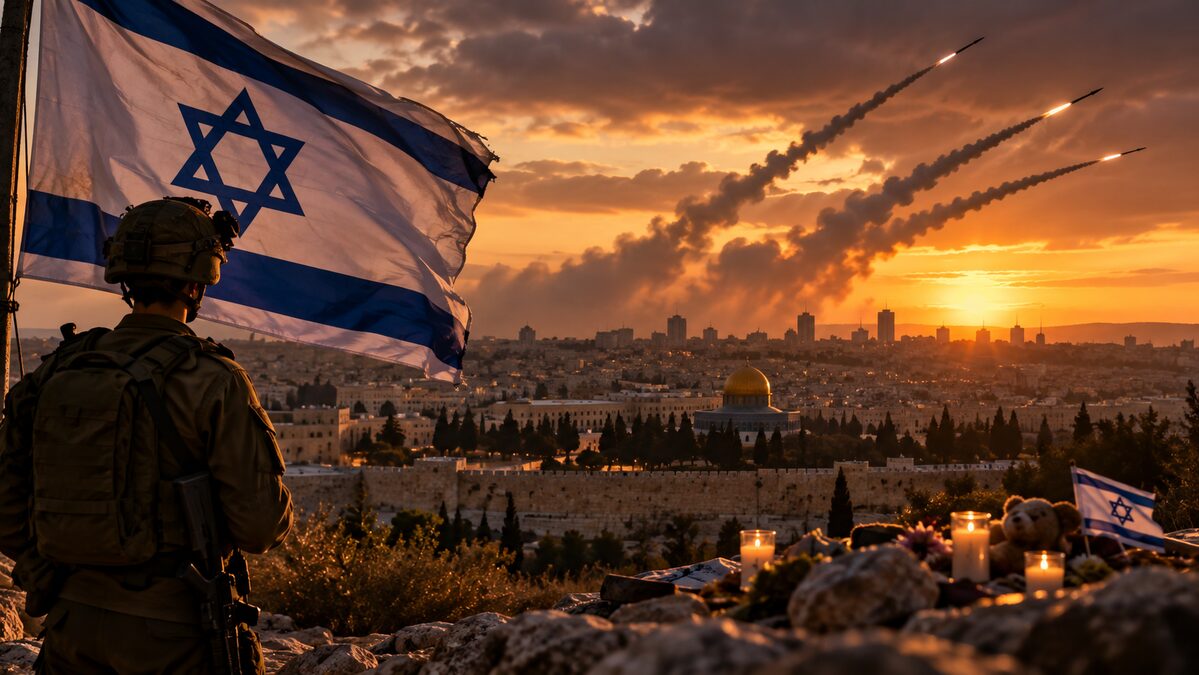
At 6:29am, Israel stops. That is the minute Hamas rockets first tore across the Negev sky in 2023. For sixty seconds this week, a country of ten million stood still. Then it went back to work, and to an election three weeks away.
A Morning the Nation Refuses to File Away
Israel buried more than 1,200 people after that Saturday. Terrorists dragged 251 hostages into Gaza. At the Nova festival near Re’im, attackers murdered over 370 young revellers. This week, families gathered again at Kibbutz Kfar Aza. They stood beside the armoury where neighbours fought room by room. Memorial events ran from the Gaza-belt kibbutzim to Mount Herzl. The Defence Ministry published a sobering tally on Sunday. Israel has lost 1,318 members of its security forces since that morning. Flags fell to half-mast at 6:29am across the country. IDF Chief of Staff Lieutenant-General Eyal Zamir spoke at Zikim base. He promised the army would teach future commanders by the example of the fallen.
A Country Remade by a Single Day
Israel did not simply change tactics. It tore up a doctrine.
For two decades, Israeli planners treated Hamas as a containable nuisance. They bought quiet with work permits and periodic rounds of fighting. That assumption died on 7 October. The state now spends like a nation at war. Defence outlays climbed to roughly 8–9 per cent of GDP after the attack. Debt-to-GDP rose towards 70 per cent. VAT went to 18 per cent. Israelis absorbed the bill with remarkably little complaint.
The reserves tell the human story. At the peak, 300,000 citizens left homes and businesses overnight. Engineers, surgeons and shopkeepers served tour after tour. The 2026 budget finally brought that number down to around 40,000 at any time. Politics shifted too. The Knesset dissolved in July. Israelis vote on 27 October. Former chief of staff Gadi Eisenkot now leads most polls, with Benjamin Netanyahu’s Likud close behind. One demand unites almost every opposition party: a full state commission of inquiry into 7 October. Israelis want to know how the warnings were missed. That argument will outlast this campaign.
The List, and the Men Still on it
Within weeks of the massacre, Israel created a unit called Nili. Its name comes from a biblical phrase: the Eternity of Israel will not lie. Its mission is singular. Find every terrorist who crossed the fence that day. Kill or capture each one. Nili works across the IDF, Shin Bet and Mossad. Analysts built a database from Hamas bodycam footage, captured documents and interrogations. The attackers filmed their own atrocities. Those films became evidence files.
In August, the IDF and Shin Bet publicly acknowledged the mission for the first time. By then Israel had eliminated roughly 2,800 names on the list. Around 300 more sit in Israeli custody awaiting trial. This week the figure rose again. Israel’s military intelligence chief told the cabinet that 4,000 of roughly 6,000 infiltrators have been killed.
The hunt has not paused for the ceasefire. On Friday, a strike in Nuseirat killed Ibrahim Abu Oweimer, a Nukhba platoon commander who entered Israel on 7 October. In July, forces killed Yahya Hamdan, who stormed the Re’im base. Earlier, Israel reached Izz al-Din al-Haddad, Hamas’s Gaza chief and a planner of the attack. Israeli officials frame this plainly. They call it law enforcement by other means, against men no court in Gaza would ever try.
From Massacre to Ceasefire
The American-brokered agreement took effect on 10 October 2025. Hamas released the last twenty living hostages three days later.
Recovering the dead took far longer. Israel brought home the remains of Ran Gvili, the final hostage, on 26 January 2026. His family had refused to let the country move on without him. Phase two has proved harder. A UN-mandated Board of Peace now oversees Gaza’s transition. Nickolay Mladenov serves as its high representative. Major General Jasper Jeffers commands the International Stabilisation Force. In July, the board announced a staged disarmament agreement covering Hamas and other armed factions. Israeli withdrawal tracks each verified stage of decommissioning. Israel’s cabinet approved the stabilisation force’s entry that same month. Israel still holds more than 60 per cent of the Strip. Jerusalem will not leave ground it cannot verify as demilitarised. Given 2023, few Israelis argue otherwise.
Reconstruction waits on that verification. The board has proposed a $2.45 billion six-month plan, with medium-term costs near $35.2 billion. Jared Kushner put the progress bluntly: “A year ago, none of this existed.”
The Region Hamas Did Not Expect
Hamas gambled that 7 October would unite an axis against Israel. It achieved the opposite. Hezbollah fired in solidarity and lost its leadership, its arsenal and its aura. Fighting resumed in March 2026 alongside the Iran campaign. Then came something nobody predicted. On 26 June, Israeli and Lebanese ambassadors signed a US-brokered framework agreement in Washington. It ties Israeli withdrawal to Hezbollah’s disarmament by the Lebanese army. President Joseph Aoun has since called that disarmament neither negotiable nor open to discussion.
Iran fared worse still. US and Israeli strikes began on 28 February 2026 and killed Supreme Leader Ali Khamenei. Tehran’s nuclear infrastructure, missile production and proxy network all took generational damage. The ring of fire has become a ring of ruins. Normalisation, meanwhile, survived the war. Kazakhstan joined the Abraham Accords in November 2025. Washington now ties a Saudi civil nuclear deal to Riyadh joining the Accords. Saudi Arabia still demands credible movement on Palestinian statehood.
What Comes Next
Three futures compete for the region. In the first, disarmament holds. The stabilisation force deploys, Gaza rebuilds under technocrats, and Israel withdraws in stages. Riyadh signs. Israel finally trades a hostile periphery for a commercial one.
In the second, Hamas stalls indefinitely. Israel holds its line, donors withhold funds, and Gaza freezes in place.
In the third, Iran rebuilds and the whole structure buckles.
Israelis have stopped assuming the best case. That, more than any battlefield result, is the real change since 2023. The country that woke on 7 October 2023 believed a fence could hold back fanatics. The country that stood silent this morning believes nothing of the sort. It has buried its dead, counted its enemies and learned to finish what it starts. Whether that hardness builds a durable peace remains the open question. Israelis will begin answering it at the ballot box on 27 October.