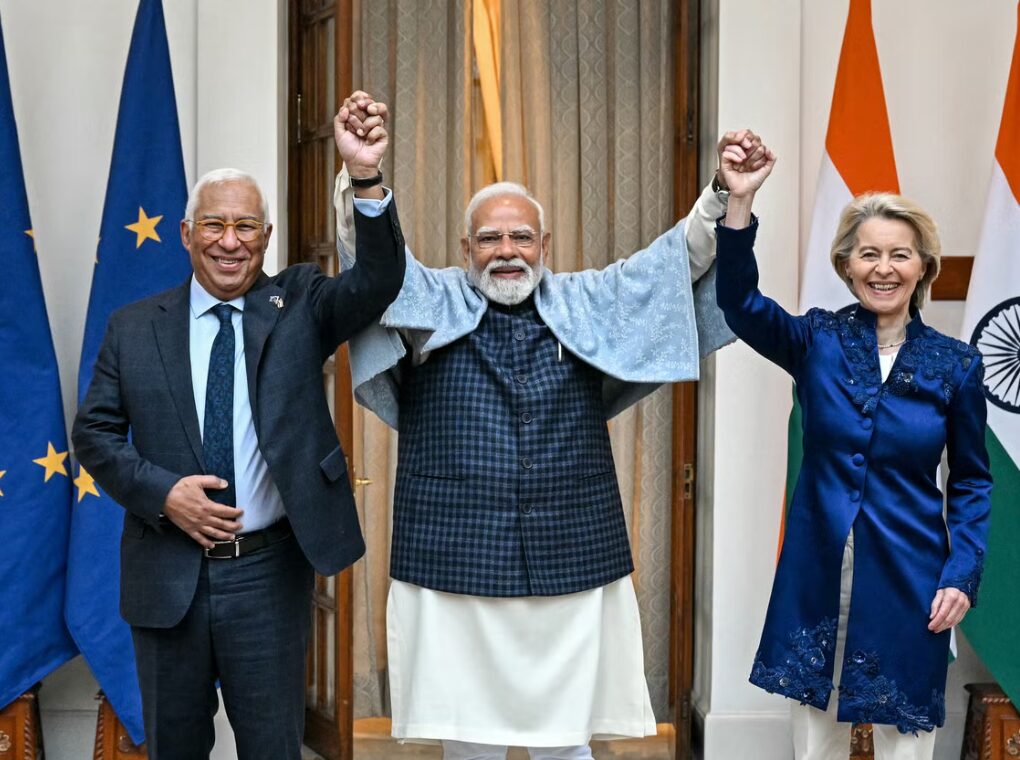
India and the European Union are set to announce what leaders have described as the “mother of all trade deals” — a sweeping Free Trade Agreement (FTA) that could reshape global trade alignments at a time of rising economic nationalism and tariff wars.
While the agreement is primarily about trade, tariffs, and market access, its timing and political backdrop give it much larger geopolitical significance. With Washington locked in tense trade negotiations with both New Delhi and Brussels, the India–EU pact is widely seen as a signal that major economies are increasingly looking to diversify partnerships beyond the United States and China.
A Trade Deal Two Decades in the Making
Negotiations between India and the EU began nearly 20 years ago but repeatedly stalled over issues such as agriculture, automobiles, intellectual property, and services access. What has changed now is the global trade climate.
Rising protectionism, supply chain disruptions, and the weaponization of tariffs have pushed both India and Europe to rethink their economic dependencies. The result is a trade pact that lowers barriers across a vast range of goods and services while respecting politically sensitive sectors.
Once implemented, the agreement will connect two of the world’s largest democratic markets — representing around two billion people and nearly one-quarter of global GDP.
Why This Deal Has Political Undertones
The agreement also lands at a moment of strained relations between the United States and several of its major partners. Former President Donald Trump’s return to aggressive tariff policies has created friction not only with rivals but also with traditional allies.
India has faced heavy tariff pressure from Washington in recent months, particularly over energy imports and trade imbalances. Europe, meanwhile, has been under pressure over defense spending, technology policies, and geopolitical disagreements. Trade negotiations between the US and EU have slowed, and talks between Washington and New Delhi have been tense and unpredictable.
In this context, the India–EU deal sends a subtle but clear message: both sides are willing to build major economic partnerships without relying on US approval or mediation. Rather than responding to pressure with concessions, India and Europe have chosen to strengthen ties with each other.
What the Trade Deal Means for India
For India, the FTA offers both economic and strategic advantages.
Lower Tariffs on European Goods
Indian consumers and businesses will benefit from reduced duties on a range of imports from Europe. These include:
Premium automobiles
Wines, spirits, and beer
Processed and gourmet foods
Industrial machinery and advanced equipment
Medical devices and healthcare technology
Cheaper access to high-end machinery and technology could help Indian manufacturers modernize, while consumers may see greater variety and competitive pricing in certain premium segments.
Protection for Sensitive Sectors
At the same time, India has ensured that sensitive sectors such as agriculture and dairy remain shielded from full tariff liberalization. This has long been a key red line for New Delhi, aimed at protecting millions of small farmers.
Boost for Indian Exports
The agreement will also make it easier for Indian exporters to access European markets. Labour-intensive sectors like textiles, leather, chemicals, marine products, and gems and jewellery are expected to gain from lower European tariffs, supporting jobs and industrial growth.
How Europe Benefits
The European Union gains access to one of the world’s fastest-growing large economies.
A Growing Consumer Market
India’s expanding middle class represents a major opportunity for European brands and manufacturers. Lower tariffs improve the competitiveness of European cars, machinery, pharmaceuticals, and consumer goods in the Indian market.
Services and Investment Opportunities
The deal also improves conditions for European companies in sectors such as finance, shipping, telecommunications, and professional services. More predictable rules and fewer barriers make India a more attractive destination for European investment.
Stronger Strategic Footing in Asia
Beyond trade, the agreement strengthens Europe’s long-term strategic presence in the Indo-Pacific region by deepening ties with a key democratic power.
The Trump Factor and Global Trade Realignment
The political symbolism of the India–EU FTA is hard to ignore. Both New Delhi and Brussels have faced pressure from Washington in recent years, often through tariffs and public criticism. Rather than escalate tensions directly, they have quietly pursued a major alternative partnership.
In many ways, the deal reflects a broader global shift: countries are increasingly seeking multiple economic anchors rather than relying heavily on one dominant market. Trade is becoming more diversified, more regional, and more strategically driven.
Some analysts believe the agreement could eventually nudge the United States back toward more constructive negotiations, as Washington risks losing influence if partners deepen ties elsewhere.
More Than a Trade Pact
The India–EU Free Trade Agreement is not just about cheaper imports or higher exports. It represents a strategic alignment between two major democratic economies at a time when the global trading system is under stress.
For India, it reinforces economic independence and global relevance. For Europe, it opens doors to growth and strengthens its position in Asia. And for the world, it signals that even in an era of tariff wars and political friction, large-scale cooperation is still possible through patient, pragmatic negotiation.