
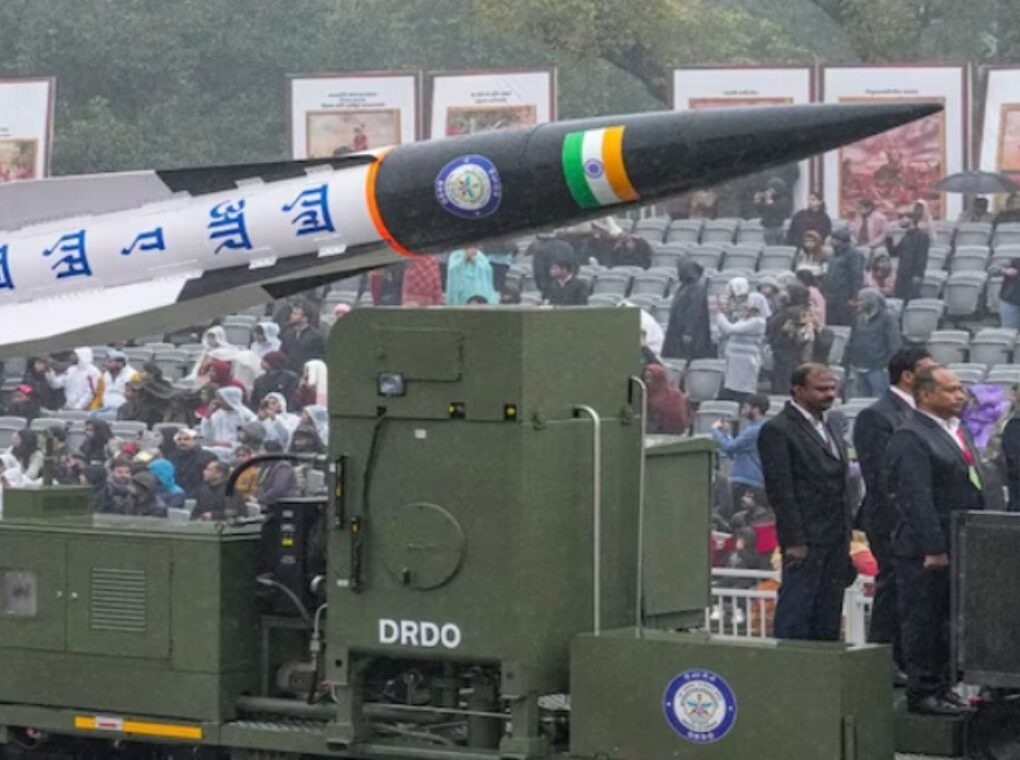
On January 26, 2026, India will publicly unveil one of its most consequential indigenous weapons systems yet—the Long Range Anti-Ship Missile (LR-AShM)—during the Republic Day parade in New Delhi. Developed by the Defence Research and Development Organisation (DRDO) for the Indian Navy, the missile’s debut places India firmly among a small group of nations that have mastered hypersonic glide vehicle (HGV) technology.
In an era where control of the seas increasingly defines geopolitical power, the LR-AShM is more than a ceremonial showcase. It represents a strategic shift in how India intends to deter adversaries, protect sea lanes, and project power across the Indian Ocean Region (IOR).
What Makes LR-AShM Different
Unlike conventional cruise or ballistic missiles, the LR-AShM follows a quasi-ballistic hypersonic glide trajectory. After launch, a solid-fuel booster accelerates the missile to hypersonic velocity—reportedly peaking near Mach 10—before the glide vehicle separates and begins sustained atmospheric flight.
During this glide phase, the missile performs controlled manoeuvres, including trajectory “skips,” allowing it to:
Extend its range
Alter flight paths unpredictably
Evade missile defence systems
With an operational range of approximately 1,500 km, the LR-AShM enables India to strike high-value naval targets such as aircraft carrier strike groups well beyond the reach of traditional anti-ship missiles.
Equipped with indigenous sensors, inertial navigation systems, satellite-aided guidance, and active radar seekers, the missile can engage moving targets during its terminal phase, even in electronically contested environments.
According to India’s defence ministry, its low-altitude, high-speed, and highly manoeuvrable flight profile significantly reduces radar detection windows, complicating interception efforts by ship-based and ground-based air defence systems.
A Maritime Game-Changer
Initially, the LR-AShM will be deployed from land-based mobile launchers along India’s coastline, strengthening coastal defence and anti-access/area denial (A2/AD) capabilities. Over time, ship-borne and air-launched variants are expected, expanding operational flexibility as integration challenges are resolved.
From a naval warfare perspective, this capability reshapes threat calculations in the Indian Ocean. A hypersonic anti-ship missile that can reach deep into the ocean in under 15 minutes compresses decision-making timelines for adversaries and challenges existing naval defence doctrines.
How India Compares Globally
India now joins Russia and China as countries with demonstrated hypersonic glide weapon capabilities.
Russia has deployed systems such as the Avangard hypersonic glide vehicle and the Kinzhal air-launched missile, claiming operational use in the Ukraine conflict.
China has fielded the DF-17, an operational medium-range ballistic missile equipped with an HGV, and continues rapid expansion of its hypersonic arsenal.
The United States, by contrast, remains behind in operational deployment despite heavy investment. Programs such as the Long-Range Hypersonic Weapon (LRHW)—known as “Dark Eagle”—have faced repeated delays due to technical challenges, testing setbacks, and integration issues.
Washington has spent over $12 billion across multiple hypersonic programs, yet as of early 2026, no US hypersonic missile system is deployed with combat units. While the US continues to conduct successful flight tests and emphasizes long-term technological depth, the absence of fielded systems contrasts sharply with the operational progress seen in Russia, China, and now India.
Strategic Implications
India’s LR-AShM is not aimed at arms racing but at credible deterrence. The Indian Ocean carries a significant portion of global trade and energy flows, and India’s geography places it at the center of this maritime crossroads.
By fielding a hypersonic anti-ship capability, India signals:
A commitment to maritime dominance in its near seas
An ability to hold adversary naval assets at risk without forward deployment
Growing self-reliance in advanced defence technologies
The missile’s public debut, alongside a DRDO tableau highlighting submarine combat systems such as Air Independent Propulsion (AIP) and heavyweight torpedoes, reinforces India’s broader push toward indigenous military modernization.
A Message Beyond the Parade
Republic Day parades are symbolic, but symbols matter in geopolitics. The LR-AShM’s appearance at Kartavya Path sends a clear message to allies and adversaries alike: India is no longer merely catching up in advanced missile technology—it is shaping the balance in its maritime theatre.
As hypersonic weapons redefine speed, survivability, and deterrence, India’s entry into this exclusive club marks a pivotal moment—not just for its navy, but for the evolving security architecture of the Indo-Pacific.