
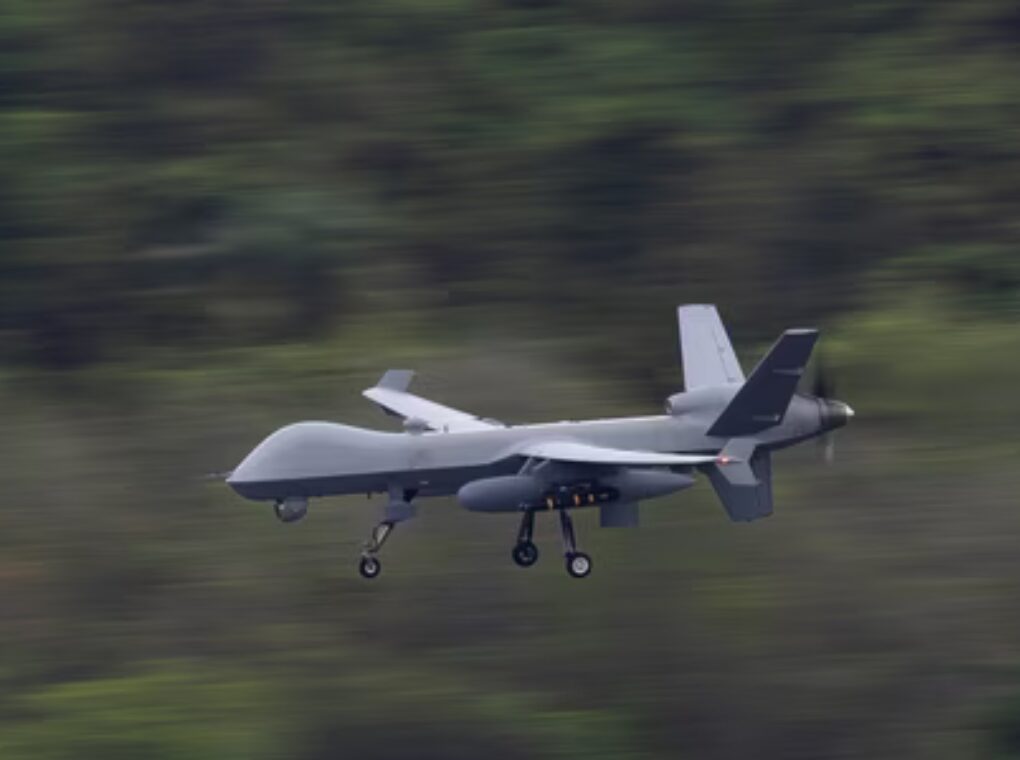
The ongoing US-led military confrontation with Iran has reportedly inflicted heavy financial and strategic losses especially on Washington’s unmanned warfare capabilities, with a new Bloomberg report claiming that Iran has destroyed up to 30 MQ-9 Reaper drones worth nearly $1 billion since the war began in February 2026.
The MQ-9 Reaper, one of the most widely used surveillance and strike drones in the US military arsenal, has become a central asset in the escalating conflict. However, according to officials cited in the report, its effectiveness is being increasingly challenged in contested Iranian airspace.
Massive Drone Losses Reported in Active Combat Zone
Bloomberg, citing a person familiar with the matter, reported that at least 24 MQ-9 Reaper drones—and possibly as many as 30—have been lost during operations. These losses include drones shot down by Iranian air defenses, destroyed on the ground during missile strikes, and aircraft written off after sustaining heavy damage.
Each MQ-9 Reaper is estimated to cost around $30 million, meaning total losses could approach or exceed $900 million. The figure represents nearly 20% of the Pentagon’s pre-war inventory of the aircraft, marking one of the most significant attrition rates for US unmanned systems in recent years.
The drones, manufactured by General Atomics, are equipped with advanced surveillance systems, infrared sensors, and can carry precision-guided munitions such as Hellfire missiles and JDAM bombs.
Strategic Setback for US Drone Warfare
Military analysts cited in the report say the losses highlight growing vulnerabilities in US drone-dependent warfare strategies, especially in environments where adversaries maintain layered air defense systems.
Despite early US and Israeli strikes reportedly weakening parts of Iran’s air defense infrastructure, large sections of Iranian airspace remain hazardous for unmanned aerial vehicles.
Bloomberg Economics defense analyst Becca Wasser noted that while MQ-9s are technically “attritable,” their high cost and limited availability make them far from expendable.
“MQ-9s may be attritable as they are uncrewed, but they are too expensive and too few with no active production line to be considered expendable,” Wasser said.
The report also highlights a deeper structural issue: the MQ-9 Reaper is no longer being produced for US military forces, limiting the ability to quickly replace losses.
Limited Alternatives and Production Constraints
The setback is compounded by the Pentagon’s limited alternatives. According to the report, only around 10 units of the newer jet-powered Avenger strike drone have been produced, leaving a significant capability gap.
While variants of the Reaper continue to be manufactured for select foreign customers, production for US forces has effectively ended, raising concerns about long-term operational sustainability in high-intensity conflict zones.
The lack of replacement platforms could force the US military to either reduce drone deployments or rely more heavily on crewed aircraft, which carry higher risk to personnel.
Wider Military Losses Add Pressure
The drone losses are part of a broader pattern of attrition in the ongoing conflict. A Congressional Research Service (CRS) report cited in the coverage outlines additional US military equipment losses, including:
- 4 F-15E Strike Eagles
- 1 F-35A Lightning II
- 1 A-10 Thunderbolt II
- 7 KC-135 Stratotankers
- 1 E-3 Sentry AWACS aircraft
- 2 MC-130J Commando II aircraft
- 1 HH-60W Jolly Green II helicopter
- 1 MQ-4C Triton drone
- 24 MQ-9 Reaper drones
The report also notes extensive consumption of high-value precision weapons, including Tomahawk cruise missiles and JASSM-ER long-range strike systems.
These cumulative losses reflect the intensity and duration of the conflict, which has seen sustained military exchanges between US-Israeli forces and Iranian defense systems.
Fragile Ceasefire Amid Continuing Tensions
The conflict escalated sharply following US and Israeli strikes on Iran on February 28, 2026. Although a fragile ceasefire has been in place since April 8, sporadic strikes and ongoing rhetoric from both sides continue to keep tensions high across the region.
US President Donald Trump has described ongoing diplomatic negotiations as being “on the borderline” between reaching an agreement and renewed escalation.
Meanwhile, reports from US media outlets, including NBC News, suggest that Washington is considering renaming its military campaign as “Operation Sledgehammer” should talks collapse and combat operations resume.
While there has been no official confirmation of a renewed offensive strategy, the remarks indicate that military planning remains active behind diplomatic discussions.
Growing Debate Over Drone Warfare Effectiveness
The reported losses have reignited debate over the role of drone warfare in modern military strategy. While drones like the MQ-9 Reaper have been central to US operations for surveillance and precision strikes, their vulnerability in contested airspace is increasingly under scrutiny.
Analysts suggest that adversaries with integrated air defense networks, like Iran, are narrowing the technological advantage traditionally held by US unmanned systems.
As the conflict continues, questions are mounting over whether high-cost drones remain viable in peer or near-peer conflicts—or whether new generations of stealthier, more survivable systems will be required.
The reported destruction of up to 30 MQ-9 Reaper drones marks one of the most significant equipment losses for US forces in the ongoing Iran conflict. Combined with broader military attrition and a fragile ceasefire, the situation underscores both the intensity of the war and the evolving challenges of modern drone-centric warfare.
With diplomacy still uncertain and military planning ongoing, the conflict between the US, Israel, and Iran appears far from resolution—keeping global attention firmly fixed on the region’s next move.