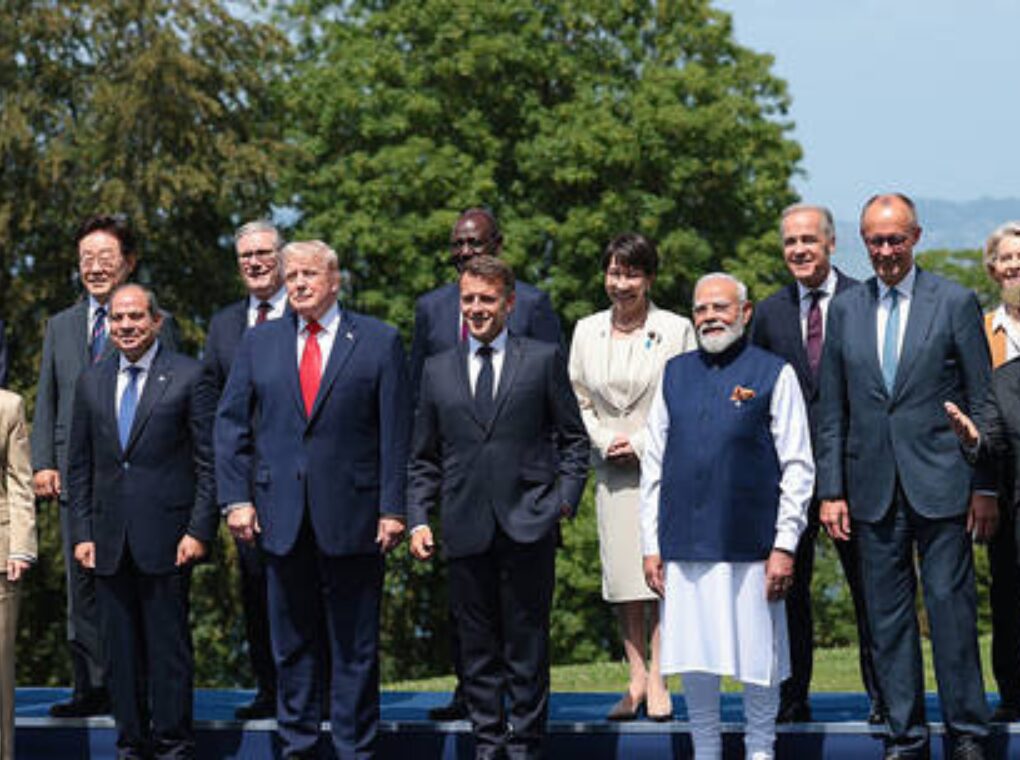
The 2026 G7 Summit in France opened against the backdrop of growing geopolitical tensions and a rapidly changing global order, with major remarks from US President Donald Trump and Canadian Prime Minister Mark Carney dominating global headlines.
Speaking at the summit in Evian, Trump addressed a range of global flashpoints, including Iran, Israel, the Strait of Hormuz, and the ongoing Russia-Ukraine conflict. Meanwhile, Carney declared that the G7 “no longer runs the world,” emphasizing the growing influence of emerging powers such as India.
Trump on Iran: ‘No Regime Change’
Trump made it clear that the United States would not pursue regime change in Iran, arguing that history has repeatedly shown such interventions often fail.
“I don’t believe in regime change. I’ve watched regime changes for years, and they never work,” Trump said while speaking on the sidelines of the summit.
His remarks came after Washington and Tehran virtually signed a draft peace framework aimed at ending months of tensions that disrupted maritime trade and regional stability. According to Trump, future negotiations with Iran are expected to focus on Tehran’s nuclear program and possible financial arrangements.
However, Trump emphasized that the United States would not be financially investing in Iran despite progress in diplomacy.
Strait of Hormuz to Stay ‘Toll-Free’
Addressing concerns over disruptions in global energy routes, Trump assured world leaders that the Strait of Hormuz would remain open for international shipping.
“The Strait is going to be open toll-free,” Trump said, praising the role of the US Navy during recent tensions in the Gulf.
The strategic waterway, responsible for transporting a major portion of the world’s oil supply, became a flashpoint after regional conflict and naval confrontations affected commercial shipping and raised fears of a global energy crisis.
Trump Expresses Frustration with Netanyahu
In one of the summit’s more surprising moments, Trump openly admitted dissatisfaction with Israeli Prime Minister Benjamin Netanyahu.
Trump said he was “not satisfied” with Netanyahu’s handling of Israel’s military objectives and suggested that Syria may possess better communication channels with Hezbollah than Israel.
The US president also expressed concerns that prolonged military operations had led to high civilian casualties and complicated wider diplomatic efforts in the region, including the US-Iran peace breakthrough.
Russia-Ukraine War: ‘Russia Should Make a Deal’
On the ongoing Russia-Ukraine war, Trump renewed calls for peace negotiations following what he described as a “very good” meeting with Ukrainian President Volodymyr Zelenskyy.
“Russia should make a deal,” Trump said, reiterating his commitment to ending the conflict.
The remarks come as the nearly four-year war continues to strain global energy markets, military alliances, and international diplomacy.
Canada’s Mark Carney: ‘G7 No Longer Runs the World’
In a statement reflecting changing global realities, Canadian Prime Minister Mark Carney said the G7 can no longer claim to dominate international affairs.
“It’s a recognition that the G7, if it ever did run the world, no longer runs the world or pretends to,” Carney said ahead of the summit.
He highlighted the participation of countries such as India, Brazil, Egypt, Kenya, and Gulf nations as evidence that solving major global problems now requires a broader coalition of countries beyond the traditional Western bloc.
Carney specifically pointed to India’s growing influence, especially as New Delhi currently holds the BRICS presidency.
India’s Rising Global Role at G7
Indian Prime Minister Narendra Modi is expected to hold key bilateral discussions with Trump during the summit amid ongoing tensions over trade tariffs and broader geopolitical cooperation.
The summit also comes as India continues pushing for reforms in global institutions, including the UN Security Council, arguing that current structures no longer reflect modern geopolitical and economic realities.
As the G7 expands its outreach to emerging and middle powers, the 2026 summit may mark a turning point in shaping what many leaders are calling a **new multipolar world order.