A dramatic near-collision in low Earth orbit (LEO) has triggered one of the largest satellite repositioning efforts in history, underscoring growing fears that space is becoming dangerously crowded. Following a close encounter between a Chinese satellite and a SpaceX Starlink spacecraft, the American company has begun lowering the orbits of roughly 4,400 satellites — nearly 40% of its active constellation — by about 70 kilometers.
The maneuver is not just a routine adjustment. It reflects mounting concern that Earth’s orbital highways are filling up faster than global coordination systems can handle.
A Close Call in a Crowded Sky
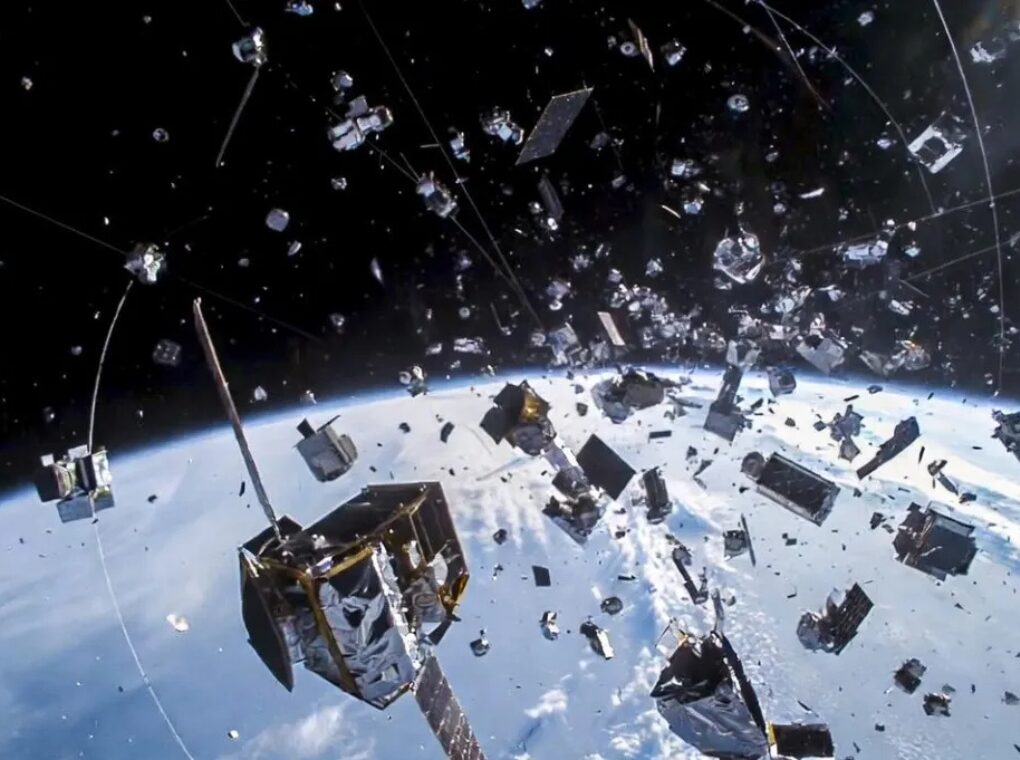
The incident occurred in December when a newly launched Chinese Earth-observation satellite passed within roughly 200 meters of a Starlink satellite. In cosmic terms, that distance is razor-thin. At orbital speeds exceeding 27,000 kilometers per hour, even a small fragment can destroy a satellite. A full collision between two intact spacecraft would have generated thousands of debris fragments, each capable of triggering further impacts.
Although automated systems and tracking networks prevented disaster, the near miss highlighted a key vulnerability: incomplete data sharing between satellite operators. When satellites are launched without widely distributed trajectory data, other operators may receive little warning of potential conflicts.
This time, disaster was avoided. Next time, the outcome might not be so forgiving.
Why 70 Kilometers Matters
To reduce long-term risk, SpaceX announced it would lower thousands of Starlink satellites from an orbital band around 550 km to approximately 480 km. On paper, that drop may sound minor. In orbital mechanics, however, altitude determines everything from debris density to atmospheric drag.
Lower orbits have two key safety advantages. First, they tend to contain fewer large constellations than the increasingly popular 500–600 km band. Second, atmospheric drag is slightly stronger at 480 km, meaning defunct satellites or debris naturally reenter Earth’s atmosphere faster instead of lingering for decades.
In short, satellites placed lower are easier to “clean up” if they fail.
The Shadow of Kessler Syndrome
This event has revived discussion of a long-feared scenario known as Kessler Syndrome — a cascading chain reaction of orbital collisions. First proposed in 1978, the theory suggests that once debris density reaches a tipping point, collisions create more debris, which causes more collisions, potentially making parts of orbit unusable for generations.
For decades, this remained largely theoretical. Today, it feels uncomfortably plausible.
Low Earth orbit is no longer the quiet scientific frontier it once was. Thousands of satellites now provide broadband internet, Earth imaging, navigation, and military surveillance. Mega-constellations — some planned to include tens of thousands of satellites — are multiplying rapidly. Every launch increases congestion and raises the probability of accidental encounters.
Even a single catastrophic crash could release a debris cloud spreading across multiple orbital paths, threatening spacecraft belonging to many nations.
A Coordination Problem, Not Just a Technology Problem
Modern satellites are increasingly equipped with autonomous collision-avoidance systems. Starlink satellites, for example, can maneuver using electric thrusters when tracking networks predict a potential impact.
But automation only works when there is reliable data. Satellite operators must share accurate and timely information about position, velocity, and planned maneuvers. Without that transparency, avoidance systems are forced to react with incomplete knowledge — a risky gamble in a domain where seconds and meters matter.
The recent near-collision illustrates how gaps in coordination can become global safety threats. Space may be vast, but the usable orbital lanes around Earth are surprisingly limited.
Geopolitics Moves Into Orbit
This is not just a technical issue — it is geopolitical. Major powers are racing to deploy large constellations for communications, reconnaissance, and strategic resilience. The United States, China, Europe, India, and Russia all have ambitious LEO expansion plans.
China has previously warned that massive commercial constellations pose hazards to shared orbital resources. At the same time, Beijing is developing its own large broadband networks. The result is a paradox: every nation wants more satellites, but no one wants more congestion.
Without agreed-upon global traffic rules, the risk of misunderstanding — or worse, accidental damage interpreted as hostile action — increases.
A Turning Point for Space Governance
SpaceX’s decision to reposition thousands of satellites is being seen as a proactive safety measure, but it also sends a broader message: the era of unregulated orbital expansion is ending. Voluntary guidelines may no longer be enough.
Experts increasingly argue for:
Mandatory sharing of orbital trajectory data
International standards for collision avoidance
Strict end-of-life disposal requirements
Active debris removal missions
Possible “orbital zoning” or traffic corridors
Earth’s orbit is a shared, finite resource. Unlike oceans or airspace, there is no natural recovery process for space debris on human timescales — especially at higher altitudes.
The Bigger Picture
The Starlink maneuver is not a retreat, but a recalibration — a recognition that sustainability in space now requires constant vigilance and global cooperation. The near-collision served as a warning shot across the bow of the spacefaring world.
If satellite traffic continues to grow without coordination, the nightmare scenario scientists have warned about for nearly half a century could move from theory to reality.
For now, the skies above remain open. But they are getting crowded — and humanity is running out of room for error.