
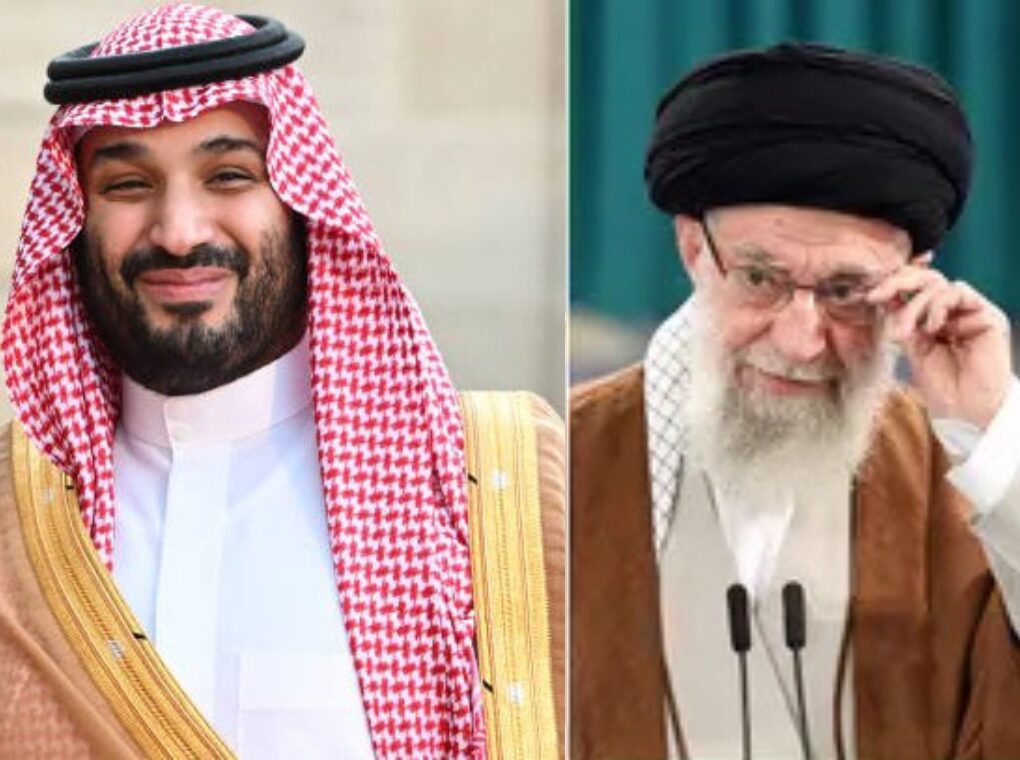
A former senior Iranian military commander has made a striking allegation that could complicate already volatile tensions in the Middle East. Hussein Kanani, once a high-ranking figure in Iran’s Islamic Revolutionary Guard Corps (IRGC), has claimed that Saudi Arabia possesses nuclear weapons — and that the United States is fully aware of it.
The accusation, delivered during a televised interview, has not been supported by publicly available evidence and has not been independently verified. Still, the timing of the claim is significant. It comes as Washington and Tehran face renewed confrontation over Iran’s nuclear activities, military deployments in the region are increasing, and diplomacy remains fragile.
Kanani’s statement has reignited a long-standing debate about whether global nuclear non-proliferation efforts are applied consistently — or shaped by geopolitical alliances.
A Region on Edge
Tensions between the United States and Iran have steadily escalated in recent years. After Washington withdrew from the 2015 Joint Comprehensive Plan of Action (JCPOA) nuclear agreement, Iran gradually reduced its compliance with the deal’s limits. Uranium enrichment levels have since risen well beyond the original thresholds, alarming Western governments concerned about how quickly Tehran could move toward weapons-grade material if it chose to do so.
Iran insists its nuclear program remains peaceful and points to what it describes as Western violations of the agreement as justification for its actions. The U.S., meanwhile, has expanded sanctions and reinforced its military posture in the region, arguing that Iran’s nuclear and missile programs pose a growing threat.
In this already tense atmosphere, Kanani’s assertion introduces a new dimension. If Saudi Arabia were indeed closer to nuclear weapons capability than publicly acknowledged, it would challenge the dominant narrative that Iran is the primary proliferation concern in the Middle East.
Saudi Arabia’s Nuclear Ambitions
Officially, Saudi Arabia maintains that its nuclear program is focused on civilian energy production. The kingdom has announced plans to build nuclear reactors as part of its long-term strategy to diversify its economy and reduce domestic oil consumption.
However, Saudi leaders have also sent strong political signals. Crown Prince Mohammed bin Salman has publicly stated that if Iran were to acquire nuclear weapons, Saudi Arabia would seek the same capability. That position has been interpreted by many analysts as a warning that a regional arms race could emerge if diplomatic efforts to constrain Iran fail.
Speculation about Saudi nuclear intentions is not new. In the late 1980s, Riyadh purchased Chinese ballistic missiles widely believed to be capable of carrying nuclear warheads. Over the years, reports have also surfaced suggesting Saudi Arabia may have supported Pakistan’s nuclear development financially, leading to theories that Islamabad could extend nuclear deterrence support to Riyadh in a crisis. These claims have never been officially confirmed, but they remain part of strategic discussions among regional security experts.
Different Standards, Different Pressures
The central issue raised by Kanani’s claim is not just whether Saudi Arabia has nuclear weapons, but how global powers respond to nuclear ambitions depending on the country involved.
Iran faces extensive sanctions, diplomatic isolation, and the constant threat of military action tied directly to its nuclear program. International monitoring of Iranian facilities is among the most rigorous in the world, and negotiations over enrichment limits have dominated global diplomacy for years.
Saudi Arabia, by contrast, remains a close strategic partner of the United States and Europe. It is a major buyer of Western weapons, an influential player in global energy markets, and a central figure in regional security arrangements. Critics argue that these partnerships soften international scrutiny and reduce political pressure over sensitive issues, including nuclear development.
This perceived imbalance fuels accusations of double standards — the idea that nuclear proliferation is treated as unacceptable in adversarial states but tolerated or downplayed in allied ones.
Military Risks and Regional Consequences
Kanani also warned that any direct military strike on Iran could trigger an unconventional response. Instead of targeting U.S. forces immediately, Tehran might direct retaliation toward Israel, a key American ally. He further suggested Iran could close the Strait of Hormuz, the narrow waterway through which a significant portion of global oil supplies transit.
Such moves would have enormous economic consequences, potentially driving energy prices sharply higher and disrupting international trade. Even the possibility of such actions highlights how nuclear tensions are intertwined with broader strategic calculations.
While Kanani’s statements reflect Iran’s perspective and strategic messaging, they also underscore how quickly regional confrontations could escalate beyond conventional boundaries.
Politics, Power, and Perception
At its core, the controversy sparked by Kanani’s remarks highlights a deeper issue in international relations: nuclear policy is rarely shaped by technical considerations alone. Political alignment, strategic value, and economic interests often influence how proliferation risks are perceived and addressed.
Saudi Arabia is an absolute monarchy frequently criticized for human rights issues and political repression. Yet it remains a key Western partner. Iran, governed by a theocratic system and long at odds with the West, faces far greater isolation. These differing relationships shape global responses as much as the nuclear question itself.
Whether or not Saudi Arabia possesses nuclear weapons today, the perception that allies and adversaries are treated differently can be destabilizing. It feeds mistrust, hardens negotiating positions, and complicates diplomatic efforts aimed at reducing nuclear risks.
A Debate That Will Not Disappear
Kanani’s claim may ultimately prove unverifiable or politically motivated. But it has revived an uncomfortable conversation about consistency in global non-proliferation policy.
As tensions simmer and military forces remain on alert across the Middle East, the nuclear issue is no longer a distant theoretical concern. It sits at the center of regional power balances and the calculations of global powers.
In that environment, perceptions of unequal treatment can be as consequential as weapons themselves. The future of Middle Eastern security may depend not only on preventing new nuclear states — but also on ensuring that the rules governing them are seen as fair and universal.